Jacobs S E, Soave R, Shore T B, Satlin M J, Schuetz A N, Magro C, Jenkins S G, Walsh T J
Transplantation-Oncology Infectious Diseases Program, Division of Infectious Diseases, Weill Cornell Medical College, New York, New York, USA.
Transpl Infect Dis. 2013 Oct;15(5):474-86. doi: 10.1111/tid.12111. Epub 2013 Jul 25.
Human rhinoviruses (HRVs) are a common cause of upper respiratory infection (URI) in hematopoietic stem cell transplant (HSCT) recipients; yet, their role in lower respiratory illness is not well understood.
We performed a retrospective chart review of HSCT recipients with HRV infection from the time molecular detection methods were implemented at our institution in 2008. Factors associated with proven or possible HRV pneumonia at the first HRV detection were evaluated by univariate and multivariate analysis. We then characterized all episodes of proven and possible HRV pneumonia from the initial HRV infection through a 1-year follow-up period.
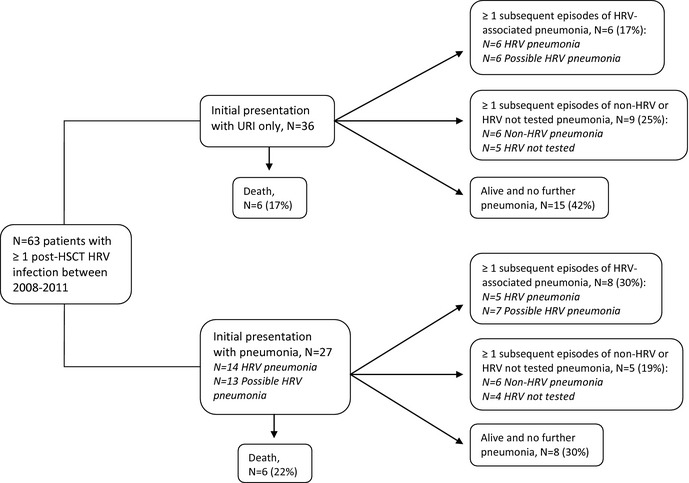
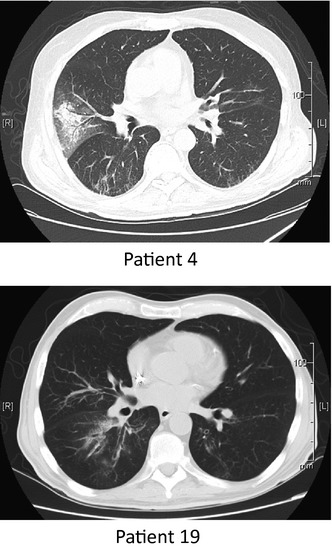
Between 2008 and 2011, 63 HSCT recipients had ≥1 documented HRV infections. At first HRV detection, 36 (57%) patients had HRV URI and 27 (43%) had proven or possible HRV pneumonia; in multivariate analysis, hypoalbuminemia (odds ratio [OR] 9.5, 95% confidence interval [CI] 1.3-71.7; P = 0.03) and isolation of respiratory co-pathogen(s) (OR 24.2, 95% CI 2.0-288.4; P = 0.01) were independently associated with pneumonia. During the study period, 22 patients had 25 episodes of proven HRV pneumonia. Fever (60%), cough (92%), sputum production (61%), and dyspnea (60%) were common symptoms. Fifteen (60%) episodes demonstrated bacterial (n = 7), fungal (n = 5), or viral (n = 3) co-infection. Among the remaining 10 (40%) cases of HRV monoinfection, patients' oxygen saturations ranged from 80% to 97% on ambient air, and computed tomography scans showed peribronchiolar, patchy, ground glass infiltrates.
HRV pneumonia is relatively common after HSCT and frequently accompanied by bacterial co-infection. As use of molecular assays for respiratory viral diagnosis becomes widespread, HRV will be increasingly recognized as a significant cause of pneumonia in immunocompromised hosts.
人鼻病毒(HRV)是造血干细胞移植(HSCT)受者上呼吸道感染(URI)的常见病因;然而,它们在下呼吸道疾病中的作用尚未得到充分了解。
我们对2008年在本机构采用分子检测方法后感染HRV的HSCT受者进行了回顾性病历审查。通过单因素和多因素分析评估首次检测到HRV时与确诊或可能的HRV肺炎相关的因素。然后我们对从最初的HRV感染到1年随访期内所有确诊和可能的HRV肺炎发作进行了特征描述。
2008年至2011年期间,63例HSCT受者有≥1次记录在案的HRV感染。首次检测到HRV时,36例(57%)患者患有HRV URI,27例(43%)患有确诊或可能的HRV肺炎;在多因素分析中,低白蛋白血症(比值比[OR] 9.5,95%置信区间[CI] 1.3 - 71.7;P = 0.03)和呼吸道合并病原体分离(OR 24.2,95% CI 2.0 - 288.4;P = 0.01)与肺炎独立相关。在研究期间,22例患者有25次确诊的HRV肺炎发作。发热(60%)、咳嗽(92%)、咳痰(61%)和呼吸困难(60%)是常见症状。15次发作(60%)显示有细菌(n = 7)、真菌(n = 5)或病毒(n = 3)合并感染。在其余10例(40%)HRV单一感染病例中,患者在室内空气中的氧饱和度范围为80%至97%,计算机断层扫描显示细支气管周围、斑片状、磨玻璃样浸润。
HRV肺炎在HSCT后相对常见,且常伴有细菌合并感染。随着用于呼吸道病毒诊断的分子检测方法的广泛应用,HRV将越来越被认为是免疫受损宿主肺炎的重要病因。