Wits Reproductive Health and HIV Institute, School of Clinical Medicine, Witwatersrand University, PO Box 18512, Hillbrow, Johannesburg, 2038, South Africa.
BMC Med Res Methodol. 2013 Jul 26;13:96. doi: 10.1186/1471-2288-13-96.
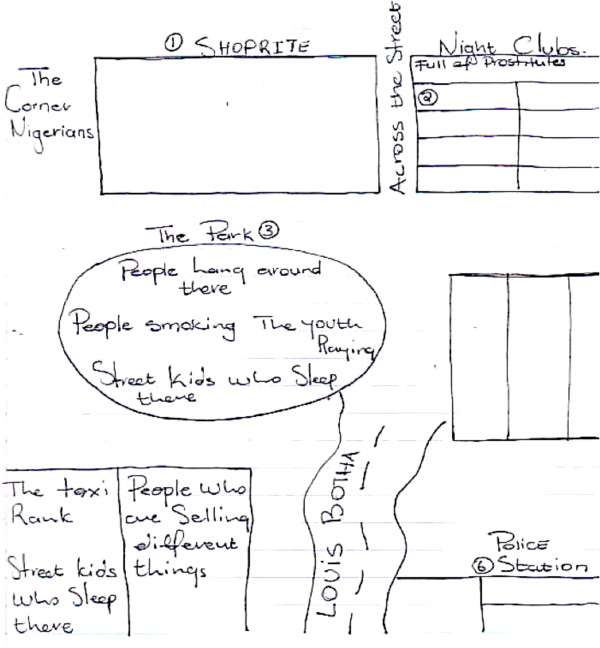
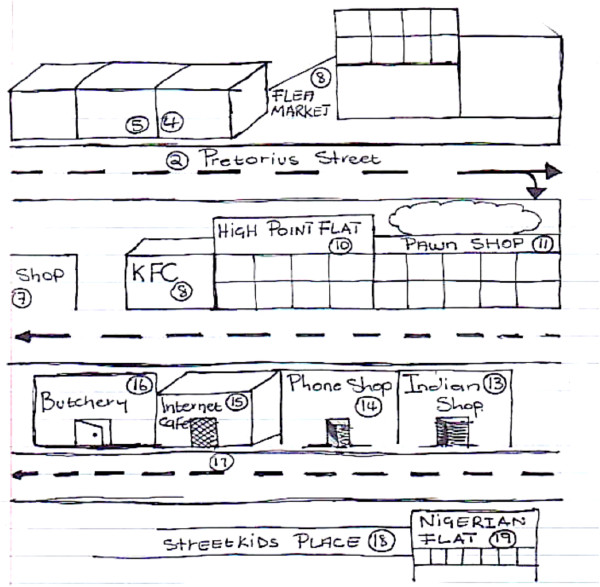
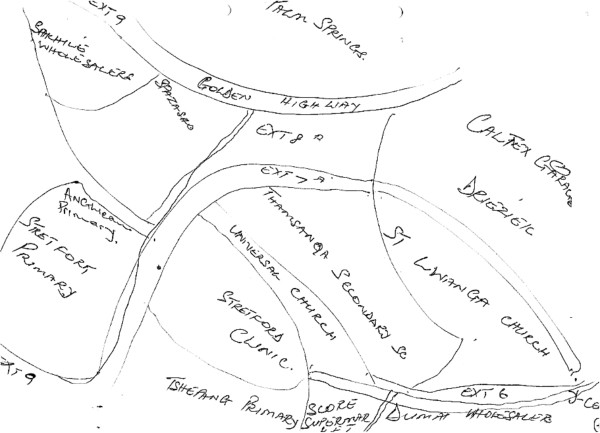
Cognitive mapping is a participatory research methodology that documents, in visual form, a construct of the local environment in which people live and work. We adapted this method to provide detailed data about study locales to inform recruitment and retention strategies for HIV prevention community based clinical trials.
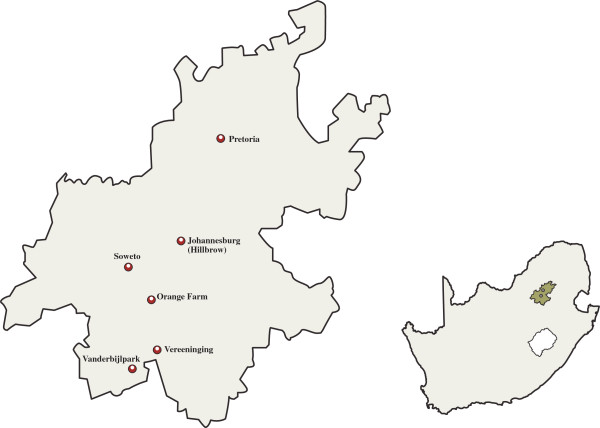
Four cognitive mapping studies were undertaken between 2005 and 2010, in and around Johannesburg in Orange Farm, and Hillbrow. Participants included members of clinical trial Community Advisory Boards (CAB), young people recruited from schools in Hillbrow and an organization for out of school youth, and men recruited from a database of men in the community interested in taking part in research. These groups participated in reconnaissance walks and in depth interviews, and drew detailed sketch maps.
The cognitive maps defined the physical boundaries of the research locales, provided insights into their social histories, and identified important characteristics of the population such as movement, social and sexual networks, ethnic and other divisions. Important differences between the official cartographic maps and the cognitive maps were raised. The mapping data was applied by identifying key areas for recruitment that recruitment staff members were less familiar with and that may otherwise have been overlooked.
Cognitive mapping is an effective, rapid and low cost method that can be used to inform recruitment and retention strategies for community-based clinical trial research. The method also provides a means for clinical trial researchers to involve the local community in research and to familiarise them with the social setting.
认知绘图是一种参与式研究方法,以视觉形式记录人们生活和工作的当地环境结构。我们对这种方法进行了调整,以便为研究地点提供详细数据,为艾滋病毒预防社区临床试验的招募和保留策略提供信息。
2005 年至 2010 年期间,在约翰内斯堡的奥兰多农场和希尔布劳进行了四项认知绘图研究。参与者包括临床试验社区咨询委员会(CAB)的成员、从希尔布劳学校招募的年轻人以及一个为校外青年组织的成员,以及从对参与研究感兴趣的社区男性数据库中招募的男性。这些群体参加了侦察步行和深入访谈,并绘制了详细的草图。
认知地图定义了研究地点的物理边界,深入了解了它们的社会历史,并确定了人口的重要特征,如流动、社会和性网络、种族和其他划分。认知地图与官方制图地图之间存在重要差异。通过确定招聘人员不太熟悉的关键招聘区域,并可能被忽视的其他区域,应用了绘图数据。
认知绘图是一种有效、快速且低成本的方法,可用于为社区为基础的临床试验研究制定招募和保留策略。该方法还为临床试验研究人员提供了一种让当地社区参与研究并熟悉社会环境的手段。