Department of Nutrition Science, Purdue University, West Lafayette, IN 47907, USA.
Nutr Res. 2013 Aug;33(8):629-35. doi: 10.1016/j.nutres.2013.05.012. Epub 2013 Jul 17.
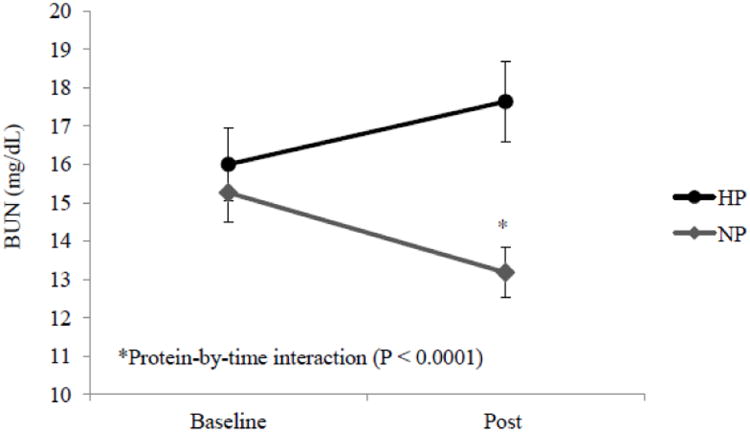
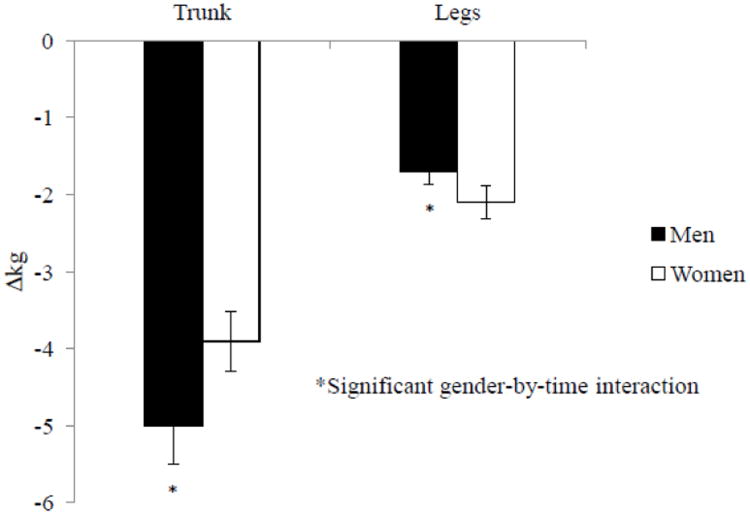
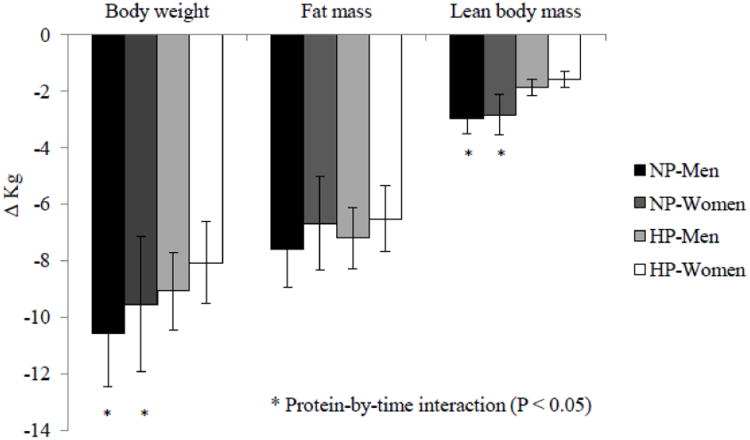
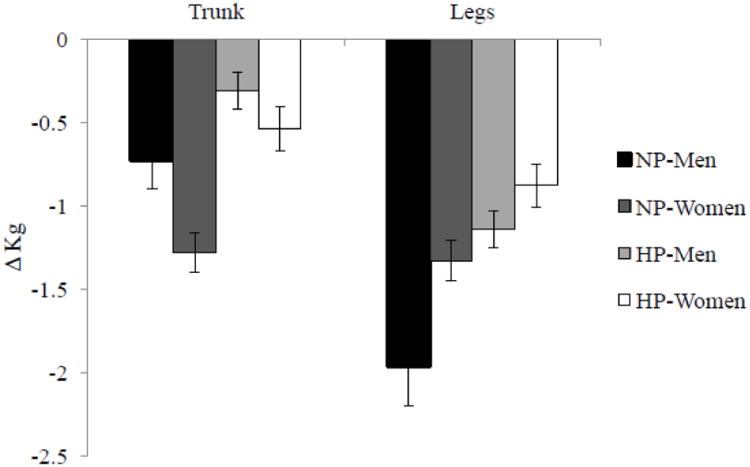
Secondary analyses of data from 2 studies were used to assess the effects of protein intake and sex on diet-induced changes in body composition. The primary hypothesis was that the changes of body composition via energy restriction (ie, lean body mass [LBM], fat mass [FM], and bone) would be sex and diet specific. For 12 weeks, 43 male (study 1) and 45 female (study 2) overweight and obese adults consumed an energy-deficit diet (750 kcal/d less than energy needs) containing either 0.8 (normal protein [NP], 21 men and 23 women) or 1.4 g protein∙kg(-1)∙d(-1) (high protein [HP], 22 men and 22 women). Body composition measurements were performed at preintervention and postintervention. Over time, all research participants lost weight, LBM, and FM. Independent of protein intake, the men lost more LBM in the trunk (-0.9 vs -0.5 kg) and less in the legs (-1.5 vs -1.1 kg) compared with the women (P < .05). Independent of sex, the HP group lost less LBM in the trunk and legs than the NP group. These sex and protein intake responses resulted in the NP men losing the most LBM in the legs and the NP women losing the most LBM in the trunk. Over time, men lost more FM (-5.0 vs -3.9 kg) from the trunk and less from legs (-1.7 vs -2.1 kg) than women (P < .05), which resulted in a greater decrease of the android-to-gynoid fat ratio for the men. Protein intake did not influence these sex-specific responses or have any independent effects on changes in FM. In addition, protein intake did not influence bone mineral density responses over time; bone mineral density was reduced in women, but not in men. These findings indicate that higher protein intake during weight loss promotes the retention of LBM in both the trunk and legs despite the sex-specific changes in these body regions.
两项研究的数据的二次分析用于评估蛋白质摄入量和性别对饮食诱导的身体成分变化的影响。主要假设是,通过能量限制(即瘦体重[LBM]、脂肪量[FM]和骨骼)引起的身体成分变化将具有性别和饮食特异性。在 12 周内,43 名超重和肥胖男性(研究 1)和 45 名超重和肥胖女性(研究 2)摄入能量不足的饮食(比能量需求少 750 卡路里/天),其中包含 0.8(正常蛋白质[NP],21 名男性和 23 名女性)或 1.4 g 蛋白质·kg(-1)·d(-1)(高蛋白[HP],22 名男性和 22 名女性)。在干预前和干预后进行身体成分测量。随着时间的推移,所有研究参与者的体重、LBM 和 FM 均减轻。与女性相比,无论蛋白质摄入量如何,男性在躯干中损失的 LBM 更多(-0.9 公斤比-0.5 公斤),而在腿部损失的 LBM 更少(-1.5 公斤比-1.1 公斤)(P <.05)。无论性别如何,HP 组在躯干和腿部中损失的 LBM 均少于 NP 组。这些性别和蛋白质摄入量的反应导致 NP 男性在腿部损失最多的 LBM,NP 女性在躯干中损失最多的 LBM。随着时间的推移,男性从躯干中损失的 FM 更多(-5.0 公斤比-3.9 公斤),从腿部损失的 FM 更少(-1.7 公斤比-2.1 公斤)(P <.05),这导致男性的安卓体到臀围脂肪比例下降更大。蛋白质摄入量没有影响这些性别特异性反应,也没有对 FM 的变化产生任何独立影响。此外,蛋白质摄入量没有随时间影响骨密度的反应;女性的骨密度降低,但男性没有。这些发现表明,在减肥期间摄入较高的蛋白质可促进 LBM 在躯干和腿部的保留,尽管这些身体部位的性别特异性变化。