Lin Feng, Heffner Kathi, Mapstone Mark, Chen Ding-Geng Din, Porsteisson Anton
School of Nursing, University of Rochester Medical Center, Rochester, NY; Department of Psychiatry, School of Medicine and Dentistry, University of Rochester Medical Center, Rochester, NY.
Department of Psychiatry, School of Medicine and Dentistry, University of Rochester Medical Center, Rochester, NY.
Am J Geriatr Psychiatry. 2014 Nov;22(11):1210-21. doi: 10.1016/j.jagp.2013.04.002. Epub 2013 Jul 23.
Recent evidence suggests that younger and middle-age adults who show greater cardiovascular reactivity (CVR) to acute mental stress demonstrate better reasoning and memory skills. The purpose of this study was to examine whether older adults would exhibit a similar positive association between CVR and executive function and whether regular engagement in mentally stimulating activities (MSA) would moderate this association.
Secondary cross-sectional analysis.
Three clinical research centers in the Midwest and on the West Coast and East Coast.
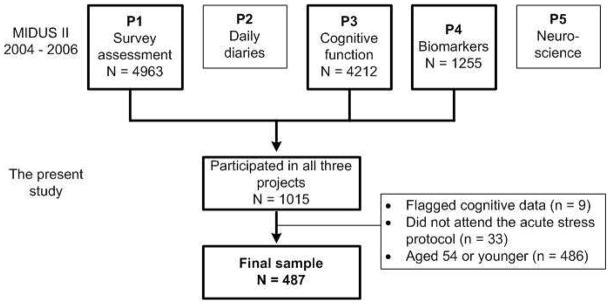
A total of 487 older adults participating in an ongoing national survey.
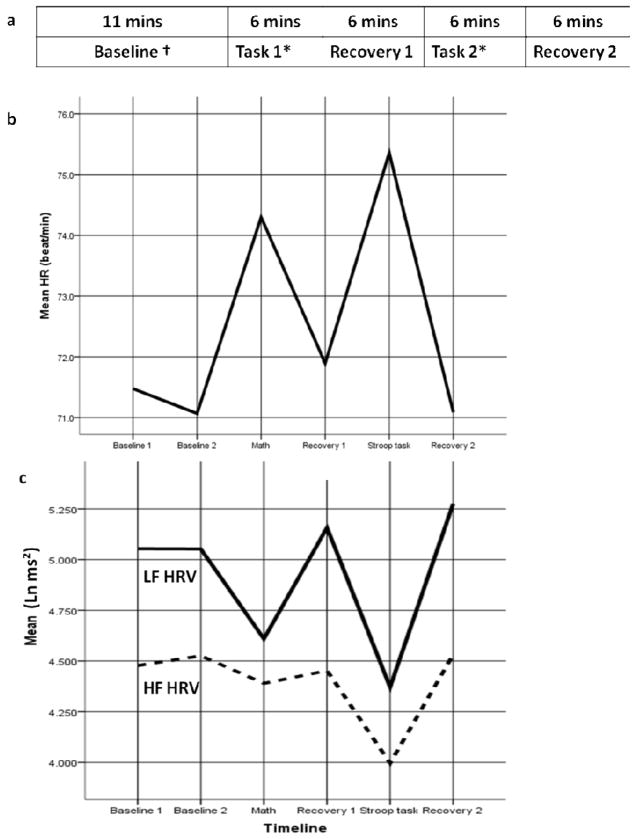
Heart rate (HR) and low-frequency (LF) and high-frequency (HF) domains of heart rate variability (HRV) were measured at baseline and in response to standard mental stress tasks (Stroop color word task and mental arithmetic). Executive function was measured separately from the stress tasks by using five neuropsychological tests. MSA was measured by self-reported frequency of six common MSA.
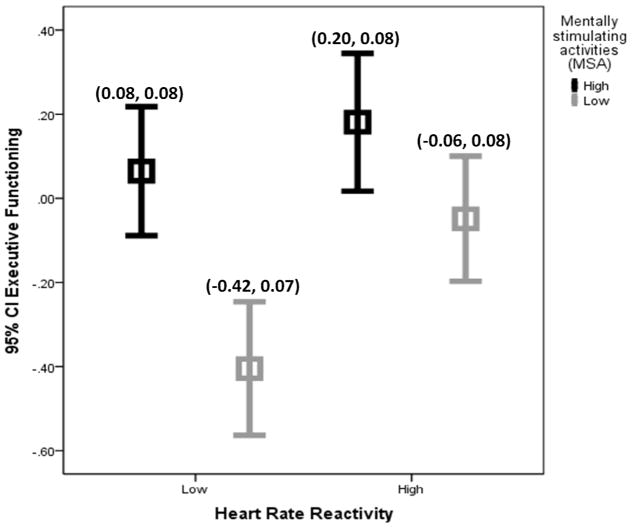
Higher HR reactivity was associated with better executive function after controlling for demographic and health characteristics and baseline HR, and the interaction between HR reactivity and MSA was significant for executive function. Higher LF-HRV reactivity was also associated with executive function, but subsequent analyses indicated that frequency of MSA was the strongest predictor of executive function in models that included LF-HRV or HF-HRV.
Higher HR reactivity to acute psychological stress is related to better executive function in older adults. For those with lower HR reactivity, engaging frequently in MSA produced compensatory benefits for executive function.
最近的证据表明,对急性精神压力表现出更大心血管反应性(CVR)的年轻人和中年人具有更好的推理和记忆能力。本研究的目的是检验老年人在CVR与执行功能之间是否也存在类似的正相关,以及经常参与刺激性脑力活动(MSA)是否会调节这种关联。
二次横断面分析。
中西部以及西海岸和东海岸的三个临床研究中心。
共有487名老年人参与一项正在进行的全国性调查。
在基线时以及对标准精神压力任务(斯特鲁普颜色词任务和心算)做出反应时,测量心率(HR)以及心率变异性(HRV)的低频(LF)和高频(HF)成分。通过五项神经心理学测试,独立于压力任务测量执行功能。通过自我报告六项常见MSA的频率来测量MSA。
在控制了人口统计学和健康特征以及基线心率之后,较高的HR反应性与较好的执行功能相关,并且HR反应性与MSA之间的交互作用对执行功能具有显著意义。较高的LF-HRV反应性也与执行功能相关,但后续分析表明,在包含LF-HRV或HF-HRV的模型中,MSA频率是执行功能的最强预测因子。
对急性心理压力较高的HR反应性与老年人较好的执行功能相关。对于HR反应性较低的人,频繁参与MSA对执行功能产生补偿性益处。