Department of Neurology, University of California San Francisco, San Francisco, CA, USA.
Neuroimage. 2014 Jan 15;85 Pt 2(0 2):794-802. doi: 10.1016/j.neuroimage.2013.07.048. Epub 2013 Jul 25.
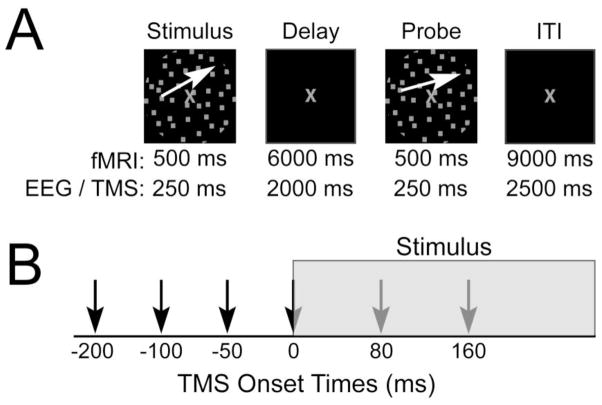
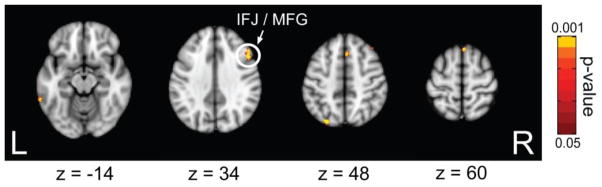
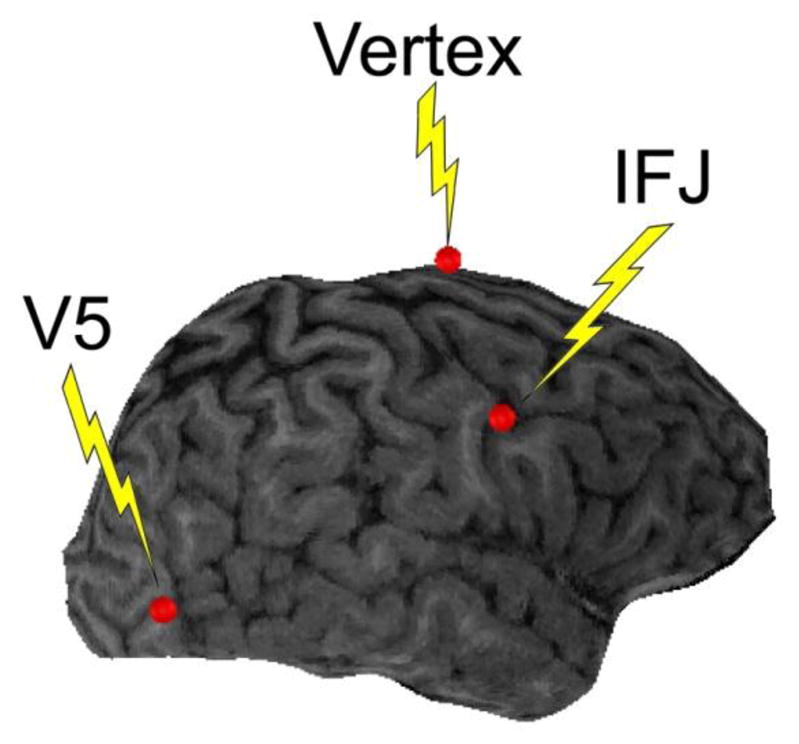
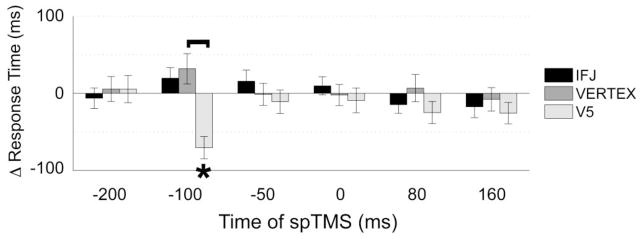
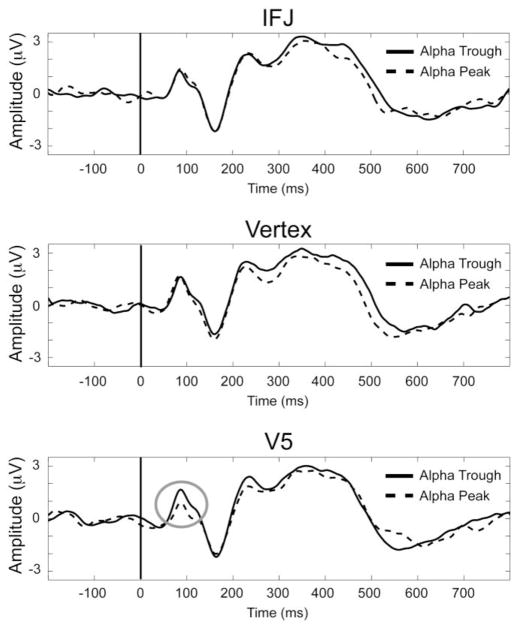
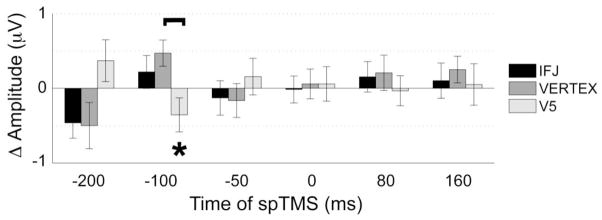
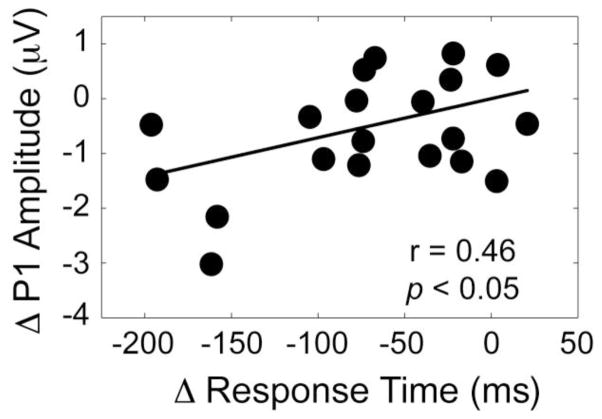
Alpha band (8-12 Hz) phase dynamics in the visual cortex are thought to reflect fluctuations in cortical excitability that influences perceptual processing. As such, visual stimuli are better detected when their onset is concurrent with specific phases of the alpha cycle. However, it is unclear whether alpha phase differentially influences cognitive performance at specific times relative to stimulus onset (i.e., is the influence of phase maximal before, at, or after stimulus onset?). To address this, participants performed a delayed-recognition, working memory (WM) task for visual motion direction during two separate visits. The first visit utilized functional magnetic resonance (fMRI) imaging to identify neural regions associated with task performance. Replicating previous studies, fMRI data showed engagement of visual cortical area V5, as well as a prefrontal cortical region, the inferior frontal junction (IFJ). During the second visit, transcranial magnetic stimulation (TMS) was applied separately to both the right IFJ and right V5 (with the vertex as a control region) while electroencephalography (EEG) was simultaneously recorded. During each trial, a single pulse of TMS (spTMS) was applied at one of six time points (-200, -100, -50, 0, 80, 160 ms) relative to the encoded stimulus onset. Results demonstrated a relationship between the phase of the posterior alpha signal prior to stimulus encoding and subsequent response times to the memory probe two seconds later. Specifically, spTMS to V5, and not the IFJ or vertex, yielded faster response times, indicating improved WM performance, when delivered during the peak, compared to the trough, of the alpha cycle, but only when spTMS was applied 100 ms prior to stimulus onset. These faster responses to the probe correlated with decreased early event related potential (ERP) amplitudes (i.e., P1) to the probe stimuli. Moreover, participants that were least affected by spTMS exhibited greater functional connectivity between V5 and fronto-parietal regions. These results suggest that posterior alpha phase indexes a critical time period for motion processing in the context of WM encoding goals, which occurs in anticipation of stimulus onset.
alpha 波段(8-12 Hz)在视觉皮层中的相位动态被认为反映了皮质兴奋性的波动,这种波动会影响感知处理。因此,当视觉刺激的起始与 alpha 周期的特定相位同时发生时,它们更容易被检测到。然而,目前尚不清楚 alpha 相位是否会在相对于刺激起始的特定时间对认知表现产生不同的影响(即相位的影响在刺激起始之前、期间还是之后最大?)。为了解决这个问题,参与者在两次不同的访问中进行了视觉运动方向的延迟识别、工作记忆(WM)任务。第一次访问利用功能磁共振成像(fMRI)来识别与任务表现相关的神经区域。复制先前的研究,fMRI 数据显示视觉皮层区域 V5 以及前额叶皮层区域下额际连接(IFJ)的参与。在第二次访问期间,分别对右 IFJ 和右 V5(以顶点为对照区域)施加经颅磁刺激(TMS),同时记录脑电图(EEG)。在每次试验中,TMS 的单个脉冲(spTMS)在相对于编码刺激起始的六个时间点之一(-200、-100、-50、0、80、160 ms)施加。结果表明,在刺激编码之前的后 alpha 信号的相位与两秒钟后对记忆探针的反应时间之间存在关系。具体来说,与 IFJ 或顶点相比,当 spTMS 在 alpha 周期的峰值而不是低谷时施加于 V5 时,会产生更快的反应时间,表明 WM 性能得到改善,但仅当 spTMS 在刺激起始前 100 毫秒施加时才如此。对探针的更快反应与对探针刺激的早期事件相关电位(ERP)振幅(即 P1)的降低相关。此外,受 spTMS 影响最小的参与者表现出 V5 与额顶区域之间更大的功能连接。这些结果表明,后 alpha 相位索引了在 WM 编码目标背景下运动处理的关键时间段,该时间段发生在刺激起始之前。