Department of Neurology, University of California San Francisco, San Francisco, CA 94158, USA.
Trends Cogn Sci. 2012 Feb;16(2):129-35. doi: 10.1016/j.tics.2011.11.014. Epub 2011 Dec 28.
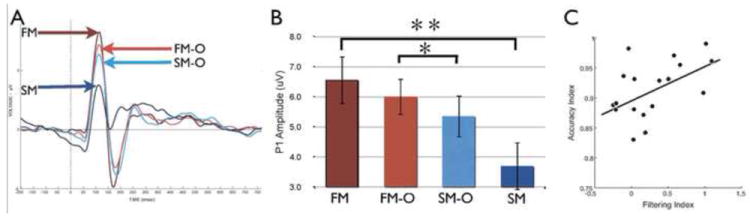
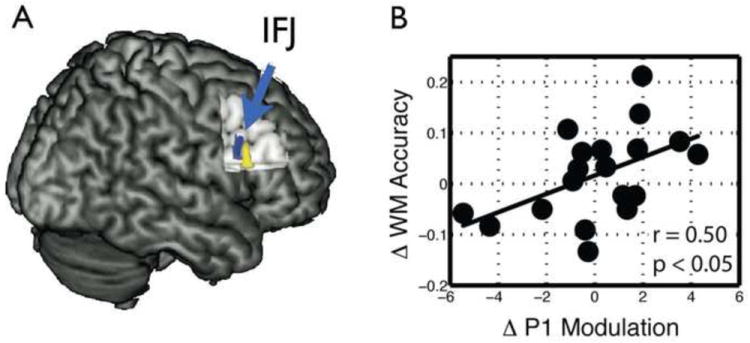
Selective attention, the ability to focus our cognitive resources on information relevant to our goals, influences working memory (WM) performance. Indeed, attention and working memory are increasingly viewed as overlapping constructs. Here, we review recent evidence from human neurophysiological studies demonstrating that top-down modulation serves as a common neural mechanism underlying these two cognitive operations. The core features include activity modulation in stimulus-selective sensory cortices with concurrent engagement of prefrontal and parietal control regions that function as sources of top-down signals. Notably, top-down modulation is engaged during both stimulus-present and stimulus-absent stages of WM tasks; that is, expectation of an ensuing stimulus to be remembered, selection and encoding of stimuli, maintenance of relevant information in mind and memory retrieval.
选择性注意,即专注于与目标相关信息的认知资源的能力,会影响工作记忆 (WM) 的表现。实际上,注意力和工作记忆正越来越被视为重叠的结构。在这里,我们回顾了来自人类神经生理学研究的最新证据,这些证据表明,自上而下的调制是这两种认知操作的共同神经机制。核心特征包括刺激选择性感觉皮层的活动调制,同时涉及前额叶和顶叶控制区域的参与,这些区域作为自上而下信号的来源。值得注意的是,自上而下的调制在 WM 任务的刺激呈现和刺激缺失阶段都被激活;也就是说,对即将要记住的刺激的期望、对刺激的选择和编码、在头脑中保持相关信息以及记忆检索。