Institute for Biotechnology and Bioengineering, Center for Biological and Chemical Engineering, Instituto Superior Técnico, Lisbon, Portugal.
PLoS One. 2013 Jul 19;8(7):e69023. doi: 10.1371/journal.pone.0069023. Print 2013.
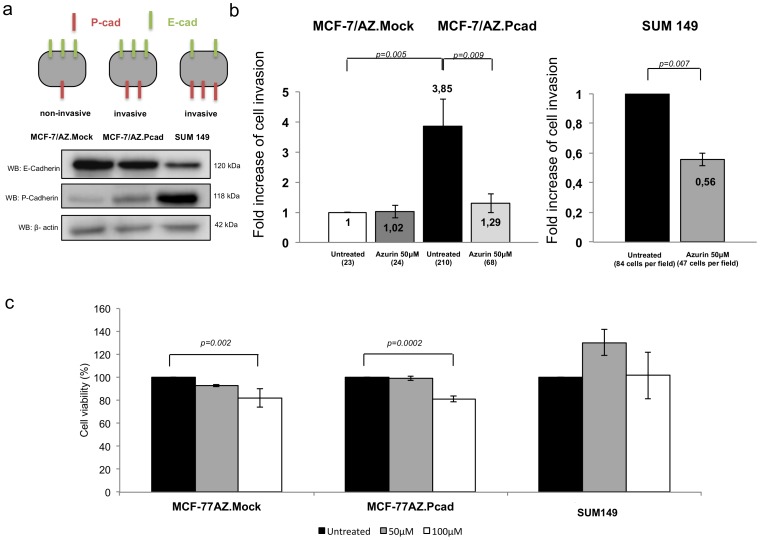
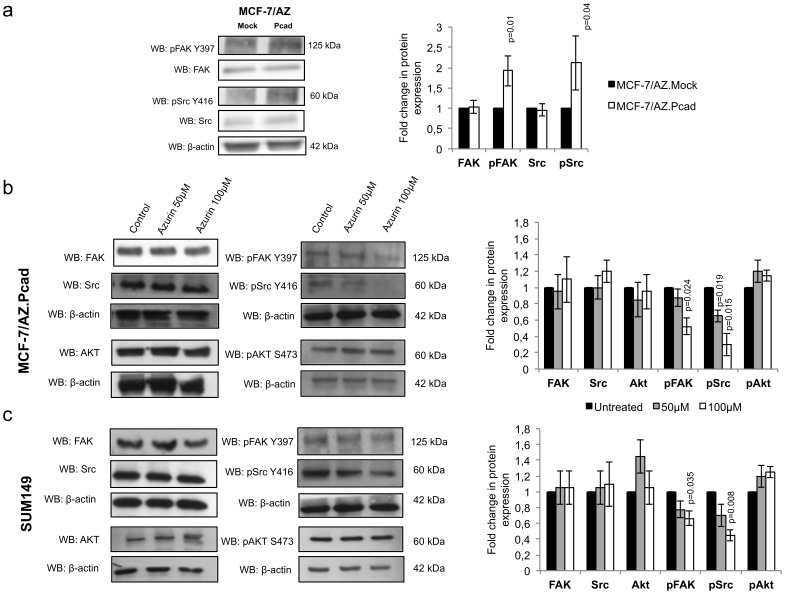
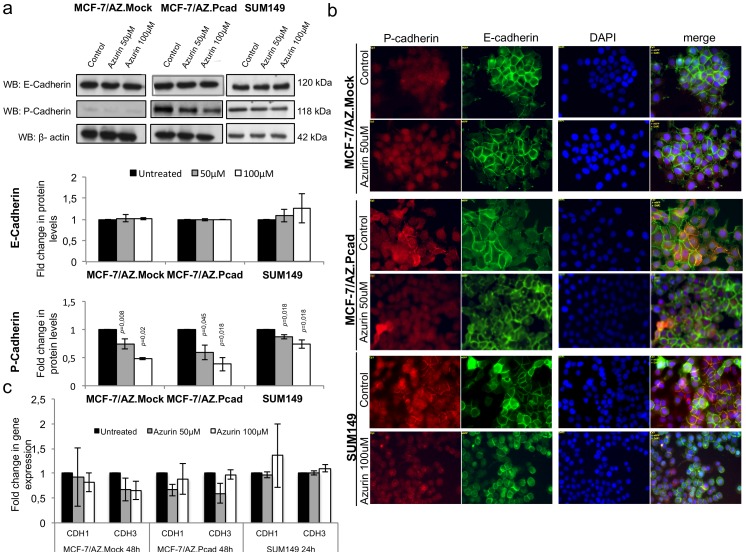
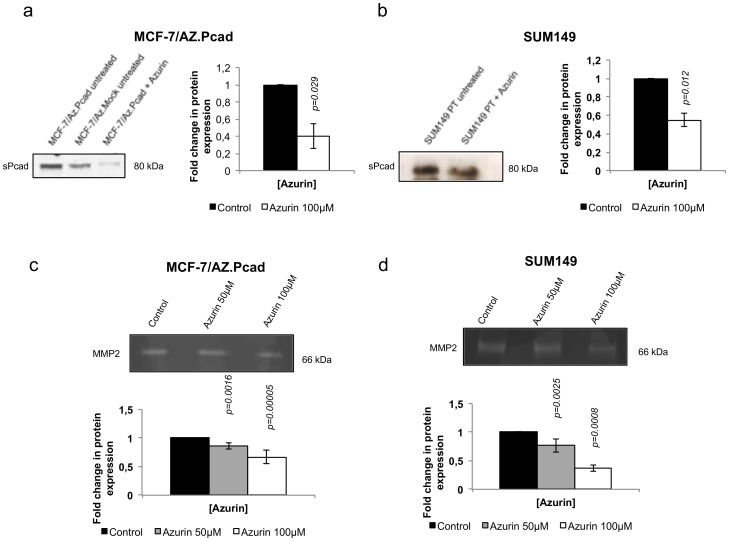
P-cadherin overexpression occurs in about 30% of all breast carcinomas, being a poor prognostic factor for breast cancer patients. In a cellular background of wild-type E-cadherin, we have previously shown that its expression promotes invasion, motility and migration of breast cancer cells due to the induced secretion of metalloproteases (MMPs) to the extracellular medium and to the concomitant shedding of a pro-invasive soluble form of this protein (sP-cad). Azurin is secreted by Pseudomonas aeruginosa and induces in vitro and in vivo cytotoxicity after its preferential penetration in human cancer cells relative to normal cells. Three different breast cancer cell lines, MCF-7/AZ.Mock, MCF-7/AZ.Pcad and SUM149 were treated with sub-killing doses of azurin. Invasion of these cells was measured using Matrigel Invasion Assays and MTT assays were performed to determine cell viability upon treatment and the effects on cadherins expression was determined by Western blot and Immunofluorescence. Gelatin Zymography was used to determine activity of MMP2 in the conditioned media of azurin treated and untreated cells and the phosphorylation levels of intracellular signaling proteins were determined by Western blot. The invasive phenotype of these breast cancer cells was significantly reduced by azurin. Azurin (50-100 µM) also caused a specific decrease on P-cadherin protein levels from 30-50% in MCF-7/AZ.Pcad and SUM149 breast cancer cell lines, but the levels of E-cadherin remain unaltered. More, the levels of sP-cad and the activity of MMP2 were reduced in the extracellular media of azurin treated cells and we also observed a decrease in the phosphorylation levels of both FAK and Src proteins. Our data show that azurin specifically targets P-cadherin, not E-cadherin, abrogating P-cadherin-mediated invasive effects and signaling. Therefore, azurin could possibly be considered a therapeutic tool to treat poor-prognosis breast carcinomas overexpressing P-cadherin in a wild type E-cadherin context.
P-钙黏蛋白在约 30%的所有乳腺癌中过表达,是乳腺癌患者预后不良的因素。在野生型 E-钙黏蛋白的细胞背景下,我们之前已经表明,由于其诱导的细胞外基质金属蛋白酶(MMPs)的分泌,以及这种蛋白的促侵袭可溶性形式(sP-cad)的伴随脱落,它的表达促进了乳腺癌细胞的侵袭、运动和迁移。铜绿假单胞菌分泌的天青杀素在其优先穿透人类癌细胞而不是正常细胞后,会在体外和体内诱导细胞毒性。用亚致死剂量的天青杀素处理三种不同的乳腺癌细胞系 MCF-7/AZ.Mock、MCF-7/AZ.Pcad 和 SUM149。使用 Matrigel 侵袭测定法测量这些细胞的侵袭,通过 MTT 测定法测定处理后细胞活力,并通过 Western blot 和免疫荧光测定法确定 cadherins 表达的变化。用明胶酶谱法测定天青杀素处理和未处理细胞条件培养基中 MMP2 的活性,并通过 Western blot 测定细胞内信号蛋白的磷酸化水平。天青杀素显著降低了这些乳腺癌细胞的侵袭表型。天青杀素(50-100µM)还使 MCF-7/AZ.Pcad 和 SUM149 乳腺癌细胞系中 P-钙黏蛋白蛋白水平从 30-50%特异性降低,但 E-钙黏蛋白水平保持不变。此外,天青杀素处理细胞的细胞外培养基中的 sP-cad 水平和 MMP2 的活性降低,我们还观察到 FAK 和 Src 蛋白的磷酸化水平降低。我们的数据表明,天青杀素特异性靶向 P-钙黏蛋白,而不是 E-钙黏蛋白,从而消除了 P-钙黏蛋白介导的侵袭作用和信号。因此,天青杀素可能被认为是一种治疗工具,可用于治疗在野生型 E-钙黏蛋白背景下过表达 P-钙黏蛋白的预后不良的乳腺癌。