Department of Oral Microbiology, Kagoshima University Graduate School of Medical and Dental Sciences, Kagoshima, Japan.
PLoS One. 2013 Jul 22;8(7):e69455. doi: 10.1371/journal.pone.0069455. Print 2013.
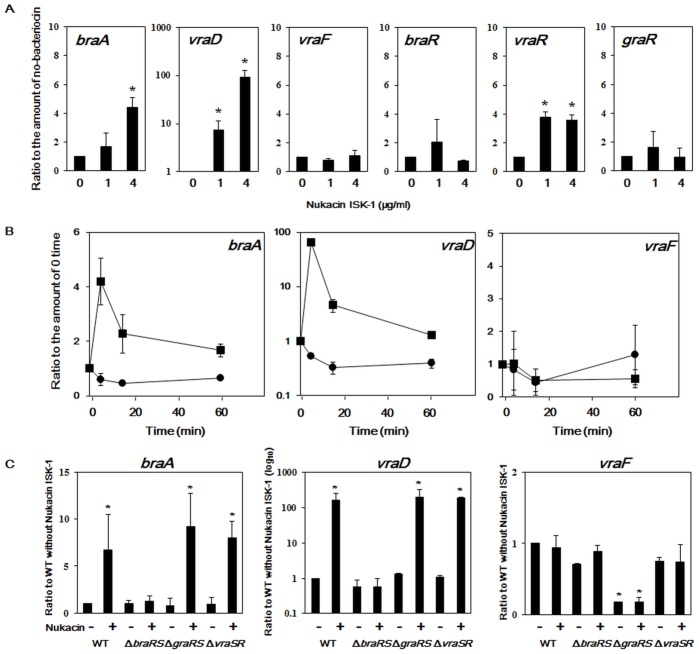
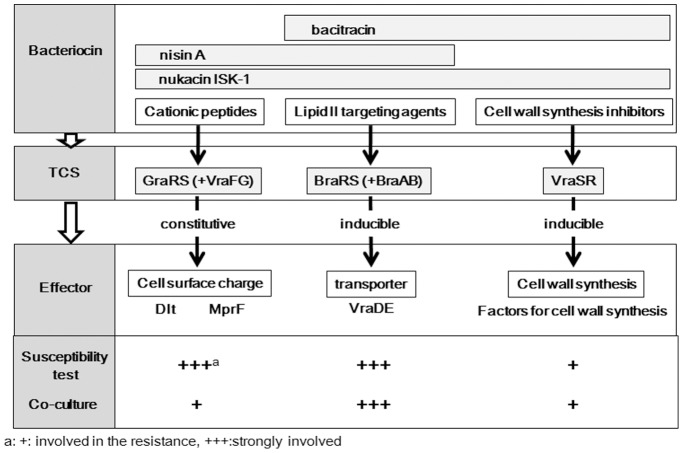
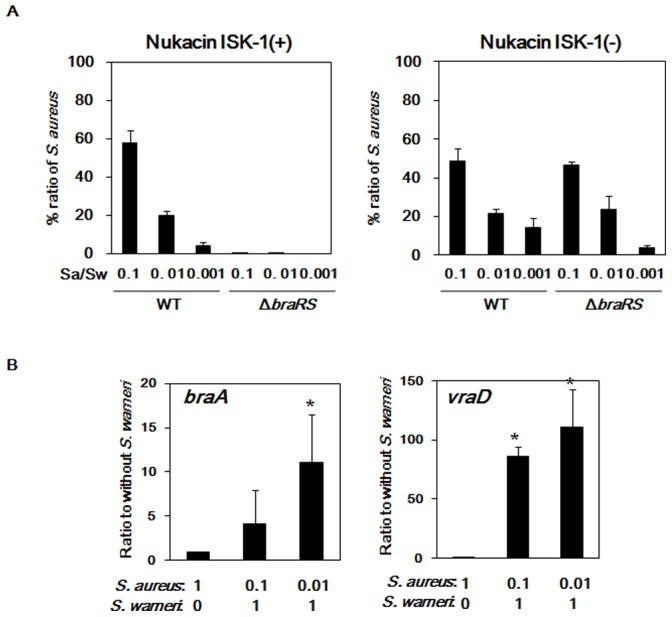
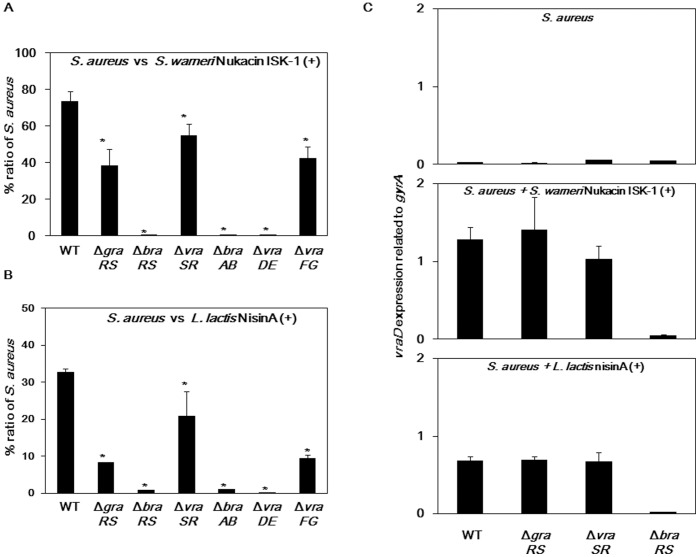
Staphylococcus aureus uses two-component systems (TCSs) to adapt to stressful environmental conditions. To colonize a host, S. aureus must resist bacteriocins produced by commensal bacteria. In a comprehensive analysis using individual TCS inactivation mutants, the inactivation of two TCSs, graRS and braRS, significantly increased the susceptibility to the class I bacteriocins, nukacin ISK-1 and nisin A, and inactivation of vraSR slightly increased the susceptibility to nukacin ISK-1. In addition, two ABC transporters (BraAB and VraDE) regulated by BraRS and one transporter (VraFG) regulated by GraRS were associated with resistance to nukacin ISK-1 and nisin A. We investigated the role of these three TCSs of S. aureus in co-culture with S. warneri, which produces nukacin ISK-1, and Lactococcus lactis, which produces nisin A. When co-cultured with S. warneri or L. lactis, the braRS mutant showed a significant decrease in its population compared with the wild-type, whereas the graRS and vraSR mutants showed slight decreases. Expression of vraDE was elevated significantly in S. aureus co-cultured with nisin A/nukacin ISK-1-producing strains. These results suggest that three distinct TCSs are involved in the resistance to nisin A and nukacin ISK-1. Additionally, braRS and its related transporters played a central role in S. aureus survival in co-culture with the strains producing nisin A and nukacin ISK-1.
金黄色葡萄球菌利用双组分系统(TCSs)来适应应激环境条件。为了在宿主中定植,金黄色葡萄球菌必须抵抗共生细菌产生的细菌素。在使用单个 TCS 失活突变体进行的综合分析中,graRS 和 braRS 两个 TCS 的失活显著增加了对 I 类细菌素,如 nukacin ISK-1 和 nisin A 的敏感性,而 vraSR 的失活则略微增加了对 nukacin ISK-1 的敏感性。此外,由 BraRS 调节的两个 ABC 转运体(BraAB 和 VraDE)和由 GraRS 调节的一个转运体(VraFG)与抵抗 nukacin ISK-1 和 nisin A 有关。我们研究了金黄色葡萄球菌的这三个 TCS 在与产生 nukacin ISK-1 的 S. warneri 和产生 nisin A 的 Lactococcus lactis 共培养中的作用。与 S. warneri 或 L. lactis 共培养时,与野生型相比,braRS 突变体的种群显著减少,而 graRS 和 vraSR 突变体则略有减少。在与产生 nisin A/nukacin ISK-1 的菌株共培养时,vraDE 的表达显著升高。这些结果表明,三个不同的 TCSs 参与了对 nisin A 和 nukacin ISK-1 的抗性。此外,braRS 及其相关转运体在金黄色葡萄球菌与产生 nisin A 和 nukacin ISK-1 的菌株共培养中的生存中发挥了核心作用。