United States Environmental Protection Agency, Office of Research and Development, National Health and Environmental Effects Research Laboratory, Research Triangle Park, North Carolina, United States of America.
PLoS One. 2013 Jul 24;8(7):e69518. doi: 10.1371/journal.pone.0069518. Print 2013.
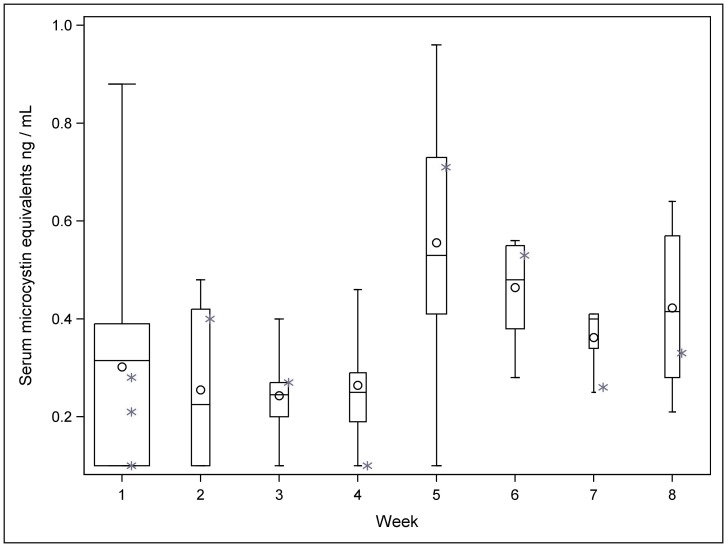
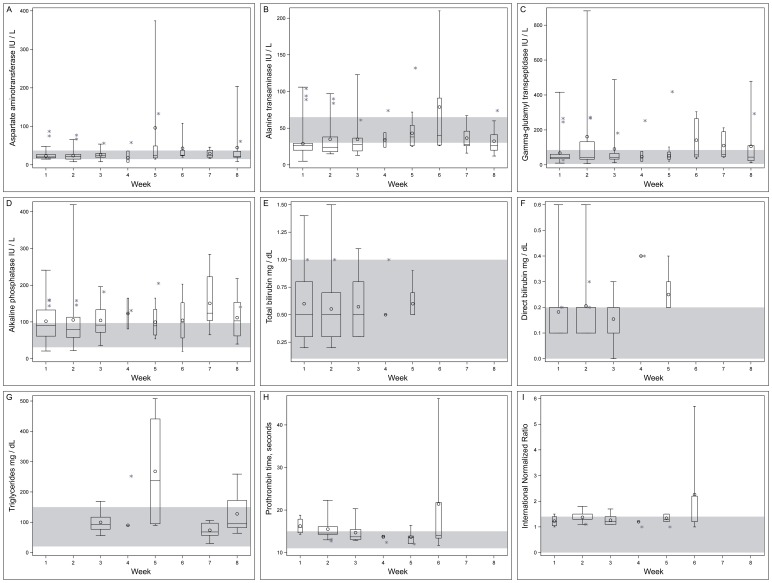
Cyanobacteria are commonly-occurring contaminants of surface waters worldwide. Microcystins, potent hepatotoxins, are among the best characterized cyanotoxins. During November, 2001, a group of 44 hemodialysis patients were exposed to microcystins via contaminated dialysate. Serum microcystin concentrations were quantified with enzyme-linked immunosorbent assay which measures free serum microcystin LR equivalents (ME). We describe serum ME concentrations and biochemical outcomes among a subset of patients during 8 weeks following exposure. Thirteen patients were included; 6 were males, patients' median age was 45 years (range 16-80), one was seropositive for hepatitis B surface antigen. The median serum ME concentration was 0.33 ng/mL (range: <0.16-0.96). One hundred thirty nine blood samples were collected following exposure. Patients' biochemical outcomes varied, but overall indicated a mixed liver injury. Linear regression evaluated each patient's weekly mean biochemical outcome with their maximum serum ME concentration; a measure of the extrinsic pathway of clotting function, prothrombin time, was negatively and significantly associated with serum ME concentrations. This group of exposed patients' biochemical outcomes display evidence of a mixed liver injury temporally associated with microcystin exposure. Interpretation of biochemical outcomes are complicated by the study population's underlying chronic disease status. It is clear that dialysis patients are a distinct 'at risk' group for cyanotoxin exposures due to direct intravenous exposure to dialysate prepared from surface drinking water supplies. Careful monitoring and treatment of water supplies used to prepare dialysate is required to prevent future cyanotoxin exposure events.
蓝藻是世界范围内地表水的常见污染物。微囊藻毒素是最具特征的蓝藻毒素之一,是一种有效的肝毒素。2001 年 11 月,一组 44 名血液透析患者因受污染的透析液而接触到微囊藻毒素。采用酶联免疫吸附试验(ELISA)定量检测血清微囊藻毒素 LR 等效物(ME),对血清微囊藻毒素浓度进行了定量检测。我们描述了暴露后 8 周内部分患者的血清 ME 浓度和生化结果。纳入 13 名患者;6 名男性,患者中位年龄 45 岁(范围 16-80 岁),1 名乙型肝炎表面抗原阳性。血清 ME 浓度中位数为 0.33ng/ml(范围:<0.16-0.96)。暴露后共采集 139 份血样。患者的生化结果各不相同,但总体上表明存在混合性肝损伤。线性回归分析评估了每位患者每周平均生化结果与血清 ME 浓度最大值之间的关系;凝血功能外源性途径的凝血酶原时间与血清 ME 浓度呈负相关且具有统计学意义。这组暴露患者的生化结果显示,在微囊藻毒素暴露期间存在混合性肝损伤。由于直接静脉内接触从地表水饮用水制备的透析液,透析患者的潜在慢性疾病状况使对生化结果的解释变得复杂。由于直接静脉内接触从地表水饮用水制备的透析液,透析患者显然是蓝藻毒素暴露的一个特殊“高危”群体。为了防止未来发生蓝藻毒素暴露事件,需要仔细监测和处理用于制备透析液的水源。