• 文献检索
  • 文档翻译
  • 深度研究
  • 学术资讯
  • Suppr Zotero 插件Zotero 插件
  • 邀请有礼
  • 套餐&价格
  • 历史记录
应用&插件
Suppr Zotero 插件Zotero 插件浏览器插件Mac 客户端Windows 客户端微信小程序
定价
高级版会员购买积分包购买API积分包
服务
文献检索文档翻译深度研究API 文档MCP 服务
关于我们
关于 Suppr公司介绍联系我们用户协议隐私条款
关注我们

Suppr 超能文献

核心技术专利:CN118964589B侵权必究
粤ICP备2023148730 号-1Suppr @ 2026

文献检索

告别复杂PubMed语法,用中文像聊天一样搜索,搜遍4000万医学文献。AI智能推荐,让科研检索更轻松。

立即免费搜索

文件翻译

保留排版,准确专业,支持PDF/Word/PPT等文件格式,支持 12+语言互译。

免费翻译文档

深度研究

AI帮你快速写综述,25分钟生成高质量综述,智能提取关键信息,辅助科研写作。

立即免费体验

吸入多壁碳纳米管后的分布及纤维化反应

Distribution and fibrotic response following inhalation exposure to multi-walled carbon nanotubes.

作者信息

Mercer Robert R, Scabilloni James F, Hubbs Ann F, Battelli Lori A, McKinney Walter, Friend Sherri, Wolfarth Michael G, Andrew Michael, Castranova Vincent, Porter Dale W

出版信息

Part Fibre Toxicol. 2013 Jul 30;10:33. doi: 10.1186/1743-8977-10-33.

DOI:10.1186/1743-8977-10-33
PMID:23895460
原文链接:https://pmc.ncbi.nlm.nih.gov/articles/PMC3733770/
Abstract

BACKGROUND

Prior studies have demonstrated a rapid and progressive acute phase response to bolus aspiration of multi-walled carbon nanotubes (MWCNTs). In this study we sought to test the hypothesis that inhalation exposure to MWCNT produces a fibrotic response and that the response is chronically persistent. To address the hypothesis that inhaled MWCNTs cause persistent morphologic changes, male C57BL/6 J mice were exposed in a whole-body inhalation system to a MWCNT aerosol and the fibrotic response in the alveolar region examined at up to 336 days after termination of exposure.

METHODS

Inhalation exposure was to a 5 mg/m3 MWCNT aerosol for 5 hours/day for 12 days (4 times/week for 3 weeks). At the end of inhalation exposures, lungs were either lavaged for analysis of bronchoalveolar lavage (BAL) or preserved by vascular perfusion of fixative while inflated with air at 1, 14, 84, 168 and 336 days post inhalation exposure. Separate, clean-air control groups were also studied. Light microscopy, enhanced darkfield microscopy and field emission electron microscopy (FESEM) of tissue sections were used to analyze the distribution of lung burden following inhalation exposure. Morphometric measurements of Sirius Red staining for fibrillar collagen were used to assess the connective tissue response. Serial section analysis of enhanced darkfield microscope images was used to examine the redistribution of MWCNT fibers within the lungs during the post-exposure period.

RESULTS

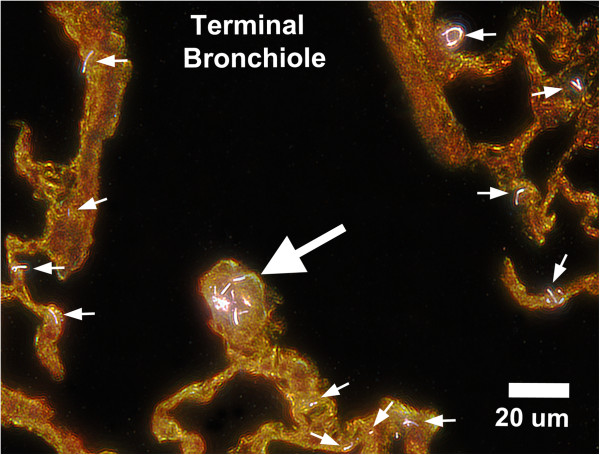
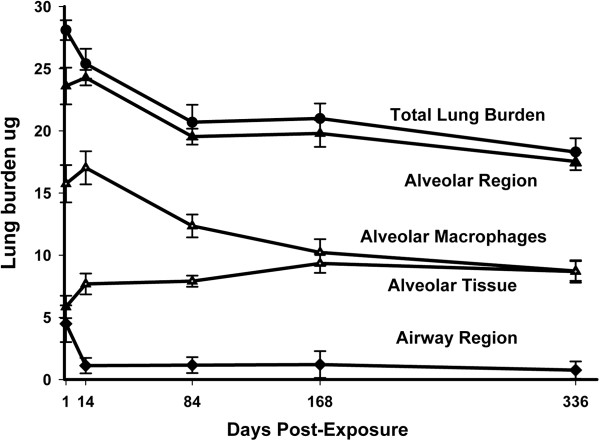
At day 1 post-exposure 84 ± 3 and 16 ± 2 percent of the lung burden (Mean ± S.E., N = 5) were in the alveolar and airway regions, respectively. Initial distribution within the alveolar region was 56 ± 5, 7 ± 4 and 20 ± 3 percent of lung burden in alveolar macrophages, alveolar airspaces and alveolar tissue, respectively. Clearance reduced the alveolar macrophage burden of MWCNTs by 35 percent between 1 and 168 days post-exposure, while the content of MWCNTs in the alveolar tissue increased by 63 percent. Large MWCNT structures containing greater than 4 fibers were 53.6 percent of the initial lung burden and accounted for the majority of the decline with clearance, while lung burden of singlet MWCNT was essentially unchanged. The mean linear intercept of alveolar airspace, a measure of the expansion of the lungs, was not significantly different between groups. Pulmonary inflammation and damage, measured as the number of polymorphnuclear leukocytes (PMNs) or lactate dehydrogenase activity (LDH) and albumin in BAL, increased rapidly (1 day post) after inhalation of MWCNTs and declined slowly with time post-exposure. The fibrillar collagen in the alveolar region of MWCNT-exposed mice demonstrated a progressive increase in thickness over time (0.17 ± 0.02, 0.22 ± 0.02, 0.26 ± 0.03, 0.25 ± 0.02 and 0.29 ± 0.01 microns for 1, 14, 84, 168 and 336 days post-exposure) and was significantly different from clean-air controls (0.16 ± 0.02) at 84 and (0.15 ± 0.02) at 336 days post-exposure.

CONCLUSIONS

Despite the relatively low fraction of the lung burden being delivered to the alveolar tissue, the average thickness of connective tissue in the alveolar region increased by 70% in the 336 days after inhalation exposure. These results demonstrate that inhaled MWCNTs deposit and are retained within the alveolar tissue where they produce a progressive and persistent fibrotic response up to 336 days post-exposure.

https://cdn.ncbi.nlm.nih.gov/pmc/blobs/9016/3733770/ae03f903ac58/1743-8977-10-33-9.jpg
https://cdn.ncbi.nlm.nih.gov/pmc/blobs/9016/3733770/831d26837e72/1743-8977-10-33-1.jpg
https://cdn.ncbi.nlm.nih.gov/pmc/blobs/9016/3733770/af279f1bee92/1743-8977-10-33-2.jpg
https://cdn.ncbi.nlm.nih.gov/pmc/blobs/9016/3733770/4515a07179e2/1743-8977-10-33-3.jpg
https://cdn.ncbi.nlm.nih.gov/pmc/blobs/9016/3733770/d060118a348b/1743-8977-10-33-4.jpg
https://cdn.ncbi.nlm.nih.gov/pmc/blobs/9016/3733770/126e8b752d0d/1743-8977-10-33-5.jpg
https://cdn.ncbi.nlm.nih.gov/pmc/blobs/9016/3733770/6bc41b5ae809/1743-8977-10-33-6.jpg
https://cdn.ncbi.nlm.nih.gov/pmc/blobs/9016/3733770/3da6c7f9f2d8/1743-8977-10-33-7.jpg
https://cdn.ncbi.nlm.nih.gov/pmc/blobs/9016/3733770/715dec3d4681/1743-8977-10-33-8.jpg
https://cdn.ncbi.nlm.nih.gov/pmc/blobs/9016/3733770/ae03f903ac58/1743-8977-10-33-9.jpg
https://cdn.ncbi.nlm.nih.gov/pmc/blobs/9016/3733770/831d26837e72/1743-8977-10-33-1.jpg
https://cdn.ncbi.nlm.nih.gov/pmc/blobs/9016/3733770/af279f1bee92/1743-8977-10-33-2.jpg
https://cdn.ncbi.nlm.nih.gov/pmc/blobs/9016/3733770/4515a07179e2/1743-8977-10-33-3.jpg
https://cdn.ncbi.nlm.nih.gov/pmc/blobs/9016/3733770/d060118a348b/1743-8977-10-33-4.jpg
https://cdn.ncbi.nlm.nih.gov/pmc/blobs/9016/3733770/126e8b752d0d/1743-8977-10-33-5.jpg
https://cdn.ncbi.nlm.nih.gov/pmc/blobs/9016/3733770/6bc41b5ae809/1743-8977-10-33-6.jpg
https://cdn.ncbi.nlm.nih.gov/pmc/blobs/9016/3733770/3da6c7f9f2d8/1743-8977-10-33-7.jpg
https://cdn.ncbi.nlm.nih.gov/pmc/blobs/9016/3733770/715dec3d4681/1743-8977-10-33-8.jpg
https://cdn.ncbi.nlm.nih.gov/pmc/blobs/9016/3733770/ae03f903ac58/1743-8977-10-33-9.jpg
摘要

背景

先前的研究已证明,多壁碳纳米管(MWCNT)团注吸入会引发快速且渐进的急性期反应。在本研究中,我们试图验证以下假设:吸入MWCNT会产生纤维化反应,且该反应具有慢性持续性。为验证吸入MWCNT会导致持续性形态学改变这一假设,将雄性C57BL/6 J小鼠置于全身吸入系统中,使其暴露于MWCNT气溶胶,并在暴露终止后长达336天的时间内检查肺泡区域的纤维化反应。

方法

吸入暴露为5 mg/m3的MWCNT气溶胶,每天暴露5小时,持续12天(每周4次,共3周)。在吸入暴露结束时,对肺部进行灌洗以分析支气管肺泡灌洗(BAL),或者在吸入暴露后1、14、84、168和336天,通过向充气的肺中灌注固定剂来保存肺部。还研究了单独的清洁空气对照组。使用组织切片的光学显微镜、增强暗场显微镜和场发射电子显微镜(FESEM)分析吸入暴露后肺部负荷的分布。用Sirius Red染色对纤维状胶原进行形态计量学测量,以评估结缔组织反应。使用增强暗场显微镜图像的连续切片分析来检查暴露后期间MWCNT纤维在肺内的重新分布。

结果

暴露后第1天,肺部负荷的84±3%和16±2%(平均值±标准误,N = 5)分别位于肺泡和气道区域。在肺泡区域内的初始分布分别为肺泡巨噬细胞、肺泡气腔和肺泡组织中肺部负荷的56±5%、7±4%和20±3%。清除作用使暴露后1至168天内肺泡巨噬细胞的MWCNT负荷降低了35%,而肺泡组织中MWCNT的含量增加了63%。含有超过4根纤维的大型MWCNT结构占初始肺部负荷的53.6%,并且是清除过程中下降的主要部分,而单根MWCNT的肺部负荷基本不变。肺泡气腔的平均线性截距(衡量肺扩张的指标)在各组之间无显著差异。以支气管肺泡灌洗中的多形核白细胞(PMN)数量或乳酸脱氢酶活性(LDH)以及白蛋白来衡量的肺部炎症和损伤,在吸入MWCNT后迅速增加(暴露后1天),并随暴露后时间缓慢下降。MWCNT暴露小鼠肺泡区域的纤维状胶原厚度随时间逐渐增加(暴露后1、14、84、168和336天分别为0.17±0.02、0.22±0.02、0.26±0.03、0.25±0.02和0.29±0.01微米),在暴露后84天与清洁空气对照组(0.16±0.02)有显著差异,在暴露后336天与清洁空气对照组(0.15±0.02)有显著差异。

结论

尽管肺部负荷输送到肺泡组织的比例相对较低,但吸入暴露后336天内肺泡区域结缔组织的平均厚度增加了70%。这些结果表明,吸入的MWCNT沉积并保留在肺泡组织内,在暴露后长达336天的时间里产生渐进性和持续性的纤维化反应。

相似文献

1
Distribution and fibrotic response following inhalation exposure to multi-walled carbon nanotubes.吸入多壁碳纳米管后的分布及纤维化反应
Part Fibre Toxicol. 2013 Jul 30;10:33. doi: 10.1186/1743-8977-10-33.
2
Pulmonary fibrotic response to aspiration of multi-walled carbon nanotubes.吸入多壁碳纳米管引起的肺纤维化反应。
Part Fibre Toxicol. 2011 Jul 22;8:21. doi: 10.1186/1743-8977-8-21.
3
Extrapulmonary transport of MWCNT following inhalation exposure.吸入暴露后多壁碳纳米管的肺外转运。
Part Fibre Toxicol. 2013 Aug 9;10:38. doi: 10.1186/1743-8977-10-38.
4
Mouse pulmonary dose- and time course-responses induced by exposure to nitrogen-doped multi-walled carbon nanotubes.暴露于氮掺杂多壁碳纳米管引起的小鼠肺部剂量和时间进程反应。
Inhal Toxicol. 2020 Jan;32(1):24-38. doi: 10.1080/08958378.2020.1723746. Epub 2020 Feb 7.
5
Subchronic 13-week inhalation exposure of rats to multiwalled carbon nanotubes: toxic effects are determined by density of agglomerate structures, not fibrillar structures.大鼠亚慢性 13 周吸入暴露于多壁碳纳米管:毒效应由团聚结构密度决定,而非纤维结构。
Toxicol Sci. 2010 Jan;113(1):226-42. doi: 10.1093/toxsci/kfp247. Epub 2009 Oct 12.
6
Pathologic and molecular profiling of rapid-onset fibrosis and inflammation induced by multi-walled carbon nanotubes.多壁碳纳米管诱导的快速纤维化和炎症的病理及分子特征分析
Arch Toxicol. 2015 Apr;89(4):621-33. doi: 10.1007/s00204-014-1428-y. Epub 2014 Dec 16.
7
Acute pulmonary dose-responses to inhaled multi-walled carbon nanotubes.吸入多壁碳纳米管的急性肺剂量反应。
Nanotoxicology. 2013 Nov;7(7):1179-94. doi: 10.3109/17435390.2012.719649. Epub 2012 Sep 13.
8
Pulmonary toxicity of multi-walled carbon nanotubes (Baytubes) relative to alpha-quartz following a single 6h inhalation exposure of rats and a 3 months post-exposure period.大鼠单次吸入暴露6小时及暴露后3个月期间,多壁碳纳米管(拜耳纳米管)相对于α-石英的肺毒性。
Toxicology. 2009 Dec 21;266(1-3):16-29. doi: 10.1016/j.tox.2009.10.007. Epub 2009 Oct 28.
9
Multiwalled carbon nanotube-induced pulmonary inflammatory and fibrotic responses and genomic changes following aspiration exposure in mice: A 1-year postexposure study.小鼠吸入多壁碳纳米管后1年的肺部炎症、纤维化反应及基因组变化:暴露后研究
J Toxicol Environ Health A. 2016;79(8):352-66. doi: 10.1080/15287394.2016.1159635. Epub 2016 Apr 19.
10
Acute nose-only exposure of rats to phosgene. Part II. Concentration x time dependence of changes in bronchoalveolar lavage during a follow-up period of 3 months.大鼠仅经鼻急性暴露于光气。第二部分。3个月随访期内支气管肺泡灌洗变化的浓度×时间依赖性
Inhal Toxicol. 2006 Aug;18(9):595-607. doi: 10.1080/08958370600742771.

引用本文的文献

1
Pulmonary Toxicity of Long, Thick MWCNT and Very Long, Thin Carboxylated MWCNT Aerosols Following 28 Days Whole-Body Exposure.28天全身暴露后长而粗的多壁碳纳米管和非常长且细的羧基化多壁碳纳米管气溶胶的肺毒性
Toxics. 2025 May 16;13(5):401. doi: 10.3390/toxics13050401.
2
Multiwalled carbon nanotubes activate the NLRP3 inflammasome-dependent pyroptosis in macrophages.多壁碳纳米管激活巨噬细胞中NLRP3炎性小体依赖性细胞焦亡。
Mol Pharmacol. 2025 May;107(5):100031. doi: 10.1016/j.molpha.2025.100031. Epub 2025 Apr 2.
3
Serum Osteopontin, KL-6, and Syndecan-4 as Potential Biomarkers in the Diagnosis of Coal Workers' Pneumoconiosis: A Case-Control Study.

本文引用的文献

1
Carbon nanotube dosimetry: from workplace exposure assessment to inhalation toxicology.碳纳米管剂量学:从工作场所暴露评估到吸入毒理学
Part Fibre Toxicol. 2013 Oct 21;10(1):53. doi: 10.1186/1743-8977-10-53.
2
Occupational exposure assessment in carbon nanotube and nanofiber primary and secondary manufacturers: mobile direct-reading sampling.碳纳米管和纳米纤维一级和二级制造商的职业暴露评估:移动式直读采样
Ann Occup Hyg. 2013 Apr;57(3):328-44. doi: 10.1093/annhyg/mes079. Epub 2012 Oct 25.
3
Multi-walled carbon nanotubes: sampling criteria and aerosol characterization.
血清骨桥蛋白、KL-6和Syndecan-4作为煤工尘肺诊断的潜在生物标志物:一项病例对照研究
Pharmgenomics Pers Med. 2023 Jun 1;16:537-549. doi: 10.2147/PGPM.S409644. eCollection 2023.
4
Understanding toxicity associated with boron nitride nanotubes: Review of toxicity studies, exposure assessment at manufacturing facilities, and read-across.了解与氮化硼纳米管相关的毒性:毒性研究综述、制造设施中的暴露评估及类推法
J Mater Res. 2022 Oct 31;37(24):4620-4638. doi: 10.1557/s43578-022-00796-8.
5
Carbon Nanotubes as Carriers in Drug Delivery for Non-Small Cell Lung Cancer, Mechanistic Analysis of Their Carcinogenic Potential, Safety Profiling and Identification of Biomarkers.碳纳米管作为非小细胞肺癌药物递送载体:致癌潜力的机制分析、安全性评估和生物标志物鉴定。
Int J Nanomedicine. 2022 Dec 8;17:6157-6180. doi: 10.2147/IJN.S384592. eCollection 2022.
6
Grouping MWCNTs based on their similar potential to cause pulmonary hazard after inhalation: a case-study.基于吸入后潜在的肺部危害将 MWCNTs 进行分组:一项案例研究。
Part Fibre Toxicol. 2022 Jul 20;19(1):50. doi: 10.1186/s12989-022-00487-6.
7
Pulmonary toxicity and gene expression changes in response to whole-body inhalation exposure to multi-walled carbon nanotubes in rats.大鼠全身吸入多壁碳纳米管后的肺毒性及基因表达变化。
Inhal Toxicol. 2022;34(7-8):200-218. doi: 10.1080/08958378.2022.2081386. Epub 2022 Jun 1.
8
Towards health-based nano reference values (HNRVs) for occupational exposure: Recommendations from an expert panel.面向职业暴露的基于健康的纳米参考值 (HNRVs):专家小组的建议。
NanoImpact. 2022 Apr;26:100396. doi: 10.1016/j.impact.2022.100396. Epub 2022 Mar 17.
9
Innate but Not Adaptive Immunity Regulates Lung Recovery from Chronic Exposure to Graphene Oxide Nanosheets.固有免疫而非适应性免疫调节慢性暴露于氧化石墨烯纳米片后的肺恢复。
Adv Sci (Weinh). 2022 Apr;9(11):e2104559. doi: 10.1002/advs.202104559. Epub 2022 Feb 15.
10
Histopathology of the broad class of carbon nanotubes and nanofibers used or produced in U.S. facilities in a murine model.美国工厂使用或生产的各类碳纳米管和纳米纤维在小鼠模型中的组织病理学研究。
Part Fibre Toxicol. 2021 Dec 20;18(1):47. doi: 10.1186/s12989-021-00440-z.
多壁碳纳米管:采样标准和气溶胶特性。
Inhal Toxicol. 2012 Oct;24(12):798-820. doi: 10.3109/08958378.2012.720741.
4
Acute pulmonary dose-responses to inhaled multi-walled carbon nanotubes.吸入多壁碳纳米管的急性肺剂量反应。
Nanotoxicology. 2013 Nov;7(7):1179-94. doi: 10.3109/17435390.2012.719649. Epub 2012 Sep 13.
5
The threshold length for fiber-induced acute pleural inflammation: shedding light on the early events in asbestos-induced mesothelioma.纤维诱导性急性胸膜炎的阈值长度:揭示石棉诱导性间皮瘤中的早期事件。
Toxicol Sci. 2012 Aug;128(2):461-70. doi: 10.1093/toxsci/kfs171. Epub 2012 May 12.
6
Occupational exposure assessment in carbon nanotube and nanofiber primary and secondary manufacturers.碳纳米管及纳米纤维一级和二级制造商的职业暴露评估。
Ann Occup Hyg. 2012 Jul;56(5):542-56. doi: 10.1093/annhyg/mer110. Epub 2011 Dec 8.
7
Pulmonary fibrotic response to aspiration of multi-walled carbon nanotubes.吸入多壁碳纳米管引起的肺纤维化反应。
Part Fibre Toxicol. 2011 Jul 22;8:21. doi: 10.1186/1743-8977-8-21.
8
Length-dependent retention of carbon nanotubes in the pleural space of mice initiates sustained inflammation and progressive fibrosis on the parietal pleura.长度依赖性碳纳米管在小鼠胸膜腔中的滞留引发壁层胸膜的持续炎症和进行性纤维化。
Am J Pathol. 2011 Jun;178(6):2587-600. doi: 10.1016/j.ajpath.2011.02.040.
9
Distribution and persistence of pleural penetrations by multi-walled carbon nanotubes.多壁碳纳米管的胸膜穿透分布和持久性。
Part Fibre Toxicol. 2010 Oct 4;7:28. doi: 10.1186/1743-8977-7-28.
10
Asbestos, carbon nanotubes and the pleural mesothelium: a review of the hypothesis regarding the role of long fibre retention in the parietal pleura, inflammation and mesothelioma.石棉、碳纳米管和胸膜间皮:关于长纤维在壁层胸膜、炎症和间皮瘤中滞留作用的假说综述。
Part Fibre Toxicol. 2010 Mar 22;7:5. doi: 10.1186/1743-8977-7-5.