Animal Genomics and Bioinformatics Division, National Institute of Animal Science, Rural Development Administration, Suwon 441-706, Republic of Korea.
BMC Genomics. 2013 Jul 30;14:519. doi: 10.1186/1471-2164-14-519.
Hanwoo (Korean cattle), which originated from natural crossbreeding between taurine and zebu cattle, migrated to the Korean peninsula through North China. Hanwoo were raised as draft animals until the 1970s without the introduction of foreign germplasm. Since 1979, Hanwoo has been bred as beef cattle. Genetic variation was analyzed by whole-genome deep resequencing of a Hanwoo bull. The Hanwoo genome was compared to that of two other breeds, Black Angus and Holstein, and genes within regions of homozygosity were investigated to elucidate the genetic and genomic characteristics of Hanwoo.
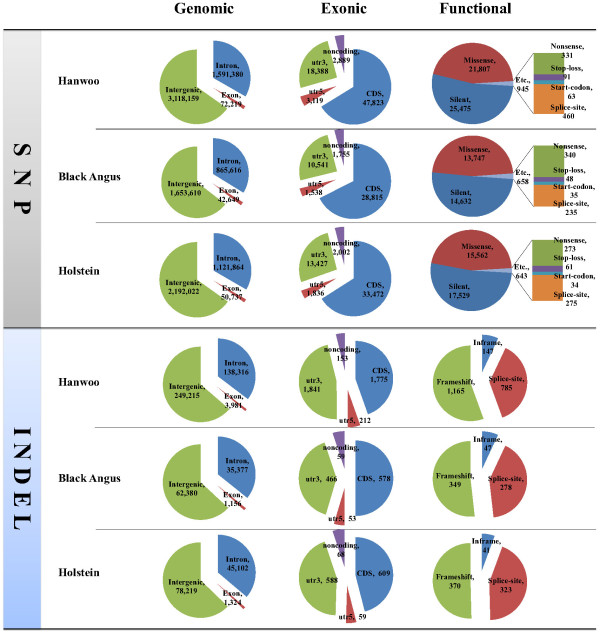
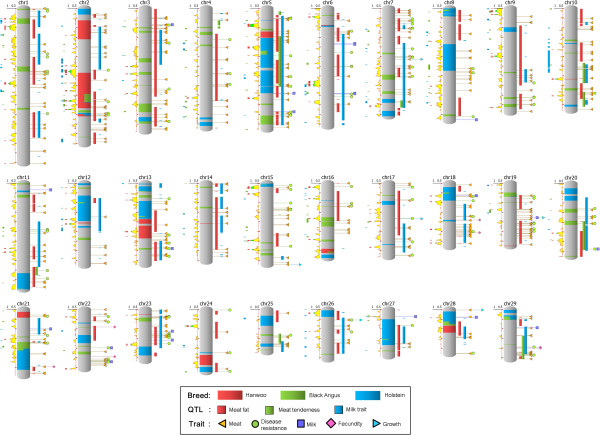
The Hanwoo bull genome was sequenced to 45.6-fold coverage using the ABI SOLiD system. In total, 4.7 million single-nucleotide polymorphisms and 0.4 million small indels were identified by comparison with the Btau4.0 reference assembly. Of the total number of SNPs and indels, 58% and 87%, respectively, were novel. The overall genotype concordance between the SNPs and BovineSNP50 BeadChip data was 96.4%. Of 1.6 million genetic differences in Hanwoo, approximately 25,000 non-synonymous SNPs, splice-site variants, and coding indels (NS/SS/Is) were detected in 8,360 genes. Among 1,045 genes containing reliable specific NS/SS/Is in Hanwoo, 109 genes contained more than one novel damaging NS/SS/I. Of the genes containing NS/SS/Is, 610 genes were assigned as trait-associated genes. Moreover, 16, 78, and 51 regions of homozygosity (ROHs) were detected in Hanwoo, Black Angus, and Holstein, respectively. 'Regulation of actin filament length' was revealed as a significant gene ontology term and 25 trait-associated genes for meat quality and disease resistance were found in 753 genes that resided in the ROHs of Hanwoo. In Hanwoo, 43 genes were located in common ROHs between whole-genome resequencing and SNP chips in BTA2, 10, and 13 coincided with quantitative trait loci for meat fat traits. In addition, the common ROHs in BTA2 and 16 were in agreement between Hanwoo and Black Angus.
We identified 4.7 million SNPs and 0.4 million small indels by whole-genome resequencing of a Hanwoo bull. Approximately 25,000 non-synonymous SNPs, splice-site variants, and coding indels (NS/SS/Is) were detected in 8,360 genes. Additionally, we found 25 trait-associated genes for meat quality and disease resistance among 753 genes that resided in the ROHs of Hanwoo. These findings will provide useful genomic information for identifying genes or casual mutations associated with economically important traits in cattle.
韩牛(韩国牛)起源于黄牛和瘤牛之间的自然杂交,通过华北迁徙到朝鲜半岛。韩牛曾作为役用牛饲养,直到 20 世纪 70 年代才引入外国种质。自 1979 年以来,韩牛一直被作为肉牛饲养。通过对一头韩牛公牛进行全基因组深度重测序分析了遗传变异。将韩牛基因组与另外两个品种,黑安格斯牛和荷斯坦牛进行了比较,并研究了同域性区域内的基因,以阐明韩牛的遗传和基因组特征。
使用 ABI SOLiD 系统对韩牛公牛基因组进行了 45.6 倍的测序。通过与 Btau4.0 参考组装进行比较,共鉴定出 470 万个单核苷酸多态性和 40 万个小插入缺失。在总共的 SNP 和 indel 中,58%和 87%分别是新的。SNP 和 BovineSNP50 BeadChip 数据之间的总体基因型一致性为 96.4%。在韩牛的 160 万个遗传差异中,在 8360 个基因中检测到大约 25000 个非同义 SNP、剪接位点变异和编码 indel(NS/SS/Is)。在韩牛中含有可靠特定 NS/SS/Is 的 1045 个基因中,有 109 个基因含有一个以上的新的有害 NS/SS/I。在含有 NS/SS/Is 的基因中,610 个基因被指定为与性状相关的基因。此外,在韩牛、黑安格斯牛和荷斯坦牛中分别检测到 16、78 和 51 个纯合区(ROH)。“肌动蛋白丝长度的调节”被揭示为一个重要的基因本体论术语,在韩牛的 ROH 中发现了 25 个与肉质和抗病性相关的性状相关基因。在韩牛中,43 个基因位于 BTA2、10 和 13 全基因组重测序和 SNP 芯片之间的共同 ROH 中,10 个与肉质脂肪性状的数量性状位点重合。此外,在 BTA2 和 16 之间的共同 ROH 在韩牛和黑安格斯牛之间是一致的。
我们通过对一头韩牛公牛进行全基因组重测序,鉴定出 470 万个 SNP 和 400 万个小插入缺失。在 8360 个基因中检测到大约 25000 个非同义 SNP、剪接位点变异和编码 indel(NS/SS/Is)。此外,我们在韩牛的 ROH 中发现了 753 个与肉质和抗病性相关的性状相关基因中的 25 个基因。这些发现将为鉴定与牛经济重要性状相关的基因或因果突变提供有用的基因组信息。