Institute for Social Medicine, Epidemiology and Health Economics, Charité, Universitätsmedizin Berlin, 10117 Berlin, Germany.
Clin Interv Aging. 2013;8:953-61. doi: 10.2147/CIA.S45242. Epub 2013 Jul 22.
Older adults often use complementary medicine; however, very few interventional studies have focused on them. The aim of this study was to evaluate the feasibility and to obtain preliminary data on effectiveness of an Integrative Medicine (IM) program compared to usual medical care.
The study consisted of older adults living in shared apartment communities including caregiving. The shared apartments were cluster-randomized to the IM program or Usual Care (UC). IM consisted of additional lifestyle modification (exercise and diet), external naturopathic applications, homeopathic treatment, and modification of conventional drug therapy for 12 months. The UC group received conventional care alone. The following outcomes were used: Nurses Observation Scale for Geriatric Patients (NOSGER); Assessment of Motor and Process Skills; Barthel Index; Qualidem; Profile of Wellbeing; and Mini-mental State Examination. Exploratory effect sizes (Cohen's d, means adjusted for differences of baseline values) were calculated to analyze group differences.
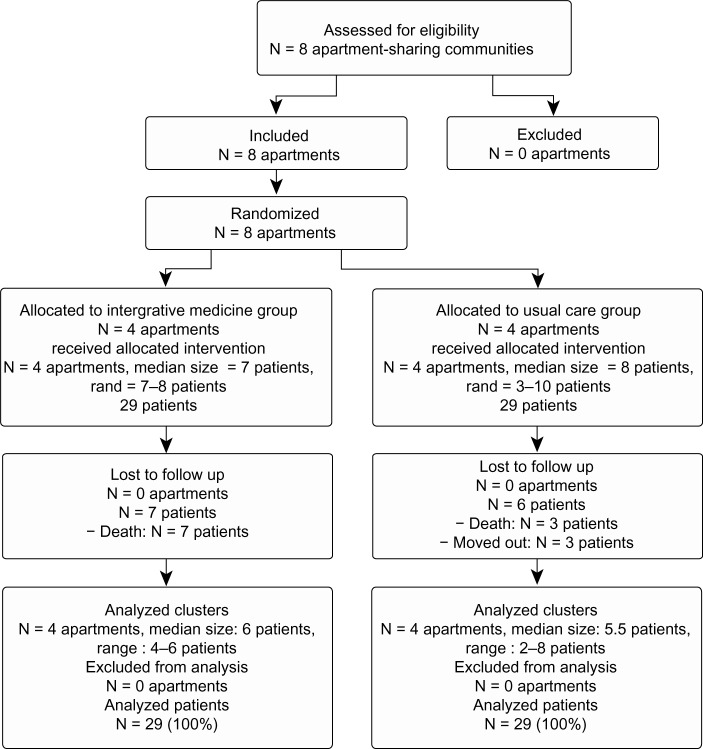
A total of eight shared apartment communities were included; four were allocated to IM (29 patients, median seven patients; [mean ± standard deviation] 82.7 ± 8.6 years) and four to UC (29 patients, median eight patients; 76.0 ± 12.8 years of age). After 12 months, effect sizes ≥0.3 were observed for activities of daily living on the NOSGER-Activities of Daily Living subscale (0.53), Barthel Index (0.30), Qualidem total sum score (0.39), Profile of Wellbeing (0.36), NOSGER-Impaired Social Behavior (0.47), and NOSGER-Depressed Mood subscales (0.40). Smaller or no effects were observed for all other outcomes. The intervention itself was found to be feasible, but elaborate and time consuming.
This exploratory pilot study showed that for a full-scale trial, the outcomes of Activities of Daily Living and Quality of Life seem to be the most promising. The results have to be interpreted with care; larger confirmatory trials are necessary to validate the effects.
老年人经常使用补充医学,但很少有干预性研究关注他们。本研究旨在评估一种综合医学(IM)方案与常规医疗相比的可行性,并获得初步疗效数据。
研究对象为居住在包括护理服务在内的共享公寓社区中的老年人。共享公寓以群组为单位随机分配至 IM 方案组或常规医疗组(UC)。IM 方案包括为期 12 个月的生活方式(运动和饮食)调整、外部顺势疗法应用、顺势疗法治疗以及常规药物治疗的调整。UC 组仅接受常规护理。使用以下结果进行评估:护士观察老年患者量表(NOSGER)、运动和过程技能评估、巴氏指数、Qualidem、幸福感概况和简易精神状态检查。计算探索性效应大小(Cohen's d,根据基线值差异进行调整的平均值),以分析组间差异。
共纳入 8 个共享公寓社区,其中 4 个被分配至 IM 组(29 名患者,中位数 7 名患者;[均数±标准差]82.7±8.6 岁),4 个被分配至 UC 组(29 名患者,中位数 8 名患者;76.0±12.8 岁)。12 个月后,在 NOSGER 日常生活活动子量表(0.53)、巴氏指数(0.30)、Qualidem 总分(0.39)、幸福感概况(0.36)、NOSGER 受损社会行为(0.47)和 NOSGER 抑郁情绪子量表(0.40)上,观察到效应大小≥0.3。在所有其他结果上,观察到的效应较小或无。干预本身被认为是可行的,但需要精心设计和耗费时间。
本探索性试点研究表明,对于全面的试验,日常生活活动和生活质量的结果似乎最有希望。这些结果需要谨慎解释;需要更大的验证性试验来验证这些效果。