1. Rajiv Gandhi Cancer Institute and Research Centre, New Delhi, India.
J Cancer. 2013 Jul 5;4(6):468-72. doi: 10.7150/jca.6568. Print 2013.
ERG oncogene fusions (predominantly TMPRSS2-ERG) represent the most common (50-70% frequency) and validated prostate cancer (CaP) genome alteration in the Western countries. A common TMPRSS2-ERG fusion type leads to the androgen dependent tumor cell specific expression of the TMPRSS2-ERG fusion transcript and amino terminally truncated ERG oncoprotein. CaP prevalence and aggressiveness, as well as genomic alterations vary in different geographic locations in the world. Recent studies from our group highlighted significantly lower frequency of ERG alterations in prostate index tumors of African American men (30%) in comparison to Caucasian Americans (60%). Further, much lower frequencies (10 -25%) of ERG alterations have been reported in studies from China and Japan. There is no study on ERG alterations in CaP patients from India, representing a significant portion of the world male population. This study focuses on the frequency of ERG oncoprotein expression in CaP patients from India.
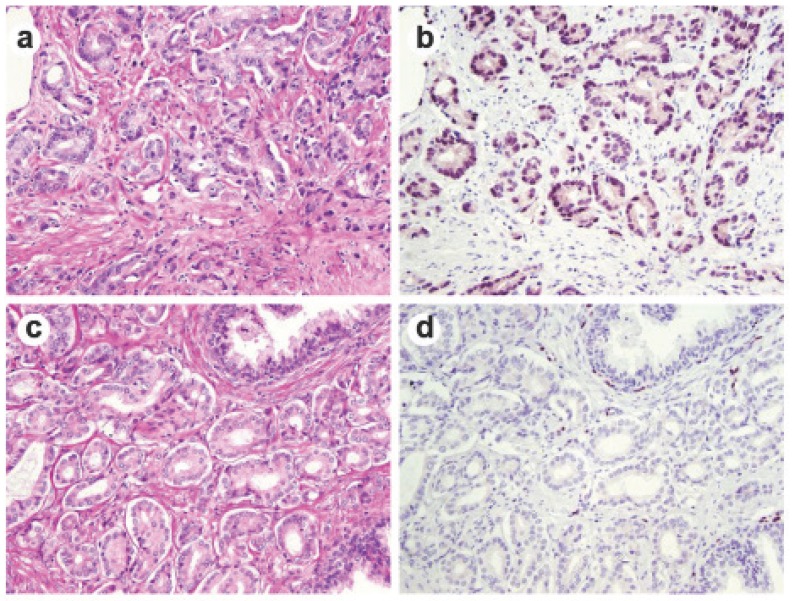
De-identified formalin-fixed paraffin-embedded (FFPE) specimens from radical prostatectomy (RP) specimens of 51 patients from the Rajiv Gandhi Cancer Institute and Research Centre (RGCI), New Delhi, India, were analyzed for ERG alterations. The ERG oncoprotein expression as a surrogate of ERG gene fusions was analyzed by using a highly specific ERG monoclonal antibody (9FY). TMPRSS2-ERG fusion was assessed by fluorescent in situ hybridization (FISH) assays using the break-apart ERG probes.
Specimens reflecting prior hormonal treatment, or lacking any tumor content, were excluded from the analyses. Of the thirty evaluable specimens, ERG positive tumors were present in 8 cases (27%) and one tumor specimen exhibited rare ERG positive cells. None of the benign glands were positive for ERG supporting previous studies showing complete specificity of the ERG oncoprotein for detection of tumors cells in prostate.
Frequency of ERG oncoprotein expression is much lower in CaP patients from India in comparison to higher frequency of ERG alterations noted in Western countries. ERG frequency in Indian CaP is similar to observations from Japan and China. Since ERG oncogenic activation is a promising biomarker and therapeutic target for CaP, careful evaluation of ERG is needed in CaP patients from different parts of the world.
ERG 致癌基因融合(主要是 TMPRSS2-ERG)代表了西方国家最常见(50-70%的频率)和已验证的前列腺癌(CaP)基因组改变。一种常见的 TMPRSS2-ERG 融合类型导致雄激素依赖性肿瘤细胞中 TMPRSS2-ERG 融合转录本和氨基末端截断的 ERG 癌蛋白的特异性表达。CaP 的患病率和侵袭性以及基因组改变在世界不同地区有所不同。我们小组的最近研究表明,与高加索裔美国人(60%)相比,非洲裔美国男性的前列腺指数肿瘤中 ERG 改变的频率显着降低(30%)。此外,在中国和日本的研究中,报道 ERG 改变的频率要低得多(10-25%)。目前尚无针对来自印度的 CaP 患者的 ERG 改变的研究,而这些患者代表了世界男性人口的重要组成部分。本研究侧重于印度 CaP 患者中 ERG 癌蛋白表达的频率。
从印度新德里拉吉夫甘地癌症研究所和研究中心(RGCI)的 51 例根治性前列腺切除术(RP)标本的福尔马林固定石蜡包埋(FFPE)标本中,分析 ERG 改变。使用高度特异性 ERG 单克隆抗体(9FY)分析 ERG 癌蛋白表达作为 ERG 基因融合的替代物。使用分离的 ERG 探针通过荧光原位杂交(FISH)检测 TMPRSS2-ERG 融合。
排除了反映先前激素治疗或缺乏任何肿瘤含量的标本。在可评估的 30 个标本中,有 8 例(27%)存在 ERG 阳性肿瘤,1 个肿瘤标本存在罕见的 ERG 阳性细胞。没有一个良性腺体呈 ERG 阳性,这支持了之前的研究,即 ERG 癌蛋白完全特异性用于检测前列腺中的肿瘤细胞。
与西方国家观察到的 ERG 改变频率较高相比,印度 CaP 患者中 ERG 癌蛋白表达的频率要低得多。印度 CaP 的 ERG 频率与日本和中国的观察结果相似。由于 ERG 致癌激活是 CaP 的有前途的生物标志物和治疗靶标,因此需要对来自世界不同地区的 CaP 患者进行仔细评估 ERG。