Ferreira Lisianny Camilla Cocri do Nascimento, da Silva Humberto José Gomes, Lins Tatiana Acioli, do Prado Wagner Luiz
Universidade de Pernambuco - UPE, Recife, PE, Brazil.
Rev Bras Hematol Hemoter. 2013;35(3):163-6. doi: 10.5581/1516-8484.20130051.
An excess of weight including obesity have reached epidemic rates in all age groups, both in developed and developing countries. It is notable that overweight children and adolescents have a higher likelihood of becoming obese adults and to present health-related problems early in life.
[corrected] To verify associations of the lipid and hematological profiles with adiposity in obese adolescents beginning multidisciplinary weight loss therapy.
This cross-sectional study was conducted with 85 adolescents of both genders, aged 12-19 years (Tanner staging 3 or 4) and body mass index greater than the 95(th) percentile. The sum of the triceps, subscapular and calf skinfolds and the waist circumference were used to estimate adiposity. Blood samples were collected from all patients after overnight fasting to analyze blood lipids (total cholesterol, high-density lipoprotein, low-density lipoprotein, very low-density lipoprotein and triglycerides), blood sugar and the hematological profile (hemoglobin, platelets and red blood cells). The Kolmogorov-Smirnov test and Spearman and Pearson correlation coefficients were used for statistical analysis with significance set for p-values ≤ 0.05.
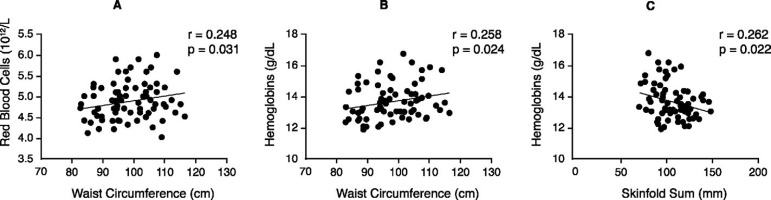
There were statistical differences between genders for red blood cells (p-value = 0.000), hemoglobin (p-value = 0.000) and platelets (p-value = 0.002). Positive correlations were found for red blood cells (p-value = 0.031) and hemoglobin (p-value = 0.024) with waist circumference. There was a negative correlation between hemoglobin and the sum of skinfolds (p-value = 0.022).
The results demonstrate an association between the lipid and hematological profiles and body adiposity in obese adolescents thus reinforcing the importance of treating obese adolescents early to prevent health related problems in adult life.
在发达国家和发展中国家,包括肥胖在内的超重现象在所有年龄组中都已达到流行程度。值得注意的是,超重的儿童和青少年更有可能成为肥胖的成年人,并在生命早期出现与健康相关的问题。
验证开始多学科减肥治疗的肥胖青少年的血脂和血液学指标与肥胖程度之间的关联。
本横断面研究对85名年龄在12 - 19岁( Tanner分期3或4期)且体重指数大于第95百分位数的青少年进行。使用肱三头肌、肩胛下和小腿皮褶厚度之和以及腰围来估计肥胖程度。所有患者在空腹过夜后采集血样,以分析血脂(总胆固醇、高密度脂蛋白、低密度脂蛋白、极低密度脂蛋白和甘油三酯)、血糖和血液学指标(血红蛋白、血小板和红细胞)。采用Kolmogorov - Smirnov检验以及Spearman和Pearson相关系数进行统计分析,设定p值≤0.05为有统计学意义。
红细胞(p值 = 0.000)、血红蛋白(p值 = 0.000)和血小板(p值 = 0.002)在性别之间存在统计学差异。红细胞(p值 = 0.031)和血红蛋白(p值 = 0.024)与腰围呈正相关。血红蛋白与皮褶厚度之和呈负相关(p值 = 0.022)。
结果表明肥胖青少年的血脂和血液学指标与身体肥胖之间存在关联,从而强化了早期治疗肥胖青少年以预防成年期健康相关问题的重要性。