Department of Cellular and Molecular Medicine, University of Ottawa Ottawa, ON, Canada ; Ottawa Hospital Research Institute Ottawa, ON, Canada.
Front Physiol. 2013 Jul 30;4:197. doi: 10.3389/fphys.2013.00197. eCollection 2013.
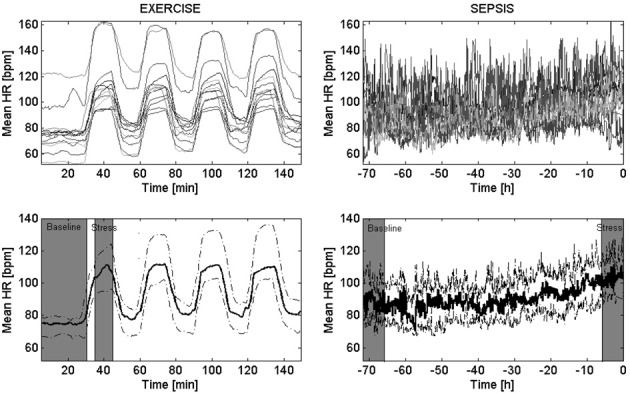
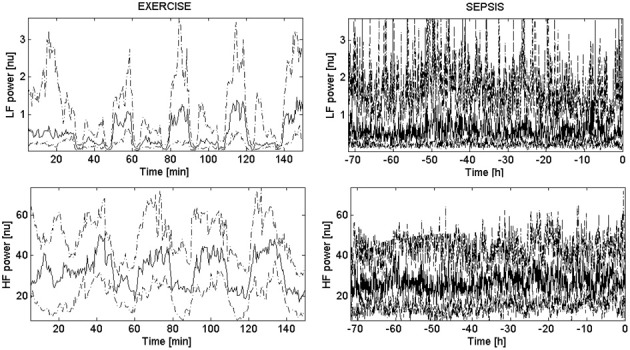
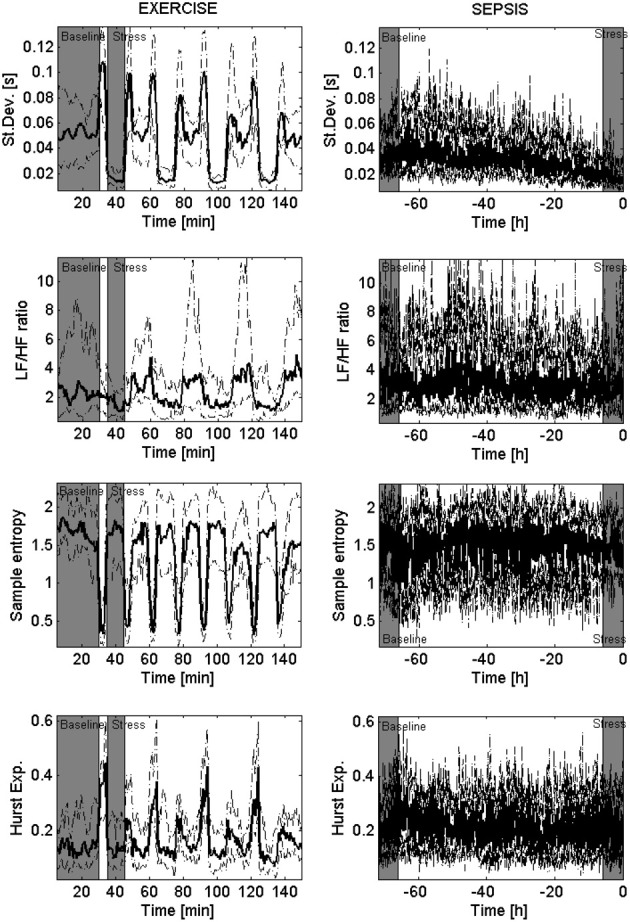
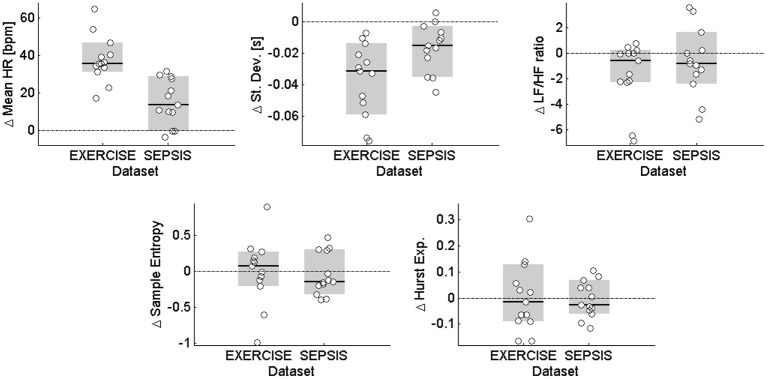
Although physiological (e.g., exercise) and pathological (e.g., infection) stress affecting the cardiovascular system have both been documented to be associated with a reduction in overall heart rate variability (HRV), it remains unclear if loss of HRV is ubiquitously similar across different domains of variability analysis or if distinct patterns of altered HRV exist depending on the stressor. Using Continuous Individualized Multiorgan Variability Analysis (CIMVA™) software, heart rate (HR) and four selected measures of variability were measured over time (windowed analysis) from two datasets, a set (n = 13) of patients who developed systemic infection (i.e., sepsis) after bone marrow transplant (BMT), and a matched set of healthy subjects undergoing physical exercise under controlled conditions. HR and the four HRV measures showed similar trends in both sepsis and exercise. The comparison through Wilcoxon sign-rank test of the levels of variability at baseline and during the stress (i.e., exercise or after days of sepsis development) showed similar changes, except for LF/HF, ratio of power at low (LF) and high (HF) frequencies (associated with sympathovagal modulation), which was affected by exercise but did not show any change during sepsis. Furthermore, HRV measures during sepsis showed a lower level of correlation with each other, as compared to HRV during exercise. In conclusion, this exploratory study highlights similar responses during both exercise and infection, with differences in terms of correlation and inter-subject fluctuations, whose physiologic significance merits further investigation.
虽然生理(例如运动)和病理(例如感染)应激都会导致整体心率变异性(HRV)降低,但尚不清楚 HRV 的丧失是否在变异性分析的不同领域普遍相似,或者是否存在取决于应激源的不同的 HRV 改变模式。使用连续个体化多器官变异性分析(CIMVA™)软件,从骨髓移植(BMT)后发生全身感染(即败血症)的一组患者(n=13)和一组在受控条件下进行身体锻炼的健康受试者的两个数据集,随时间(窗口分析)测量心率(HR)和四个选定的变异性指标。HR 和四个 HRV 指标在败血症和运动中均显示出相似的趋势。通过 Wilcoxon 符号秩检验比较基线和应激期间(即运动或败血症发生后几天)的变异性水平,除了 LF/HF(与交感神经和副交感神经调节相关的低频和高频功率比)外,发现相似的变化,LF/HF 在运动中受到影响,但在败血症期间没有任何变化。此外,与运动期间的 HRV 相比,败血症期间的 HRV 指标彼此之间的相关性更低。总之,这项探索性研究强调了运动和感染期间的相似反应,在相关性和个体间波动方面存在差异,其生理意义值得进一步研究。