Microbiology and Immunology Graduate Program, Drexel University College of Medicine, Philadelphia, PA, USA; Department of Microbiology and Immunology, Drexel University College of Medicine, Philadelphia, PA, USA.
Immunology. 2013 Oct;140(2):153-67. doi: 10.1111/imm.12143.
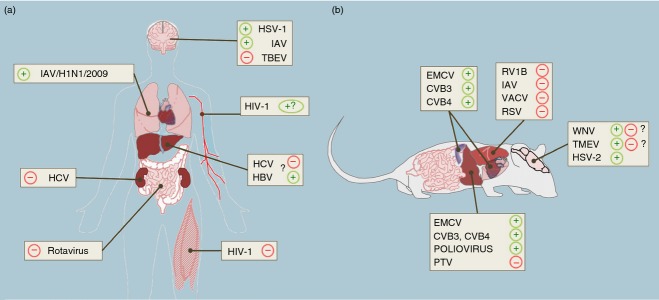
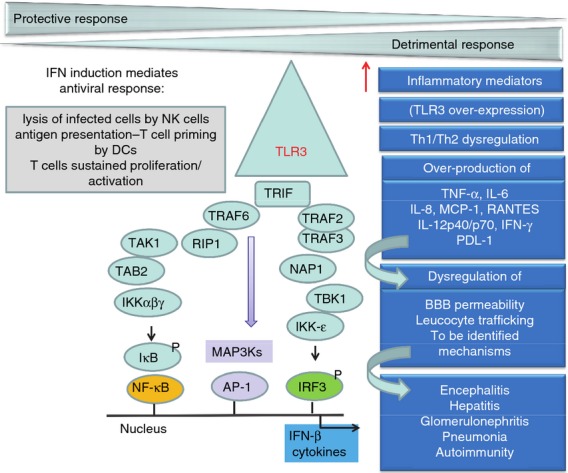
Viral infections frequently induce acute and chronic inflammatory diseases, yet the contribution of the innate immune response to a detrimental host response remains poorly understood. In virus-infected cells, double-stranded RNA (dsRNA) is generated as an intermediate during viral replication. Cell necrosis (and the release of endogenous dsRNA) is a common event during both sterile and infectious inflammatory processes. The discovery of Toll-like receptor 3 (TLR3) as an interferon-inducing dsRNA sensor led to the assumption that TLR3 was the master sentinel against viral infections. This simplistic view has been challenged by the discovery of at least three members of the DExd/H-box helicase cytosolic sensors of dsRNA that share with TLR3 the Toll-interleukin-1 receptor (TIR) -adapter molecule TIR domain-containing adaptor protein interferon-β (TRIF) for downstream type I interferon signalling. Data are conflicting on the role of TLR3 in protective immunity against viruses in the mouse model. Varying susceptibility to infection and disease outcomes have been reported in TLR3-immunodeficient mice. Surprisingly, the susceptibility to develop herpes simplex virus-1 encephalitis in humans with inborn defects of the TLR3 pathway varies, and TLR3-deficient humans do not show increased susceptibility to other viral infections. Therefore, a current challenge is to understand the protective versus pathogenic contribution of TLR3 in viral infections. We review recent advances in the identification of TLR3-signalling pathways, endogenous and virus-induced negative regulators of the TLR3 cascade, and discuss the protective versus pathogenic role of TLR3 in viral pathogenesis.
病毒感染常引起急性和慢性炎症性疾病,但先天免疫反应对宿主有害反应的贡献仍知之甚少。在病毒感染的细胞中,双链 RNA (dsRNA) 作为病毒复制过程中的中间产物产生。细胞坏死(和内源性 dsRNA 的释放)是无菌和感染性炎症过程中的常见事件。Toll 样受体 3 (TLR3) 作为一种诱导干扰素的 dsRNA 传感器的发现,导致人们假设 TLR3 是针对病毒感染的主要哨兵。这种简单的观点受到至少三种细胞质 dsRNA 的 DExd/H-box 解旋酶细胞传感器的发现的挑战,这些传感器与 TLR3 共享 Toll-白细胞介素-1 受体 (TIR) -接头分子 TIR 结构域包含干扰素-β (TRIF) 用于下游 I 型干扰素信号。关于 TLR3 在小鼠模型中针对病毒的保护性免疫中的作用的数据存在争议。在 TLR3 免疫缺陷小鼠中报告了感染和疾病结果的易感性变化。令人惊讶的是,具有 TLR3 途径先天缺陷的人类中单纯疱疹病毒-1 脑炎的易感性不同,并且 TLR3 缺陷的人类不会增加对其他病毒感染的易感性。因此,目前的挑战是了解 TLR3 在病毒感染中的保护作用与致病作用。我们回顾了 TLR3 信号通路、内源性和病毒诱导的 TLR3 级联负调节剂的最新进展,并讨论了 TLR3 在病毒发病机制中的保护作用与致病作用。