Cemin Roberto, Janardhanan Rajesh, Donazzan Luca, Daves Massimo
Department of Cardiology, San Maurizio Regional Hospital of Bolzano, Italy.
Curr Cardiol Rev. 2013 Aug;9(3):179-84. doi: 10.2174/1573403x113099990029.
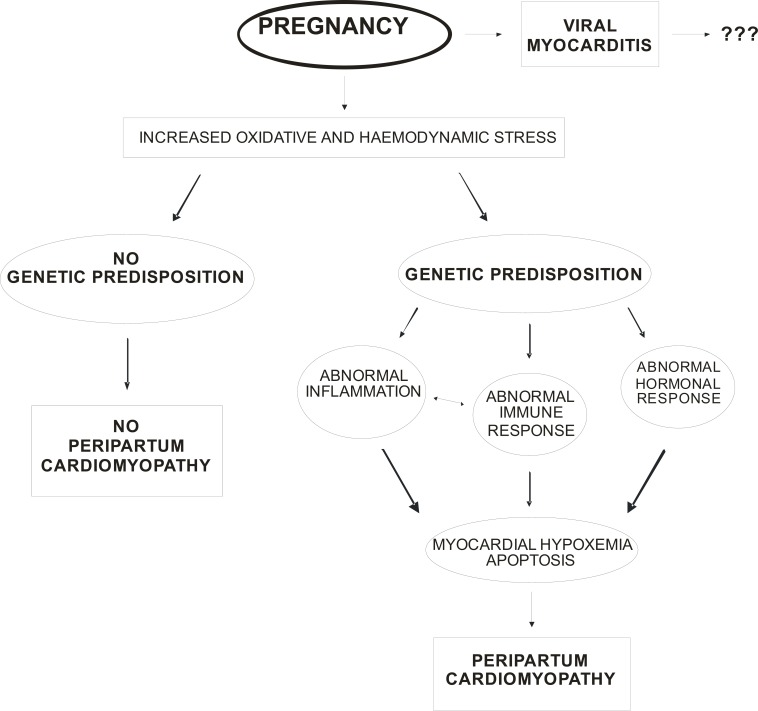
Peripartum cardiomyopathy (PCM) is a relatively rare disease with potentially devasting consequences requiring prompt identification and correct treatment. Overall prognosis is good in majority of the cases, although some patients may progress to irreversible heart failure. Early diagnosis is important and effective treatment reduces mortality rates and increases the chance of complete recovery of ventricular systolic function. The aetiology and pathogenesis seems to be multifactorial and poorly understood, with the available literature rather conflicting. In recent years, there has been increased interest in the role played by genetic predisposition in the development of PCM. It probably develops as a result of a complex interaction of pregnancy-associated factors and genetic factors and recently there have been many observations pointing out the central role played by a genetic predisposition. The direct and indirect observations on genetic susceptibility may offer new insights into the pathogenesis of PCM. However, larger studies are needed before advising routine genetic testing in these patients.
围产期心肌病(PCM)是一种相对罕见的疾病,可能产生严重后果,需要及时识别和正确治疗。尽管有些患者可能会发展为不可逆的心力衰竭,但大多数病例的总体预后良好。早期诊断很重要,有效的治疗可降低死亡率,并增加心室收缩功能完全恢复的机会。病因和发病机制似乎是多因素的,且了解甚少,现有文献相当矛盾。近年来,人们对遗传易感性在PCM发生发展中所起的作用越来越感兴趣。它可能是妊娠相关因素和遗传因素复杂相互作用的结果,最近有许多观察结果指出遗传易感性起着核心作用。关于遗传易感性的直接和间接观察可能为PCM的发病机制提供新的见解。然而,在建议对这些患者进行常规基因检测之前,还需要进行更大规模的研究。