Department of Chemistry and Institute of Nuclear Medicine, UCL, London, United Kingdom.
Bioorg Med Chem Lett. 2013 Sep 15;23(18):5170-3. doi: 10.1016/j.bmcl.2013.07.014. Epub 2013 Jul 18.
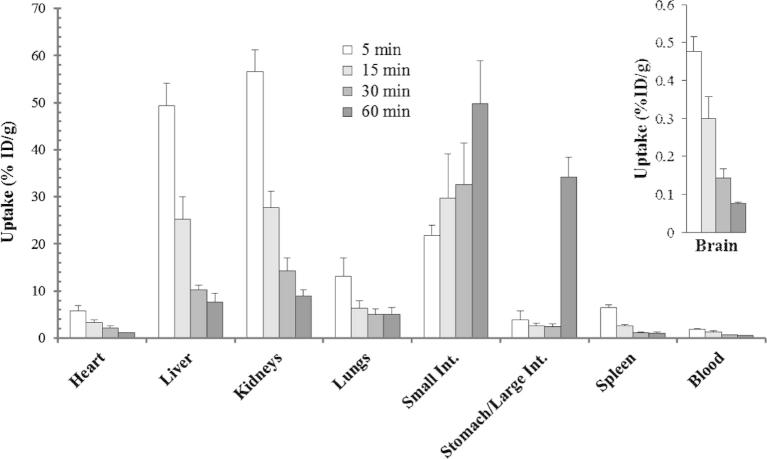
In vivo imaging of voltage-gated sodium channels (VGSCs) can potentially provide insights into the activation of neuronal pathways and aid the diagnosis of a number of neurological diseases. The iminodihydroquinoline WIN17317-3 is one of the most potent sodium channel blockers reported to date and binds with high affinity to VGSCs throughout the rat brain. We have synthesized a (125)I-labeled analogue of WIN17317-3 and evaluated the potential of the tracer for imaging of VGSCs with SPECT. Automated patch clamp studies with CHO cells expressing the Nav1.2 isoform and displacement studies with [(3)H]BTX yielded comparable results for the non-radioactive iodinated iminodihydroquinoline and WIN17317-3. However, the (125)I-labeled tracer was rapidly metabolized in vivo, and suffered from low brain uptake and high accumulation of radioactivity in the intestines. The results suggest that iminodihydroquinolines are poorly suited for tracer development.
在体成像电压门控钠离子通道(VGSCs)可以提供对神经元通路激活的深入了解,并有助于诊断多种神经疾病。亚氨基二氢喹啉 WIN17317-3 是迄今为止报道的最有效的钠离子通道阻滞剂之一,它与大鼠脑中的 VGSCs 具有高亲和力结合。我们已经合成了 WIN17317-3 的(125)I 标记类似物,并评估了该示踪剂用于 SPECT 成像 VGSCs 的潜力。用表达 Nav1.2 同工型的 CHO 细胞进行自动贴片钳研究和用[(3)H]BTX 进行置换研究,对于非放射性碘化亚氨基二氢喹啉和 WIN17317-3 得出了可比的结果。然而,(125)I 标记的示踪剂在体内迅速代谢,并遭受脑摄取率低和放射性在肠道中积累高的问题。结果表明,亚氨基二氢喹啉不适于作为示踪剂开发。