Wakatsuki Masaru, Ohno Tatsuya, Kato Shingo, Ando Ken, Noda Shin-Ei, Kiyohara Hiroki, Shibuya Kei, Karasawa Kumiko, Kamada Tadashi, Nakano Takashi
Research Center for Charged Particle Therapy, National Institute of Radiological Sciences, 4-9-1 Anagawa, Inage-ku, Chiba 263-8555, Japan.
J Radiat Res. 2014 Jan 1;55(1):139-45. doi: 10.1093/jrr/rrt097. Epub 2013 Aug 2.
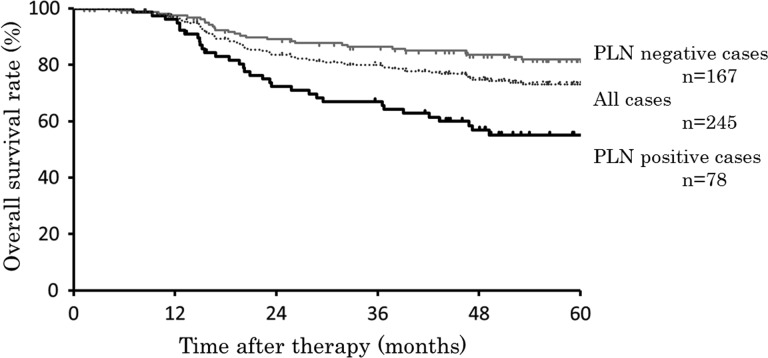
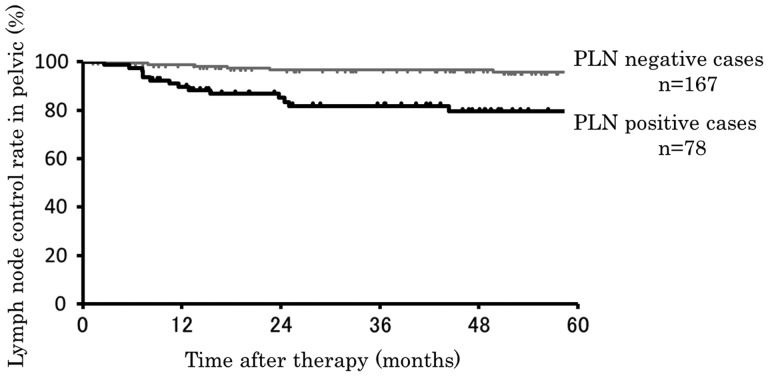
Radiation therapy (RT) for metastatic pelvic lymph nodes (PLNs) is not well established in cervical cancer. In this study the correlation between size of lymph nodes and control doses of RT was analyzed. Between January 2002 and December 2007, 245 patients with squamous cell carcinoma of the cervix treated with a combination of external beam irradiation with or without boost irradiation and high-dose rate brachytherapy were investigated. Size of lymph node was measured by computed tomography before RT and just after 50 Gy RT. Of the 245 patients, 78 had PLN metastases, and a total of 129 had enlarged PLNs diagnosed as metastases; 22 patients had PLN failure. The PLN control rate at 5 years was 79.5% for positive cases and 95.8% for negative cases. In cases with positive PLNs, 12 of 129 nodes (9.3%) developed recurrences. There was significant correlation between PLN control rate and size of PLN after 50 Gy (<10 mm: 96.7%, ≥ 10 mm: 75.7 % (P<0.001)). In addition, the recurrence in these poor-response nodes was significantly correlated with dose of RT. Nine of 16 nodes receiving ≤ 58 Gy had recurrence, but none of 21 nodes receiving > 58 Gy had recurrence (P = 0.0003). These results suggested that the response of lymph nodes after RT was a more significant predictive factor for recurrence than size of lymph node before RT, and poor-response lymph nodes might require boost irradiation at a total dose of > 58 Gy.
转移性盆腔淋巴结(PLN)的放射治疗(RT)在宫颈癌治疗中尚未得到充分确立。本研究分析了淋巴结大小与RT控制剂量之间的相关性。在2002年1月至2007年12月期间,对245例接受外照射联合或不联合增敏照射及高剂量率近距离放疗的宫颈鳞状细胞癌患者进行了研究。在RT前及50 Gy RT后即刻通过计算机断层扫描测量淋巴结大小。245例患者中,78例有PLN转移,共129例有被诊断为转移的肿大PLN;22例患者出现PLN失败。阳性病例的5年PLN控制率为79.5%,阴性病例为95.8%。在PLN阳性的病例中,129个淋巴结中有12个(9.3%)出现复发。50 Gy后PLN控制率与PLN大小之间存在显著相关性(<10 mm:96.7%,≥10 mm:75.7%(P<0.001))。此外,这些反应较差的淋巴结中的复发与RT剂量显著相关。接受≤58 Gy的16个淋巴结中有9个复发,但接受>58 Gy的21个淋巴结中无一复发(P = 0.0003)。这些结果表明,RT后淋巴结的反应比RT前淋巴结大小是更重要的复发预测因素,反应较差的淋巴结可能需要总剂量>58 Gy的增敏照射。