Cappellani Alessandro, Piccolo Gaetano, Cardì Francesco, Cavallaro Andrea, Lo Menzo Emanuele, Cavallaro Vincenzo, Zanghì Antonio, Di Vita Maria, Berretta Massimiliano
World J Surg Oncol. 2013 Aug 5;11:172. doi: 10.1186/1477-7819-11-172.
Gastrointestinal stromal tumors (GISTs) represent 85% of all mesenchymal neoplasms that affect the gastrointestinal (GI) tract. These GISTs range in size from small lesions to large masses. Often they are clinically silent until they reach a significant size, so their discovery is usually incidental.
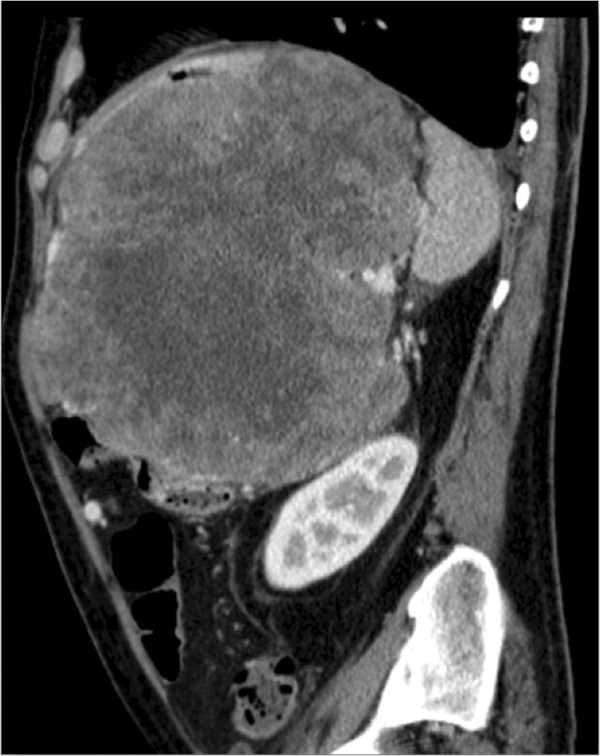
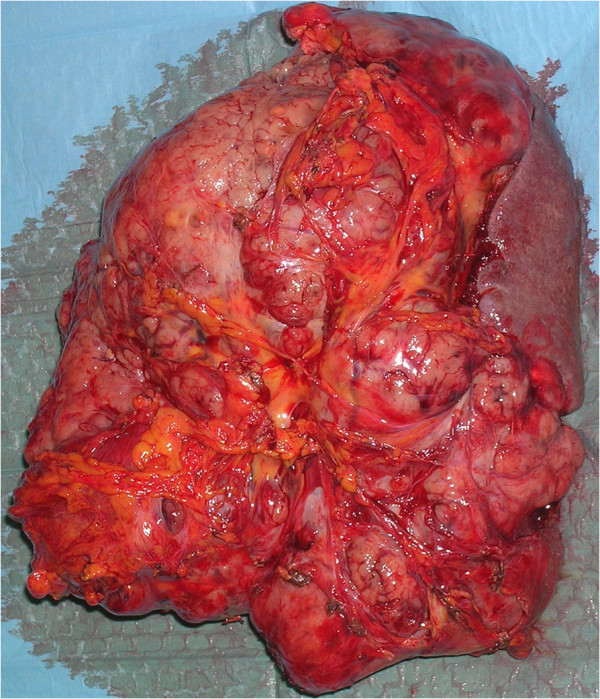
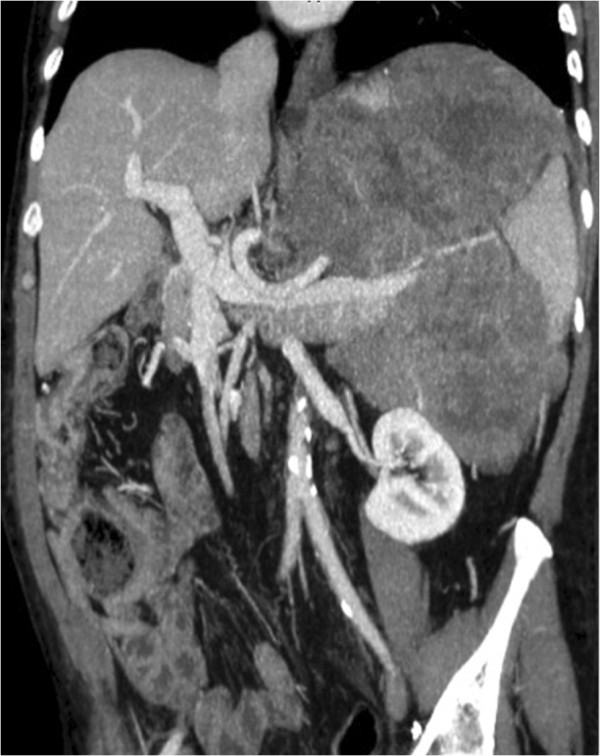
A 67-year-old man was admitted at our general surgery department with a persistent abdominal pain in the left hypochondrium, associated with nausea and vomiting. Clinical examination revealed a palpable mass in the epigastrium and in the left hypochondrium, which was approximately 40 cm long. Ultrasonography and computed tomography of the abdomen showed a large mass of 40 × 25 cm, which extended from the posterior wall of the stomach to the spleen, involving the body and the tail of the pancreas. The patient underwent en-block resection of the mass, sleeve resection of the stomach, and distal pancreatectomy-splenectomy. The histopathology of the resected specimen was consistent with a gastrointestinal stromal tumor of the stomach (positive for CD 117) with a high risk of malignancy (mitotic count >5/50 high-power fieldand Ki67/Mib1 >10%). The postoperative course was uneventful and treatment with imatinib mesylate began immediately. The patient appears to be disease free after four years.
Giant GISTs of the stomach are rare. Surgical resection with curative intent is feasible. The combination of surgical resection and imatinib can provide long-termdisease-free survival. An R0 resection is the best achievable treatment, therefore the patient should be evaluated over time for potential resectability.
胃肠道间质瘤(GISTs)占所有影响胃肠道(GI)的间质性肿瘤的85%。这些GISTs大小不一,从小病灶到巨大肿块。它们通常在临床上没有症状,直到长得很大才被发现,所以其发现往往是偶然的。
一名67岁男性因左季肋部持续性腹痛伴恶心、呕吐入住我院普通外科。临床检查发现上腹部和左季肋部可触及一肿块,长约40厘米。腹部超声和计算机断层扫描显示一个40×25厘米的巨大肿块,从胃后壁延伸至脾脏,累及胰腺体部和尾部。患者接受了肿块整块切除、胃袖状切除以及远端胰腺切除-脾切除术。切除标本的组织病理学检查结果与胃胃肠道间质瘤一致(CD 117阳性),具有高恶性风险(有丝分裂计数>5/50高倍视野且Ki67/Mib1>10%)。术后病程顺利,立即开始使用甲磺酸伊马替尼治疗。四年后患者似乎无疾病迹象。
胃巨大GISTs罕见。以治愈为目的的手术切除是可行的。手术切除与伊马替尼联合应用可实现长期无病生存。R0切除是可达到的最佳治疗方式,因此应定期评估患者是否有潜在的可切除性。