Department of Biological Science, Florida State University, Tallahassee, FL 32306-4295, USA.
BMC Genomics. 2013 Aug 2;14:531. doi: 10.1186/1471-2164-14-531.
Snake venom is shaped by the ecology and evolution of venomous species, and signals of positive selection in toxins have been consistently documented, reflecting the role of venoms as an ecologically critical phenotype. New World coral snakes (Elapidae) are represented by three genera and over 120 species and subspecies that are capable of causing significant human morbidity and mortality, yet coral-snake venom composition is poorly understood in comparison to that of Old World elapids. High-throughput sequencing is capable of identifying thousands of loci, while providing characterizations of expression patterns and the molecular evolutionary forces acting within the venom gland.
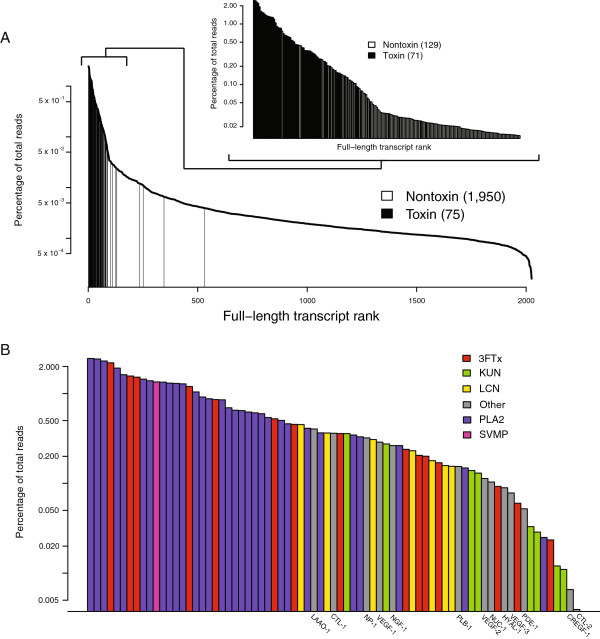
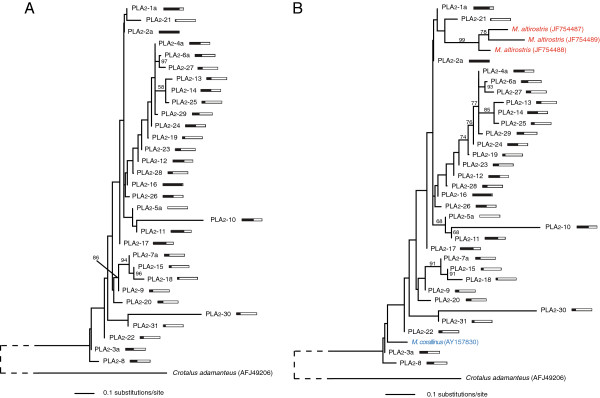
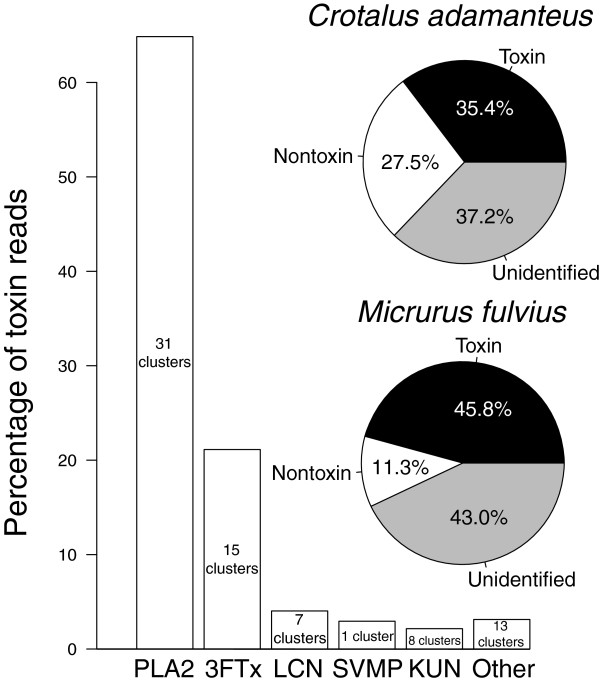
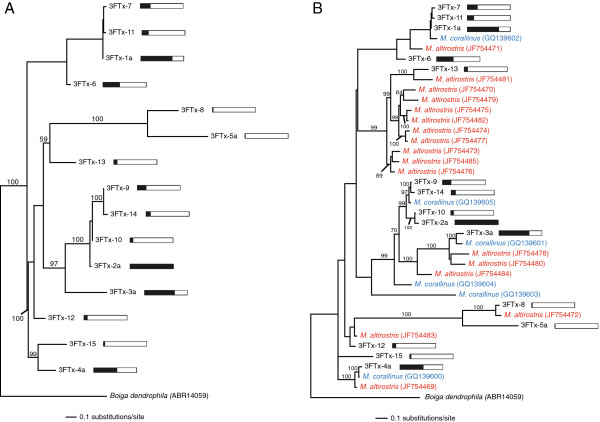
We describe the de novo assembly and analysis of the venom-gland transcriptome of the eastern coral snake (Micrurus fulvius). We identified 1,950 nontoxin transcripts and 116 toxin transcripts. These transcripts accounted for 57.1% of the total reads, with toxins accounting for 45.8% of the total reads. Phospholipases A(2) and three-finger toxins dominated expression, accounting for 86.0% of the toxin reads. A total of 15 toxin families were identified, revealing venom complexity previously unknown from New World coral snakes. Toxins exhibited high levels of heterozygosity relative to nontoxins, and overdominance may favor gene duplication leading to the fixation of advantageous alleles. Phospholipase A(2) expression was uniformly distributed throughout the class while three-finger toxin expression was dominated by a handful of transcripts, and phylogenetic analyses indicate that toxin divergence may have occurred following speciation. Positive selection was detected in three of the four most diverse toxin classes, suggesting that venom diversification is driven by recurrent directional selection.
We describe the most complete characterization of an elapid venom gland to date. Toxin gene duplication may be driven by heterozygote advantage, as the frequency of polymorphic toxin loci was significantly higher than that of nontoxins. Diversification among toxins appeared to follow speciation reflecting species-specific adaptation, and this divergence may be directly related to dietary shifts and is suggestive of a coevolutionary arms race.
蛇毒是由有毒物种的生态和进化形成的,毒素中正向选择的信号一直被记录下来,反映了毒液作为一种具有生态关键性表型的作用。新世界珊瑚蛇(Elapidae)由三个属和 120 多种亚种组成,它们能够对人类造成严重的发病率和死亡率,但与旧世界的眼镜蛇相比,珊瑚蛇毒液的组成还不太了解。高通量测序能够识别数千个基因座,同时提供毒液腺中表达模式和分子进化力量的特征描述。
我们描述了东部珊瑚蛇(Micrurus fulvius)毒液腺转录组的从头组装和分析。我们鉴定了 1950 个非毒素转录本和 116 个毒素转录本。这些转录本占总读取数的 57.1%,毒素占总读取数的 45.8%。磷脂酶 A2 和三指毒素占据主导地位,占毒素读取数的 86.0%。共鉴定出 15 个毒素家族,揭示了以前未知的新世界珊瑚蛇的毒液复杂性。与非毒素相比,毒素表现出高度的杂合性,超显性可能有利于基因复制,从而导致有利等位基因的固定。磷脂酶 A2 的表达在整个类群中均匀分布,而三指毒素的表达则由少数转录本主导,系统发育分析表明,毒素的分化可能是在物种形成之后发生的。在四个最多样化的毒素类群中的三个中检测到正选择,这表明毒液多样化是由反复的定向选择驱动的。
我们描述了迄今为止最完整的眼镜蛇毒液腺特征。毒素基因的复制可能是由杂合优势驱动的,因为多态性毒素基因座的频率明显高于非毒素基因座。毒素的多样化似乎是在物种形成之后发生的,反映了物种特异性的适应,这种分化可能与饮食的转变直接相关,并暗示了一种共同进化的军备竞赛。