Department of Internal Medicine, Chonnam National University Medical School, 42 Jebong-ro, Gwangju 501-757, Korea.
Yonsei Med J. 2013 Sep;54(5):1194-201. doi: 10.3349/ymj.2013.54.5.1194.
We investigated the effects of proteinuria and renal insufficiency on all-cause mortality in patients with colorectal cancer, with special emphasis on cancer staging and cancer-related deaths.
We retrospectively studied a cohort of patients with colorectal cancer. In protocol 1, patients were classified into four groups based on the operability of cancer and proteinuria: group 1, early-stage cancer patients (colorectal cancer stage ≤ 3) without proteinuria; group 2, early-stage cancer patients with proteinuria; group 3, advanced-stage cancer patients without proteinuria (colorectal cancer stage=4); and group 4, advanced- stage cancer patients with proteinuria. In protocol 2, patients were classified into four similar groups based on cancer staging and renal insufficiency (eGFR <60 mL/min/1.73 m(2)). Between January 1, 1998 and December 31, 2009, 3379 patients were enrolled in this cohort and followed until May 1, 2012 or until death.
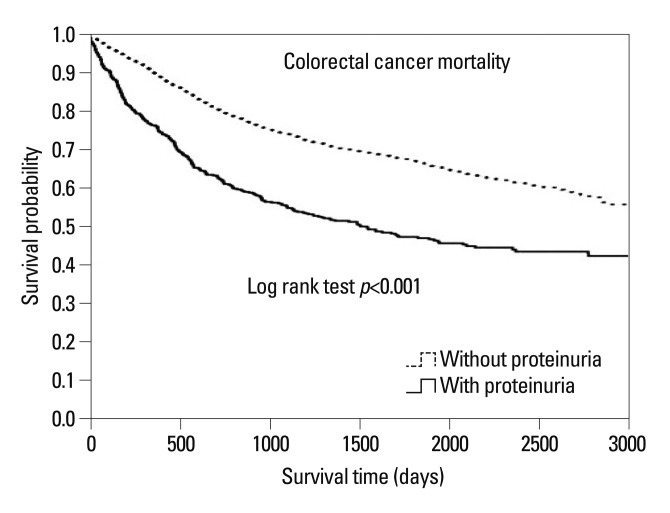
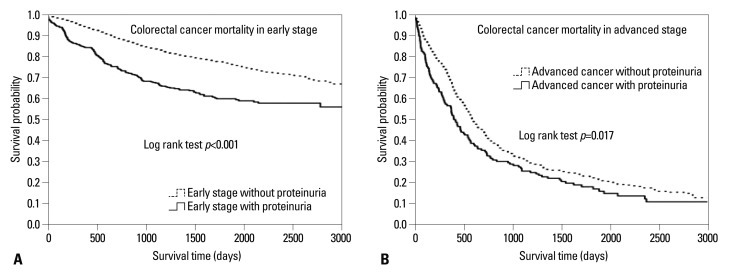
The number of patients with proteinuria was 495 (14.6%). The prevalence of proteinuria was higher in advanced-stage cancer (n=151, 22.3%) than in early-stage cancer patients (n=344, 12.7%). After adjusting for age, gender and other clinical variables, the proteinuric, early-stage cancer group was shown to be associated with an adjusted hazard ratio of 1.67 and a 95% confidence interval of 1.38-2.01, compared with non-proteinuric early-stage cancer patients. However, renal insufficiency was not associated with colorectal cancer mortality.
Proteinuria is an important risk factor for cancer mortality, especially in relatively early colorectal cancer.
本研究旨在探讨蛋白尿和肾功能不全对结直肠癌患者全因死亡率的影响,尤其关注癌症分期和与癌症相关的死亡。
本研究回顾性分析了一组结直肠癌患者的数据。在方案 1 中,根据癌症的可操作性和蛋白尿情况将患者分为四组:组 1,无蛋白尿的早期癌症患者(结直肠癌分期≤3);组 2,有蛋白尿的早期癌症患者;组 3,无蛋白尿的晚期癌症患者(结直肠癌分期=4);组 4,有蛋白尿的晚期癌症患者。在方案 2 中,根据癌症分期和肾功能不全(eGFR<60 mL/min/1.73 m²)将患者分为四组。1998 年 1 月 1 日至 2009 年 12 月 31 日期间,共有 3379 例患者纳入该队列并随访至 2012 年 5 月 1 日或死亡。
蛋白尿患者 495 例(14.6%)。晚期癌症患者中蛋白尿的发生率(n=151,22.3%)高于早期癌症患者(n=344,12.7%)。在校正年龄、性别和其他临床变量后,与无蛋白尿的早期癌症患者相比,有蛋白尿的早期癌症患者的调整后危险比为 1.67,95%置信区间为 1.38-2.01。然而,肾功能不全与结直肠癌死亡率无关。
蛋白尿是癌症死亡的一个重要危险因素,尤其在相对较早的结直肠癌中。