Ecology and Evolutionary Biology, University of Colorado Ramaley N122, Boulder, Colorado, 80309-0334.
Ecol Evol. 2013 Jul;3(7):2310-21. doi: 10.1002/ece3.635. Epub 2013 Jun 11.
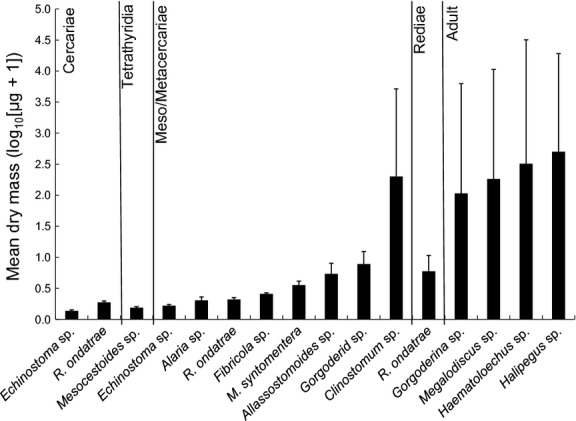
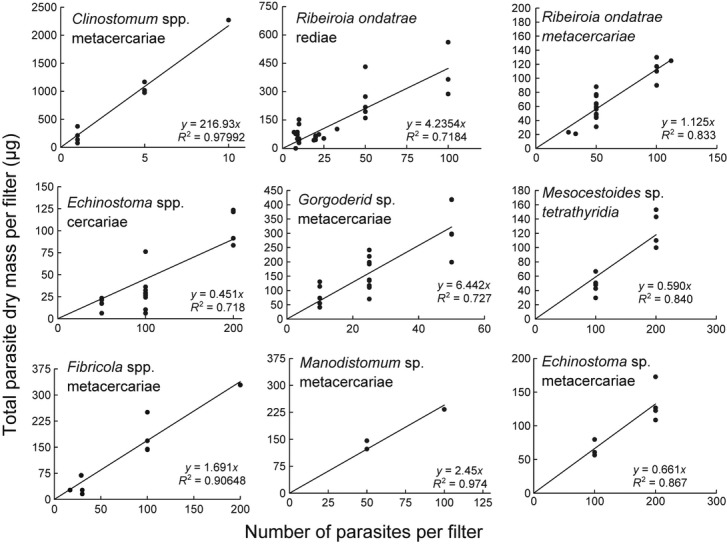
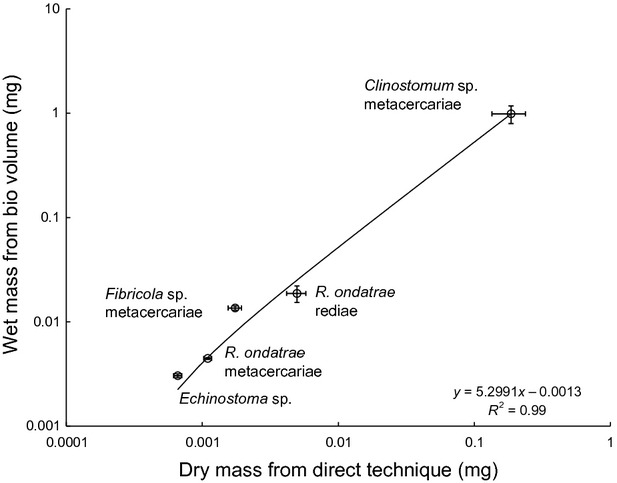
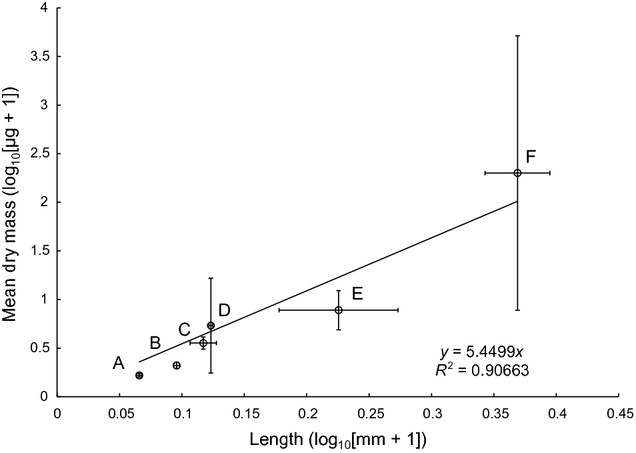
By infecting multiple host species and acting as a food resource, parasites can affect food web topography and contribute to ecosystem energy transfer. Owing to the remarkable secondary production of some taxa, parasite biomass - although cryptic - can be comparable to other invertebrate and vertebrate groups. More resolved estimates of parasite biomass are therefore needed to understand parasite interactions, their consequences for host fitness, and potential influences on ecosystem energetics. We developed an approach to quantify the masses of helminth parasites and compared our results with those of biovolume-based approaches. Specifically, we massed larval and adult parasites representing 13 species and five life stages of trematodes and cestodes from snail and amphibian hosts. We used a replicated regression approach to quantify dry mass and compared these values with indirect biovolume estimates to test the validity of density assumptions. Our technique provided precise estimates (R (2) from 0.69 to 0.98) of biomass across a wide range of parasite morphotypes and sizes. Individual parasites ranged in mass from 0.368 ± 0.041 to 320 ± 98.1 μg. Among trematodes, adult parasites tended to be the largest followed by rediae, with nonclonal larval stages (metacercariae and cercariae) as the smallest. Among similar morphotypes, direct estimates of dry mass and the traditional biovolume technique provided generally comparable estimates (although important exceptions also emerged). Finally, we present generalized length-mass regression equations to calculate trematode mass from length measurements, and discuss the most efficient use of limited numbers of parasites. By providing a novel method of directly estimating parasite biomass while also helping to validate more traditional methods involving length-mass conversion, our findings aim to facilitate future investigations into the ecological significance of parasites, particularly with respect to ecosystem energetics. In addition, this novel technique can be applied to a wide range of difficult-to-mass organisms.
通过感染多种宿主物种并作为食物资源,寄生虫可以影响食物网结构,并有助于生态系统能量传递。由于某些类群的次生生产力显著,寄生虫生物量虽然是隐蔽的,但可以与其他无脊椎动物和脊椎动物群体相媲美。因此,需要更准确的寄生虫生物量估计值来了解寄生虫相互作用、它们对宿主适应性的影响以及对生态系统能量学的潜在影响。我们开发了一种量化寄生虫质量的方法,并将我们的结果与基于生物量的方法进行了比较。具体来说,我们对代表 13 种物种和 5 种吸虫和绦虫生活阶段的幼虫和成虫寄生虫进行了量化,这些寄生虫来自蜗牛和两栖宿主。我们使用重复回归方法来量化干质量,并将这些值与间接生物量估计值进行比较,以检验密度假设的有效性。我们的技术为广泛的寄生虫形态和大小提供了精确的估计值(R 2 值从 0.69 到 0.98)。个体寄生虫的质量范围从 0.368 ± 0.041 到 320 ± 98.1 μg。在吸虫中,成虫寄生虫往往最大,其次是裂殖体,非克隆幼虫阶段(尾蚴和囊蚴)最小。在相似的形态类型中,直接估计干质量和传统的生物量技术通常提供可比的估计值(尽管也出现了重要的例外)。最后,我们提出了通用的长度-质量回归方程,以从长度测量值计算吸虫的质量,并讨论了最有效地利用有限数量的寄生虫的方法。通过提供一种直接估计寄生虫生物量的新方法,同时帮助验证涉及长度-质量转换的更传统方法,我们的研究结果旨在促进未来对寄生虫生态意义的研究,特别是在生态系统能量学方面。此外,这种新技术可以应用于广泛的难以测量的生物体。