Department of Biology, University of Florida, Gainesville, Florida, United States of America.
PLoS Biol. 2009 Sep;7(9):e1000210. doi: 10.1371/journal.pbio.1000210. Epub 2009 Sep 29.
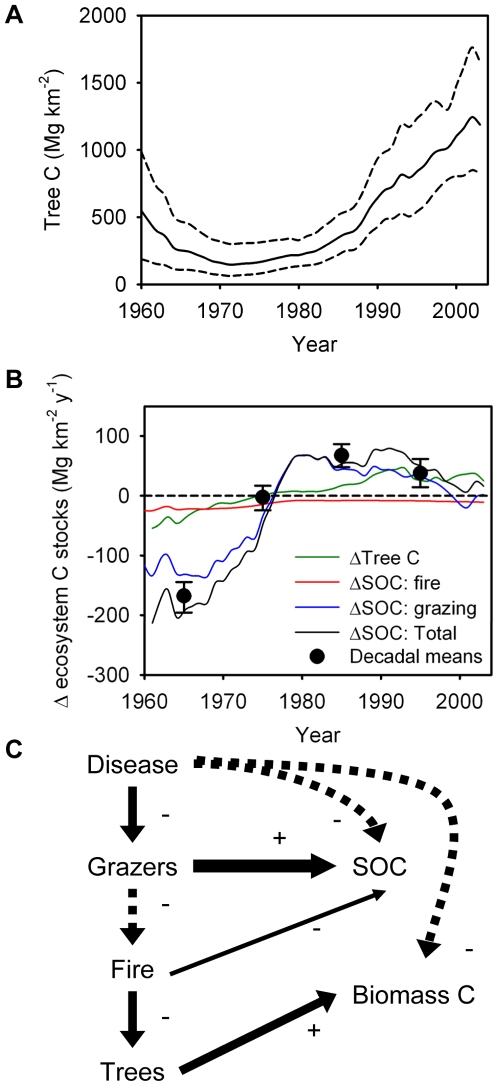
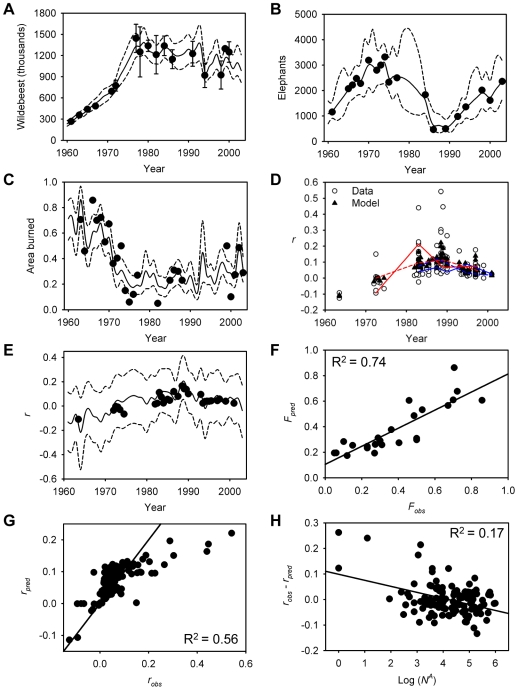
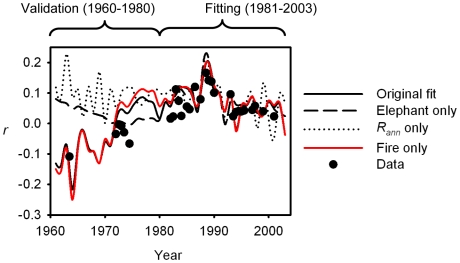
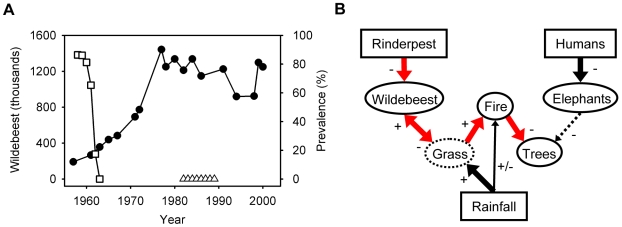
Tree cover is a fundamental structural characteristic and driver of ecosystem processes in terrestrial ecosystems, and trees are a major global carbon (C) sink. Fire and herbivores have been hypothesized to play dominant roles in regulating trees in African savannas, but the evidence for this is conflicting. Moving up a trophic scale, the factors that regulate fire occurrence and herbivores, such as disease and predation, are poorly understood for any given ecosystem. We used a Bayesian state-space model to show that the wildebeest population eruption that followed disease (rinderpest) eradication in the Serengeti ecosystem of East Africa led to a widespread reduction in the extent of fire and an ongoing recovery of the tree population. This supports the hypothesis that disease has played a key role in the regulation of this ecosystem. We then link our state-space model with theoretical and empirical results quantifying the effects of grazing and fire on soil carbon to predict that this cascade may have led to important shifts in the size of pools of C stored in soil and biomass. Our results suggest that the dynamics of herbivores and fire are tightly coupled at landscape scales, that fire exerts clear top-down effects on tree density, and that disease outbreaks in dominant herbivores can lead to complex trophic cascades in savanna ecosystems. We propose that the long-term status of the Serengeti and other intensely grazed savannas as sources or sinks for C may be fundamentally linked to the control of disease outbreaks and poaching.
树木覆盖是陆地生态系统结构特征和生态系统过程的基本驱动因素,树木也是全球主要的碳(C)汇。火和食草动物被假设在调控非洲热带稀树草原的树木方面发挥主导作用,但这方面的证据存在矛盾。再往上一个营养级,调控火灾发生和食草动物的因素,如疾病和捕食,对于任何给定的生态系统来说,都知之甚少。我们使用贝叶斯状态空间模型表明,在东非塞伦盖蒂生态系统中,疾病(牛瘟)根除后,角马种群爆发,导致火灾范围广泛减少,树木种群持续恢复。这支持了疾病在调节这个生态系统方面发挥了关键作用的假设。然后,我们将我们的状态空间模型与量化放牧和火灾对土壤碳影响的理论和经验结果联系起来,预测这种级联可能导致储存在土壤和生物量中的碳库大小发生重要变化。我们的研究结果表明,在景观尺度上,食草动物和火的动态是紧密耦合的,火对树木密度有明显的自上而下的影响,而主要食草动物的疾病爆发可能导致热带稀树草原生态系统中复杂的营养级联。我们提出,塞伦盖蒂和其他高强度放牧的热带稀树草原作为碳源或汇的长期状况可能与疾病爆发和偷猎的控制密切相关。