Department of Biomedical Sciences, Ontario Veterinary College, University of Guelph, Guelph, ON N1G2W1, Canada.
BMC Cancer. 2013 Aug 7;13:375. doi: 10.1186/1471-2407-13-375.
Akt is a serine/threonine kinase that mediates signaling downstream of tyrosine kinase receptors like the type I insulin-like growth factor receptor (IGF-IR). In fact, we have previously shown that mammary tumors induced by elevated expression of the IGF-IR are associated with hyperactivation of Akt. However, there are three mammalian isoforms of Akt (Akt1, Akt2 and Akt3) and these isoforms regulate distinct physiologic properties within cells. In this manuscript, the impact of disrupting Akt1 or Akt2 in mammary tumors induced by IGF-IR overexpression were examined to determine whether specific Akt isoforms regulate different aspects of mammary tumorigenesis.
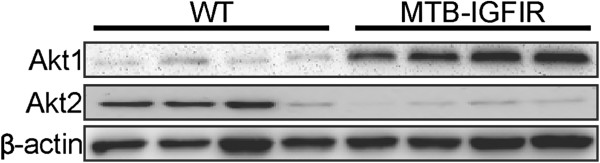
Akt1 and Akt2 levels were stably ablated in mammary tumors of MTB-IGFIR transgenic mice by crossing MTB-IGFIR transgenic mice with either Akt1(-/-) or Akt2(-/-) mice. Tumor onset, growth rate, and metastasis were determined.
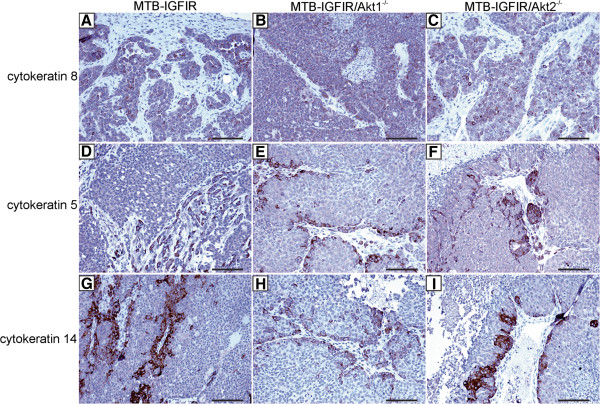
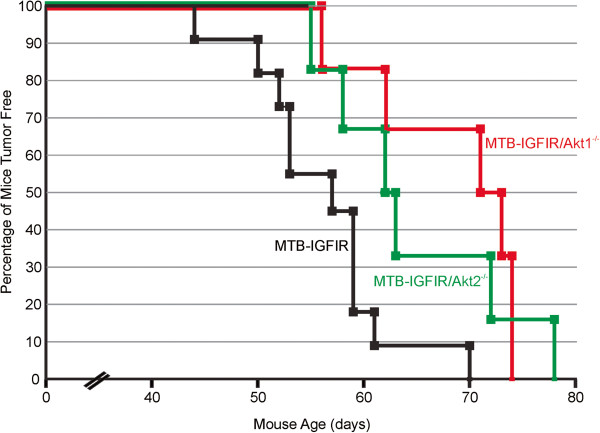
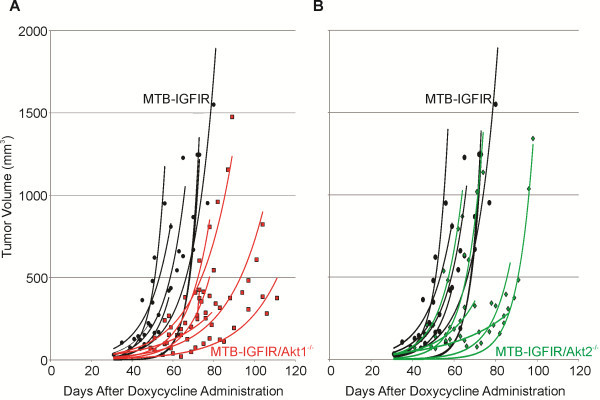
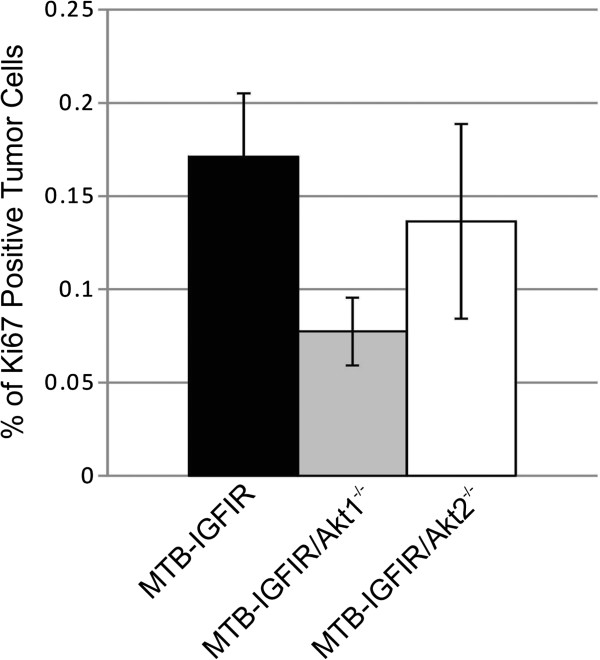
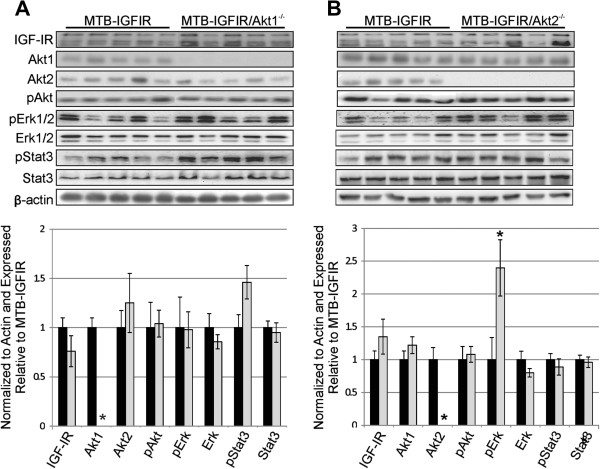
Ablation of Akt1 or Akt2 significantly delayed tumor onset and tumor growth rate but did not significantly alter lung metastasis. Despite the absence of Akt1 or Akt2, mammary tumors that developed in the MTB-IGFIR mice maintained detectable levels of phosphorylated Akt. Disruption of Akt1 or Akt2 did not affect cell morphology or the expression of luminal or basal cytokeratins in mammary tumors.
Although loss of Akt1 or Akt2 significantly inhibited mammary tumor onset and growth rates the effects were less dramatic than anticipated. Despite the complete loss of Akt1 or Akt2, the level of total phosphorylated Akt remained largely unaffected in the mammary tumors suggesting that loss of one Akt isoform is compensated by enhanced activation of the remaining Akt isoforms. These findings indicate that therapeutic strategies targeting the activation of individual Akt isoforms will prove less effective than simultaneously inhibiting the activity of all three Akt isoforms for the treatment of breast cancer.
Akt 是一种丝氨酸/苏氨酸激酶,可介导酪氨酸激酶受体(如 I 型胰岛素样生长因子受体(IGF-IR))下游的信号转导。事实上,我们之前已经表明,由 IGF-IR 表达升高诱导的乳腺肿瘤与 Akt 的过度激活有关。然而,Akt 有三种哺乳动物同工型(Akt1、Akt2 和 Akt3),这些同工型调节细胞内不同的生理特性。在本手稿中,检查了破坏 IGF-IR 过表达诱导的乳腺肿瘤中的 Akt1 或 Akt2 对确定特定 Akt 同工型是否调节不同方面的乳腺肿瘤发生的影响。
通过将 MTB-IGFIR 转基因小鼠与 Akt1(-/-)或 Akt2(-/-)小鼠杂交,稳定敲除 MTB-IGFIR 转基因小鼠乳腺肿瘤中的 Akt1 和 Akt2。确定肿瘤的发病、生长速度和转移。
Akt1 或 Akt2 的缺失显着延迟了肿瘤的发生和肿瘤生长速度,但对肺转移没有显着影响。尽管缺乏 Akt1 或 Akt2,在 MTB-IGFIR 小鼠中发展的乳腺肿瘤仍保持可检测水平的磷酸化 Akt。Akt1 或 Akt2 的破坏不影响乳腺肿瘤的细胞形态或腔细胞或基底细胞角蛋白的表达。
尽管 Akt1 或 Akt2 的缺失显着抑制了乳腺肿瘤的发生和生长速度,但效果不如预期的那么明显。尽管完全缺乏 Akt1 或 Akt2,但在乳腺肿瘤中总磷酸化 Akt 的水平基本保持不变,这表明一种 Akt 同工型的缺失通过剩余 Akt 同工型的增强激活得到补偿。这些发现表明,针对单个 Akt 同工型的激活的治疗策略将不如同时抑制所有三种 Akt 同工型的活性治疗乳腺癌有效。