Lipid Research Laboratory, VA Medical Center, Washington, DC 98100, USA.
Department of Biochemistry and Molecular Medicine, The George Washington University Medical Center, Washington, DC 20037, USA.
Cells. 2019 Oct 29;8(11):1337. doi: 10.3390/cells8111337.
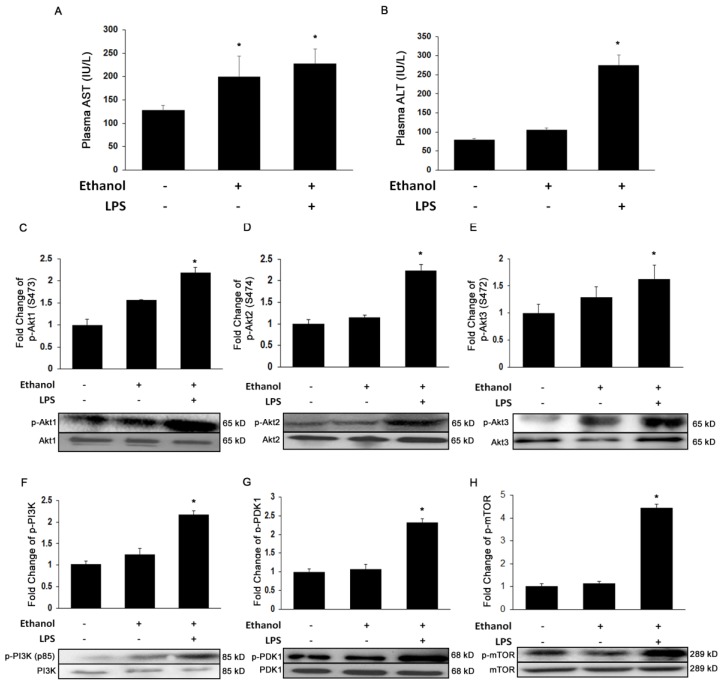
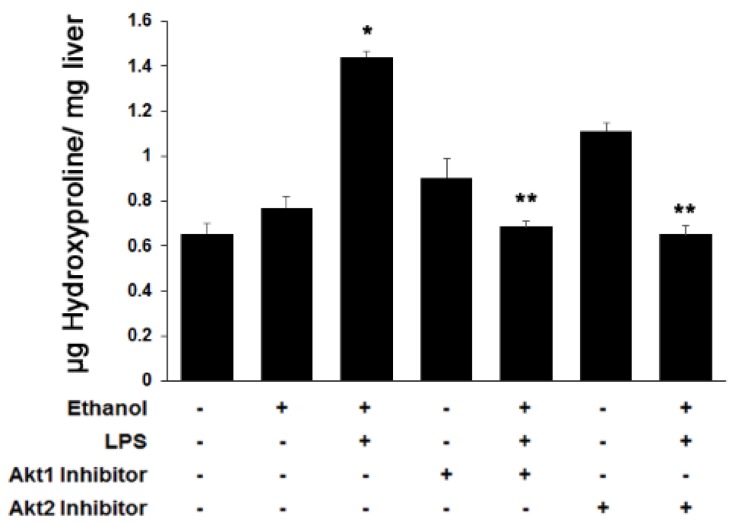
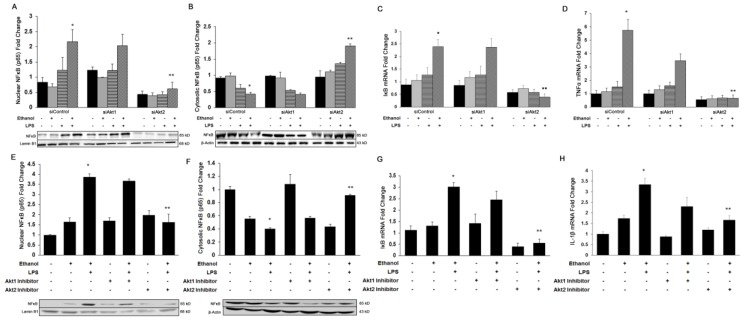
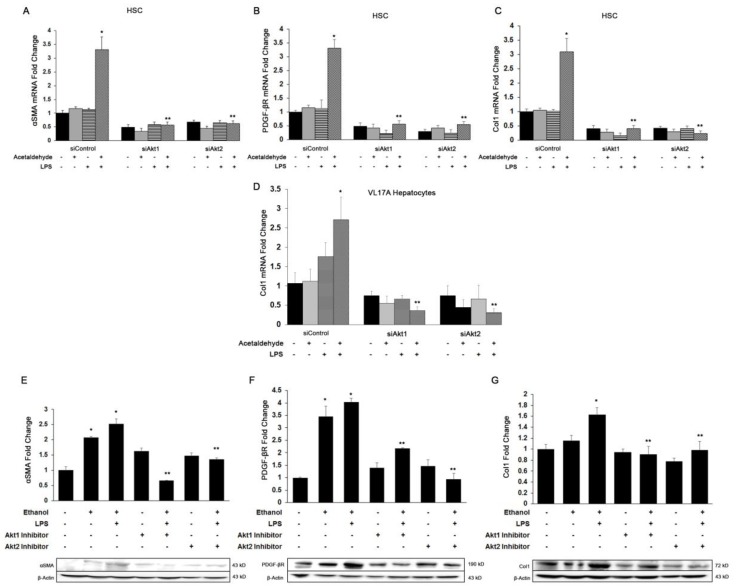
Akt kinase isoforms (Akt1, Akt2, and Akt3) have generally been thought to play overlapping roles in phosphoinositide 3-kinase (PI3K)-mediated-signaling. However, recent studies have suggested that they display isoform-specific roles in muscle and fat. To determine whether such isoform-specificity is observed with respect to alcoholic liver disease (ALD) progression, we examined the role of Akt1, Akt2, and Akt3 in hepatic inflammation, and pro-fibrogenic proliferation and migration using Kupffer cells, hepatic stellate cells (HSC), and hepatocytes in an ethanol and lipopolysaccharide (LPS)-induced two-hit model in vitro and in vivo. We determined that siRNA-directed silencing of Akt2, but not Akt1, significantly suppressed cell inflammatory markers in HSC and Kupffer cells. Although both Akt1 and Akt2 inhibited cell proliferation in HSC, only Akt2 inhibited cell migration. Both Akt1 and Akt2, but not Akt3, inhibited fibrogenesis in hepatocytes and HSC. In addition, our in vivo results show that administration of chronic ethanol, binge ethanol and LPS (EBL) in wild-type C57BL/6 mice activated all three Akt isoforms with concomitant increases in activated forms of phosphoinositide dependent kinase-1 (PDK1), mammalian target-of-rapamycin complex 2 (mTORC2), and PI3K, resulting in upregulation in expression of inflammatory, proliferative, and fibrogenic genes. Moreover, pharmacological blocking of Akt2, but not Akt1, inhibited EBL-induced inflammation while blocking of both Akt1 and Akt2 inhibited pro-fibrogenic marker expression and progression of fibrosis. Our findings indicate that Akt isoforms play unique roles in inflammation, cell proliferation, migration, and fibrogenesis during EBL-induced liver injury. Thus, close attention must be paid when targeting all Akt isoforms as a therapeutic intervention.
Akt 激酶同工型(Akt1、Akt2 和 Akt3)通常被认为在磷脂酰肌醇 3-激酶(PI3K)介导的信号中发挥重叠作用。然而,最近的研究表明,它们在肌肉和脂肪中表现出同工型特异性作用。为了确定这种同工型特异性是否与酒精性肝病(ALD)进展有关,我们使用乙醇和脂多糖(LPS)诱导的体外和体内两击模型中的库普弗细胞、肝星状细胞(HSC)和肝细胞,研究了 Akt1、Akt2 和 Akt3 在肝炎症、促纤维生成增殖和迁移中的作用。我们发现,siRNA 介导的 Akt2 沉默而非 Akt1 沉默显著抑制了 HSC 和库普弗细胞中的细胞炎症标志物。虽然 Akt1 和 Akt2 均抑制 HSC 中的细胞增殖,但只有 Akt2 抑制细胞迁移。Akt1 和 Akt2 均抑制肝细胞和 HSC 中的纤维生成,但 Akt3 不抑制。此外,我们的体内结果表明,在野生型 C57BL/6 小鼠中给予慢性乙醇、 binge 乙醇和 LPS(EBL)会激活所有三种 Akt 同工型,同时增加磷酸肌醇依赖性激酶-1(PDK1)、雷帕霉素靶蛋白复合物 2(mTORC2)和 PI3K 的激活形式,导致炎症、增殖和纤维生成基因的表达上调。此外,药理学阻断 Akt2,但不是 Akt1,抑制了 EBL 诱导的炎症,而阻断 Akt1 和 Akt2 抑制了促纤维生成标志物的表达和纤维化的进展。我们的研究结果表明,Akt 同工型在 EBL 诱导的肝损伤过程中炎症、细胞增殖、迁移和纤维生成中发挥独特作用。因此,在作为治疗干预靶向所有 Akt 同工型时,必须密切关注。