Graduate Program in Neuroscience, University of Minnesota, Minneapolis, Minnesota, USA.
PLoS One. 2013 Jun 18;8(6):e68090. doi: 10.1371/journal.pone.0068090. Print 2013.
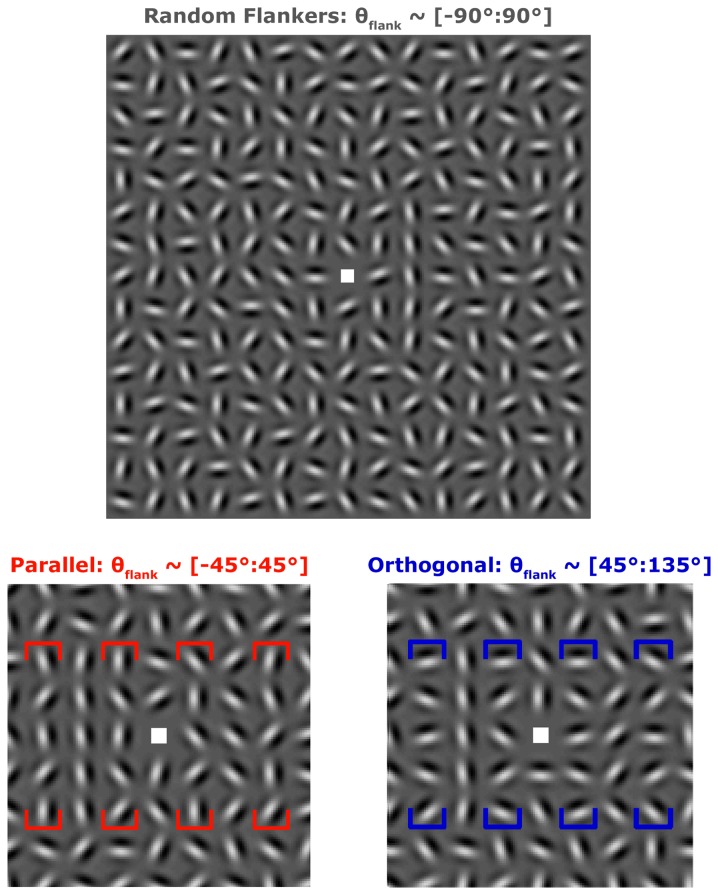
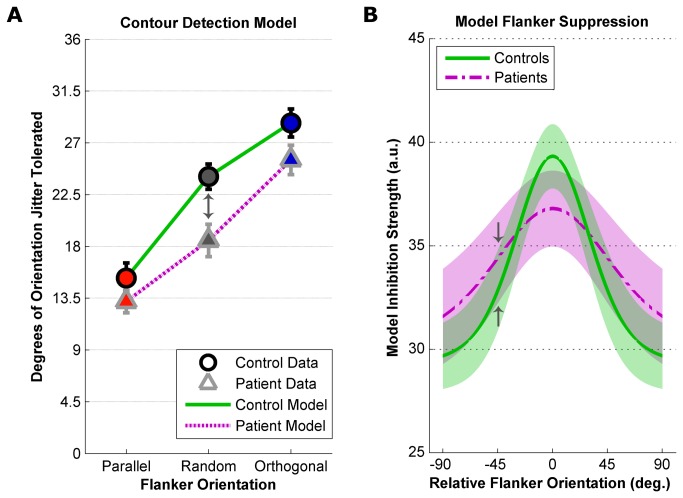
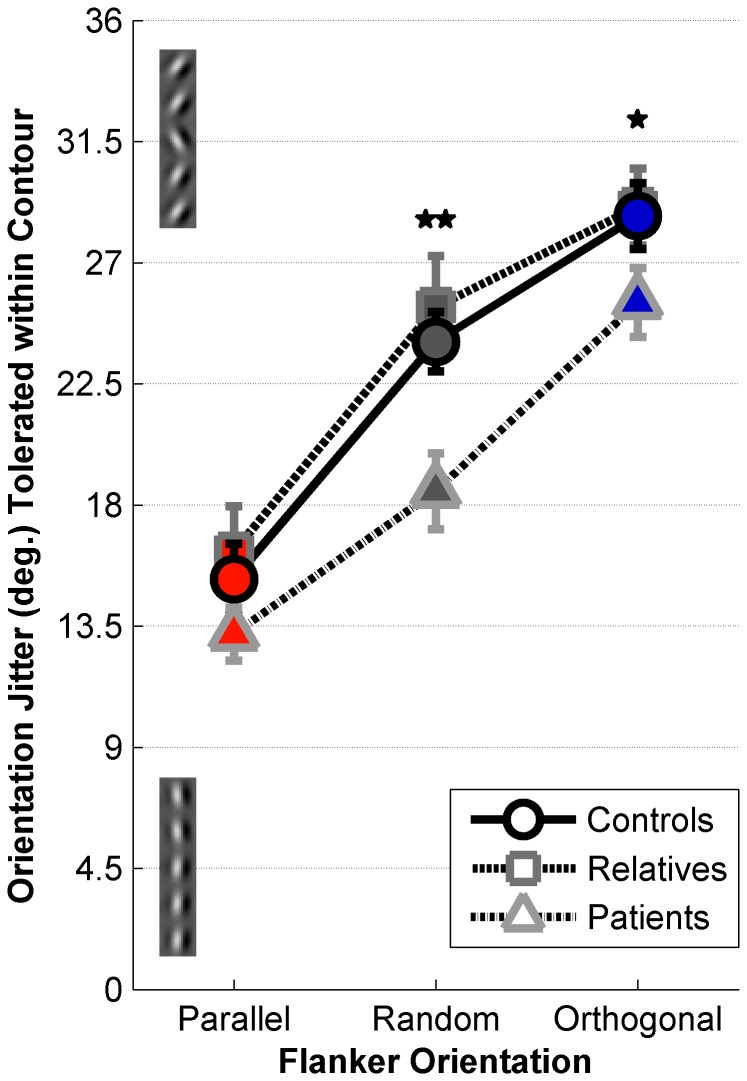
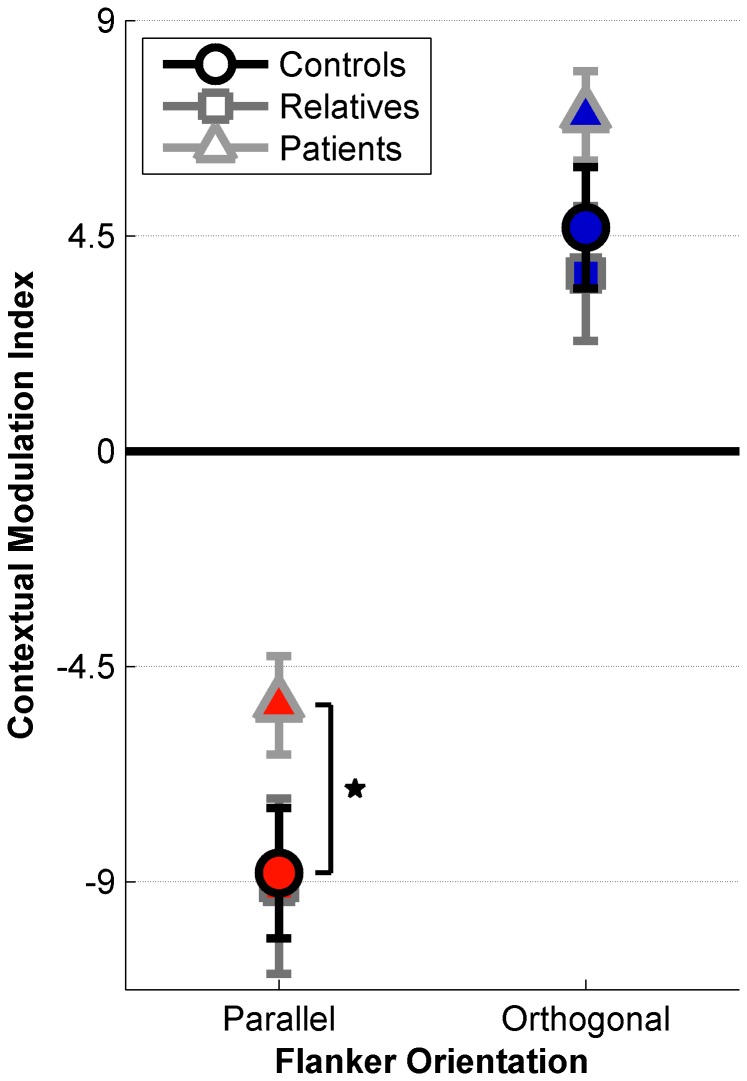
Schizophrenia patients demonstrate perceptual deficits consistent with broad dysfunction in visual context processing. These include poor integration of segments forming visual contours, and reduced visual contrast effects (e.g. weaker orientation-dependent surround suppression, ODSS). Background image context can influence contour perception, as stimuli near the contour affect detection accuracy. Because of ODSS, this contextual modulation depends on the relative orientation between the contour and flanking elements, with parallel flankers impairing contour perception. However in schizophrenia, the impact of abnormal ODSS during contour perception is not clear. It is also unknown whether deficient contour perception marks genetic liability for schizophrenia, or is strictly associated with clinical expression of this disorder. We examined contour detection in 25 adults with schizophrenia, 13 unaffected first-degree biological relatives of schizophrenia patients, and 28 healthy controls. Subjects performed a psychophysics experiment designed to quantify the effect of flanker orientation during contour detection. Overall, patients with schizophrenia showed poorer contour detection performance than relatives or controls. Parallel flankers suppressed and orthogonal flankers enhanced contour detection performance for all groups, but parallel suppression was relatively weaker for schizophrenia patients than healthy controls. Relatives of patients showed equivalent performance with controls. Computational modeling suggested that abnormal contextual modulation in schizophrenia may be explained by suppression that is more broadly tuned for orientation. Abnormal flanker suppression in schizophrenia is consistent with weaker ODSS and/or broader orientation tuning. This work provides the first evidence that such perceptual abnormalities may not be associated with a genetic liability for schizophrenia.
精神分裂症患者表现出与视觉上下文处理广泛功能障碍一致的感知缺陷。这些缺陷包括视觉轮廓形成部分的整合不良,以及视觉对比效应减弱(例如,较弱的方位依赖性环绕抑制,ODSS)。背景图像上下文会影响轮廓感知,因为轮廓附近的刺激会影响检测准确性。由于 ODSS,这种上下文调制取决于轮廓和侧翼元素之间的相对方位,平行的侧翼会损害轮廓感知。然而,在精神分裂症中,轮廓感知期间异常 ODSS 的影响尚不清楚。也不知道缺陷的轮廓感知是否标志着精神分裂症的遗传易感性,或者是否与这种疾病的临床表达严格相关。我们检查了 25 名精神分裂症患者、13 名精神分裂症患者的无影响一级生物学亲属和 28 名健康对照者的轮廓检测。受试者进行了一项旨在量化轮廓检测过程中侧翼方位影响的心理物理学实验。总的来说,精神分裂症患者的轮廓检测表现比亲属或对照组差。对于所有组,平行侧翼抑制和正交侧翼增强轮廓检测性能,但精神分裂症患者的平行抑制相对弱于健康对照组。患者亲属的表现与对照组相当。计算模型表明,精神分裂症中异常的上下文调制可能是由更广泛的方位调谐引起的抑制引起的。精神分裂症中异常的侧翼抑制与较弱的 ODSS 和/或更广泛的方位调谐一致。这项工作首次提供了证据表明,这种感知异常可能与精神分裂症的遗传易感性无关。