Department of Oral Medicine, School of Dental Medicine, University of Zagreb, Zagreb, Croatia.
PLoS One. 2013 Jul 29;8(7):e69736. doi: 10.1371/journal.pone.0069736. Print 2013.
The association between human papillomavirus (HPV) types and oral lesions has been shown in many studies. Considering the significance that HPV has in the development of malignant and potentially malignant disorders of the oral mucosa, the purpose of this study was to investigate the prevalence of HPV DNA in different oral lesions. In addition, we wanted to elucidate whether the HPV infection is associated predominantly with either the lesion or a particular anatomic site of the oral cavity.
METHODOLOGY/PRINCIPAL FINDINGS: The study included 246 subjects with different oral lesions, and 73 subjects with apparently healthy oral mucosa (controls). The oral lesions were classified according to their surface morphology and clinical diagnosis. The epithelial cells were collected with a cytobrush from different topographic sites in the oral cavity of the oral lesions and controls. The presence of HPV DNA was evaluated by consensus and type-specific primer-directed polymerase chain reaction. The HPV positivity was detected in 17.7% of oral lesions, significantly more than in apparently healthy mucosa (6.8%), with a higher presence in benign proliferative mucosal lesions (18.6%). High-risk HPV types were predominantly found in potentially malignant oral disorders (HPV16 in 4.3% and HPV31 in 3.4%), while benign proliferative lesions as well as healthy oral mucosa contained mainly undetermined HPV type (13.6 and 6.8%, respectively).
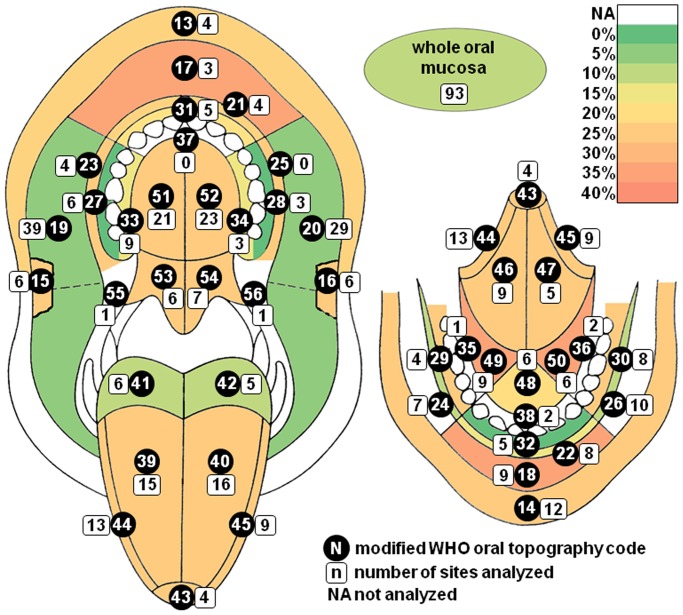
CONCLUSIONS/SIGNIFICANCE: The distribution of positive HPV findings on the oral mucosa seems to be more associated with a particular anatomical site than the diagnosis itself. Samples taken from the vermilion border, labial commissures, and hard palate were most often HPV positive. Thus, topography plays a role in HPV prevalence findings in oral lesions. Because of the higher prevalence of the high-risk HPV types in potentially malignant oral disorders, these lesions need to be continuously controlled and treated.
许多研究表明人乳头瘤病毒(HPV)类型与口腔病变之间存在关联。鉴于 HPV 在口腔黏膜恶性和潜在恶性疾病发展中的重要性,本研究旨在调查不同口腔病变中 HPV DNA 的流行情况。此外,我们还想阐明 HPV 感染是否主要与病变或口腔特定解剖部位相关。
方法/主要发现:该研究纳入了 246 名患有不同口腔病变的患者和 73 名口腔黏膜健康的患者(对照组)。根据病变的表面形态和临床诊断对口腔病变进行分类。使用细胞刷从口腔病变和对照组的口腔不同解剖部位采集上皮细胞。通过共识和基于特定类型的引物指导聚合酶链反应评估 HPV DNA 的存在。在口腔病变中检测到 HPV 阳性率为 17.7%,明显高于口腔黏膜健康者(6.8%),在良性增生性黏膜病变中阳性率更高(18.6%)。高危 HPV 型主要存在于潜在恶性口腔疾病中(HPV16 占 4.3%,HPV31 占 3.4%),而良性增生性病变和口腔黏膜健康者主要包含未确定的 HPV 型(分别为 13.6%和 6.8%)。
结论/意义:口腔黏膜 HPV 阳性结果的分布似乎与特定解剖部位更相关,而不是诊断本身。从唇红缘、唇间沟和硬腭采集的样本最常 HPV 阳性。因此,口腔病变的 HPV 流行情况与解剖部位有关。由于高危 HPV 型在潜在恶性口腔疾病中更为常见,这些病变需要持续控制和治疗。