U.S. Centers for Disease Control and Prevention, Atlanta, Georgia, United States of America.
PLoS One. 2013 Jul 29;8(7):e70064. doi: 10.1371/journal.pone.0070064. Print 2013.
The reasons that patients with multidrug-resistant tuberculosis (MDR TB) miss treatment are multi-factorial and complex. Identifying patterns of treatment interruption that predict poor outcomes can be used to target program activities aiming to improve treatment adherence.
To characterize patterns of treatment interruption among MDR TB patients and determine the association between patterns and treatment outcomes.
Retrospective analysis of MDR TB patients. A treatment interruption was defined as any time that a patient missed a prescribed dose of treatment for at least 1 day but for a period of less than 2 consecutive months. Patients were characterized by the number, length and variability of interruptions, variability of time between interruptions, and percent of missed doses. Final treatment outcome was dichotomized as a successful (cured or completed) or poor outcome (defaulted, failed, or died). Risk ratios were calculated to determine the association between characteristics of treatment interruption and treatment outcomes. All analyses were conducted in 6 month treatment intervals.
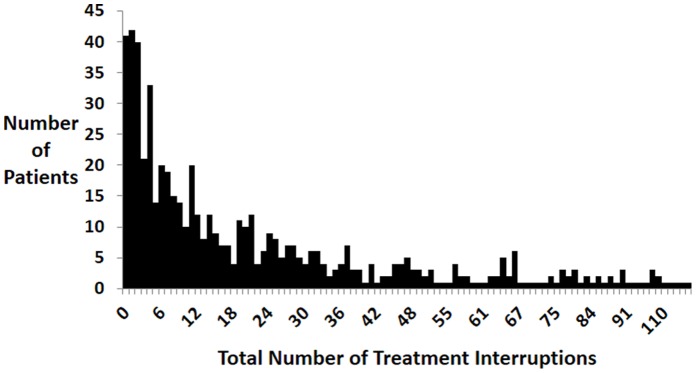
Only 7.0% of 583 patients completed treatment without interruption. Of the remaining 542 patients, the median time to the first interruption was 2 ½ months (70 days). In multivariate analysis, patients who had longer interruptions with sporadic variability during the 6-12 month or the 12-18 month treatment period had a significantly increased risk for poor outcomes compared to patients who had short, regular interruptions (RR(adj) 4.37, 95% CI 1.2-15.8; = 0.03 and RR(adj) 3.38, 95% CI 1.6-7.1; p = 0.001, respectively). In addition, missing 10% or more of the prescribed doses during any 6 month period in the initial 18 months of therapy significantly increased the risk for poor outcomes (RR(adj) range 1.55-2.35; p-value range 0.01-0.005).
Patients that miss more consecutive days of treatment with sporadic interruption patterns or a greater proportion of treatment are at an increased risk for poor treatment outcomes.
耐多药结核病(MDR-TB)患者失访的原因是多因素且复杂的。确定中断治疗的模式可以预测不良结局,从而有针对性地开展旨在提高治疗依从性的项目活动。
描述耐多药结核病患者中断治疗的模式,并确定这些模式与治疗结局之间的关联。
对耐多药结核病患者进行回顾性分析。治疗中断定义为患者错过规定剂量的治疗时间至少 1 天,但不超过连续 2 个月。通过中断次数、长度和变异性、中断之间时间的变异性以及错过剂量的百分比来描述患者特征。最终治疗结局分为成功(治愈或完成)或不良结局(失访、失败或死亡)。计算风险比以确定治疗中断特征与治疗结局之间的关联。所有分析均在 6 个月的治疗间隔内进行。
仅有 7.0%的 583 名患者在治疗过程中没有中断。在其余 542 名患者中,首次中断的中位时间为 2 个半月(70 天)。多变量分析显示,在 6-12 个月或 12-18 个月治疗期间,中断时间较长且变异性较大的患者与中断时间较短且规律的患者相比,不良结局的风险显著增加(调整后的风险比 [RR(adj)]分别为 4.37,95%置信区间 [CI] 1.2-15.8;=0.03 和 3.38,95%CI 1.6-7.1;p=0.001)。此外,在治疗的最初 18 个月内,任何 6 个月期间错过 10%或更多规定剂量的患者,不良结局的风险显著增加(调整后的风险比 [RR(adj)]范围为 1.55-2.35;p 值范围为 0.01-0.005)。
连续错过更多天数治疗且中断模式不规律,或错过更多比例治疗的患者,其治疗结局不良的风险增加。