The Department of Epidemiology, The Fourth Military Medical University, Xi'an, Shaanxi province, China.
BMC Public Health. 2010 Mar 7;10:112. doi: 10.1186/1471-2458-10-112.
The directly observed therapy-short course (DOTS) strategy was introduced in Shaanxi province, China to improve tuberculosis (TB) control by means of improved case detection (target: > = 70%) and treatment success rates (target: > = 85%) in new smear positive (SS+) TB patients. At a provincial level the targets were both reached in 2005. However in 30 (28%) out of 107 counties of Shaanxi province the cure rate was below 85%. This study aimed to investigate patient and treatment characteristics associated with non-cure after tuberculosis (TB) treatment in these counties.
In this case-control study, new smear positive TB cases in 30 counties with a cure rate <85% were included. Cured patients were compared to non-cured patients using logistic regression analysis to assess determinants for non-cure.
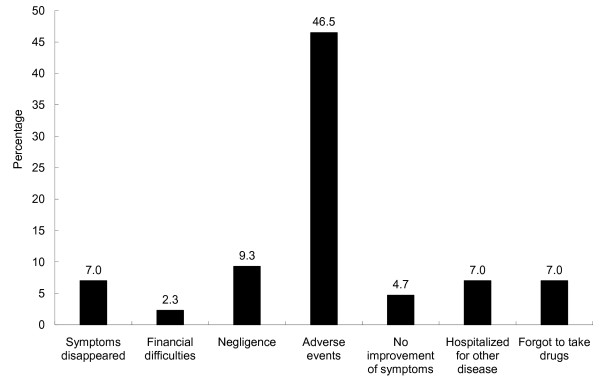
Of the 659 patients included, 153 (23.2%) did not have cure as treatment outcome. Interruption of treatment was most strongly associated with non-cure (OR = 8.7, 95% CI 3.9-18.4). Other independent risk factors were co-morbidity, low education level, lack of appetite as an initial symptom of TB disease, diagnosis of TB outside of the government TB control institutes, missing sputum re-examinations during treatment, and not having a treatment observer. Twenty-six percent of patients did not have a treatment observer. The non-cure rate was better for those with a doctor (odds ratio (OR) 0.38, 95% confidence interval (CI) 0.17-0.88) as treatment observer than for those with a family member (OR 0.62, 95%CI 0.37-1.03). The main reason for interrupted treatment mentioned by patients was presence of adverse effects during treatment (46.5%).
Interruption of treatment was most strongly associated with non-cure. Although treatment observation by medical staff is preferred, in order to diminish the proportion of patients who do not have a treatment observer and thereby reduce the proportion of patients who interrupt treatment, we suggest making it possible for family members, after sufficient training, to be treatment observers in remote areas where it is logistically difficult to have village doctors observe treatment for all patients.
直接观察治疗短期疗程(DOTS)策略在中国陕西省引入,旨在通过提高新涂阳(SS+)肺结核患者的病例检出率(目标:≥70%)和治疗成功率(目标:≥85%)来改善结核病控制。在省级层面,2005 年两个目标都已达到。然而,在陕西省 107 个县中的 30 个县(28%),治愈率低于 85%。本研究旨在调查这些县结核病(TB)治疗后未治愈患者的临床特征和治疗特征。
在这项病例对照研究中,我们纳入了 30 个治愈率低于 85%的县中涂阳新发病例。使用逻辑回归分析比较治愈患者和未治愈患者,以评估未治愈的决定因素。
在纳入的 659 例患者中,153 例(23.2%)治疗结局未治愈。中断治疗与未治愈的关系最为密切(OR=8.7,95%CI 3.9-18.4)。其他独立的危险因素包括合并症、低教育程度、食欲不振作为结核病症状的初始表现、在政府结核病防治机构以外诊断结核病、治疗期间痰检缺失以及没有治疗观察者。26%的患者没有治疗观察者。治疗观察者为医生的患者未治愈率(比值比(OR)0.38,95%置信区间(CI)0.17-0.88)优于治疗观察者为家庭成员的患者(OR 0.62,95%CI 0.37-1.03)。患者提到中断治疗的主要原因是治疗期间出现不良反应(46.5%)。
中断治疗与未治愈的关系最为密切。虽然医务人员的治疗观察更受青睐,但为了减少没有治疗观察者的患者比例,从而减少中断治疗的患者比例,我们建议在难以让乡村医生为所有患者提供治疗观察的偏远地区,在经过充分培训后,允许家庭成员担任治疗观察者。