Department of Surgical Oncology, Affiliated Sir Runrun Shaw Hospital, Zhejiang University School of Medicine, Hangzhou, China.
PLoS One. 2013 Jul 29;8(7):e70191. doi: 10.1371/journal.pone.0070191. Print 2013.
We aimed to investigate the prognostic value of RRM1 in GC patients.
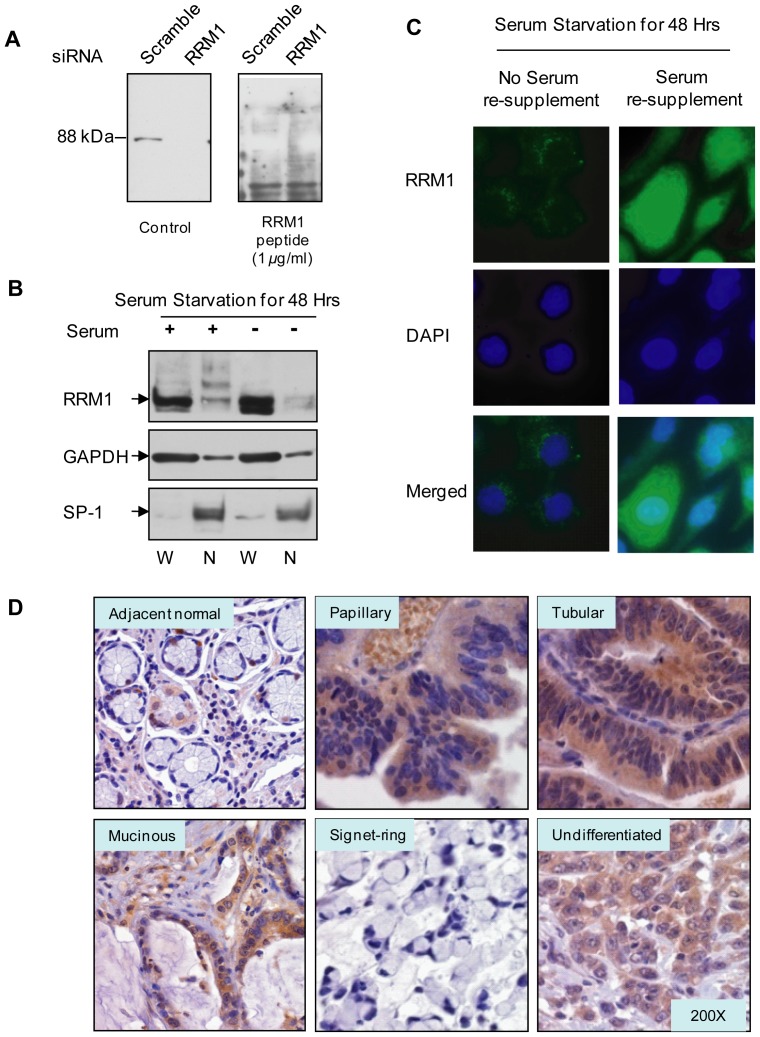
A total of assessable 389 GC patients with clinicopathological and survival information were enrolled from City of Hope (COH, n = 67) and Zhejiang University (ZJU, n = 322). RRM1 protein expression was determined by immunohistochemistry on FFPE tissue samples. Kaplan-Meier and Cox analyses were used to measure survival. Ras/Raf activity and invasion assays were used to evaluate the role of RRM1 in GC cell lines.
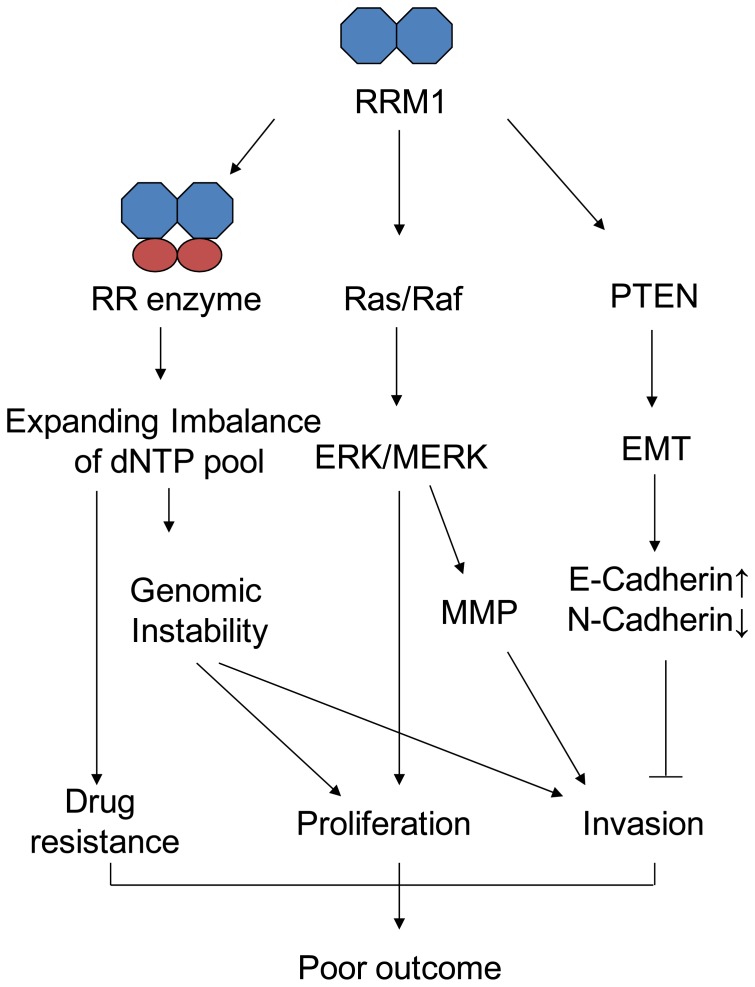
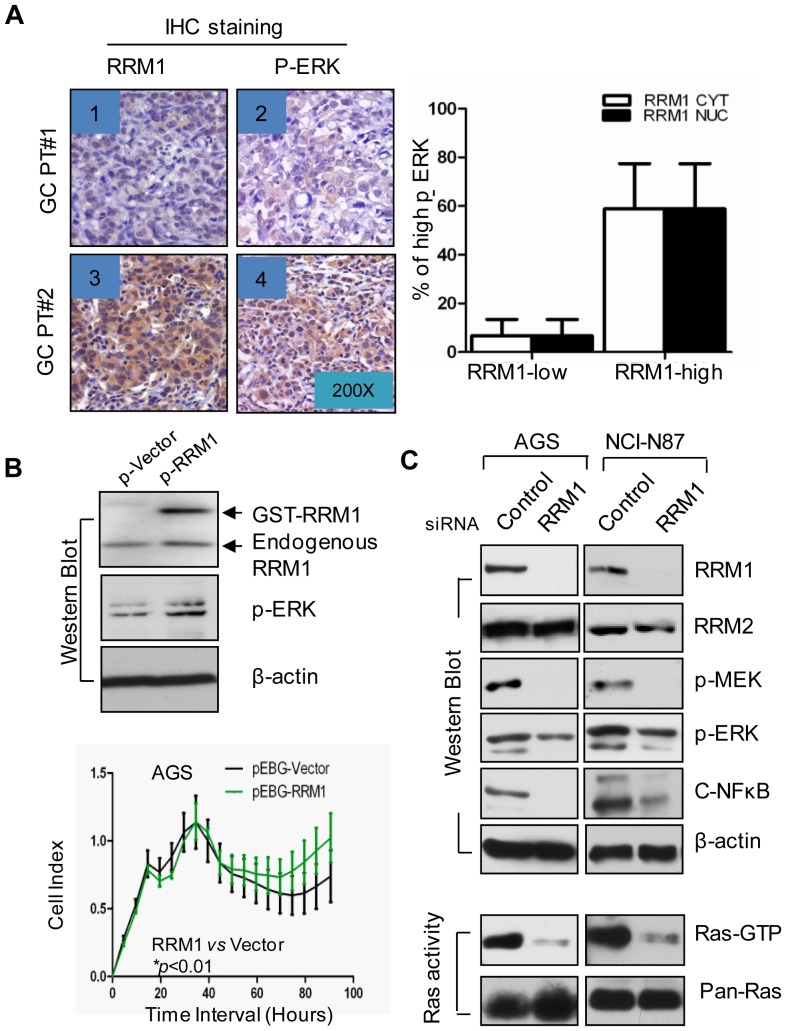
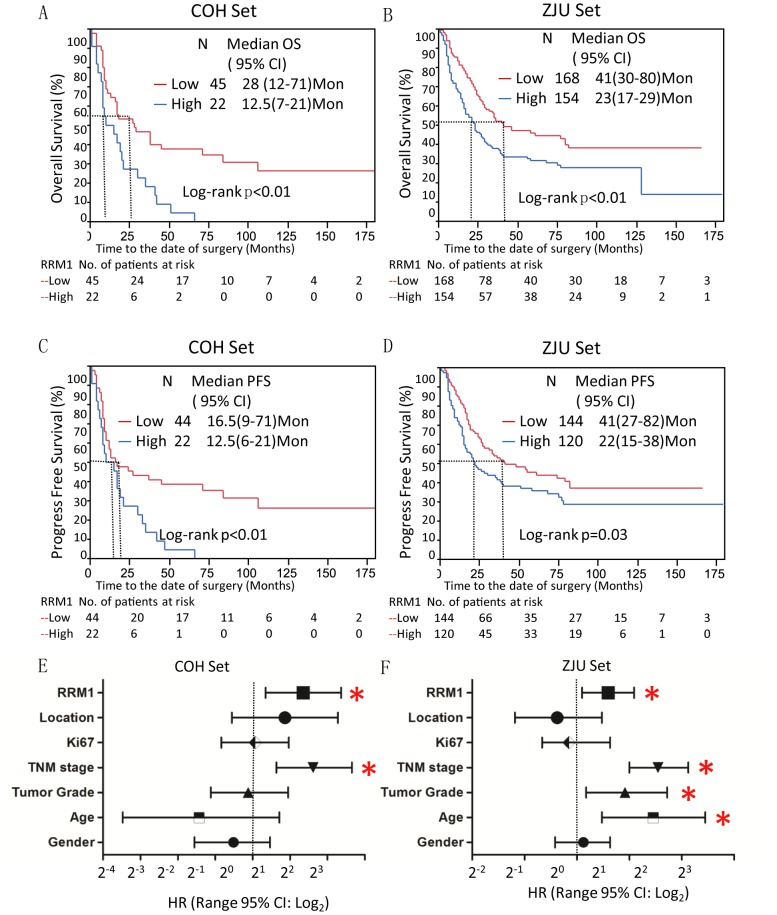
In vitro experiments demonstrated RRM1 activated Ras/Raf/MAPK signal transduction and promoted GC cell proliferation. Meanwhile, RRM1 expression was significantly associated with lymph node involvement, tumor size, Ki67 expression, histological subtype and histological grade in the GC tissue samples (p<0.05). Kaplan-Meier analysis illustrated that high RRM1 expression predicted poor survival in GC patients in the COH and ZJU cohorts (log-rank p<0.01). In multivariate Cox analysis, the hazard ratios of RRM1 for overall survival were 2.55 (95% CI 1.27-5.15) and 1.51 (95% CI 1.07-2.13) in the COH and ZJU sets, respectively. In particular, RRM1 specifically predicted the outcome of advanced GCs with poor differentiation and high proliferative ability. Furthermore, inhibition of RRM1 by siRNA significantly reduced the dNTP pool, Ras/Raf and MMP-9 activities and the levels of p-MEK, p-ERK and NF-κB, resulting in growth retardation and reduced invasion in AGS and NCI-N87 cells.
RRM1 overexpression predicts poor survival in GC patients with advanced TNM stage. RRM1 could potentially serve as prognostic biomarker and therapeutic target for GCs.
本研究旨在探讨 RRM1 在胃癌患者中的预后价值。
本研究共纳入了来自希望之城(COH)和浙江大学(ZJU)的 389 名具有临床病理和生存信息的可评估胃癌患者(COH 队列:n=67;ZJU 队列:n=322)。采用免疫组化法检测 FFPE 组织样本中的 RRM1 蛋白表达。采用 Kaplan-Meier 分析和 Cox 分析来评估生存情况。采用 Ras/Raf 活性和侵袭实验来评估 RRM1 在胃癌细胞系中的作用。
体外实验表明,RRM1 激活了 Ras/Raf/MAPK 信号转导并促进了 GC 细胞的增殖。同时,在胃癌组织样本中,RRM1 的表达与淋巴结受累、肿瘤大小、Ki67 表达、组织学亚型和组织学分级显著相关(p<0.05)。Kaplan-Meier 分析表明,在 COH 和 ZJU 队列中,高 RRM1 表达预示着胃癌患者的生存预后不良(log-rank p<0.01)。在多变量 Cox 分析中,COH 和 ZJU 队列中,RRM1 对总生存的风险比分别为 2.55(95%CI 1.27-5.15)和 1.51(95%CI 1.07-2.13)。特别是,RRM1 能够特异性地预测分化差、增殖能力强的晚期 GC 的预后。此外,用 siRNA 抑制 RRM1 可显著降低 dNTP 池、Ras/Raf 和 MMP-9 的活性以及 p-MEK、p-ERK 和 NF-κB 的水平,从而导致 AGS 和 NCI-N87 细胞的生长迟缓和侵袭减少。
RRM1 过表达预示着晚期 TNM 期胃癌患者的生存预后不良。RRM1 可能成为 GC 的预后生物标志物和治疗靶点。