Department of Hepatobiliary and Pancreatic Surgery, Graduate School of Medicine, Tokyo Medical and Dental University, Tokyo, Japan.
Department of Molecular Oncology, Graduate School of Medicine, Tokyo Medical and Dental University, Tokyo, Japan.
PLoS One. 2021 Jun 10;16(6):e0252917. doi: 10.1371/journal.pone.0252917. eCollection 2021.
RRM1 is functionally associated with DNA replication and DNA damage repair. However, the biological activity of RRM1 in pancreatic cancer remains undetermined.
To determine relationships between RRM1 expression and the prognosis of pancreatic cancer, and to explore RRM1 function in cancer biology, we investigated RRM1 expression levels in 121 pancreatic cancer patients by immunohistochemical staining and performed in vitro experiments to analyze the functional consequences of RRM1 expression.
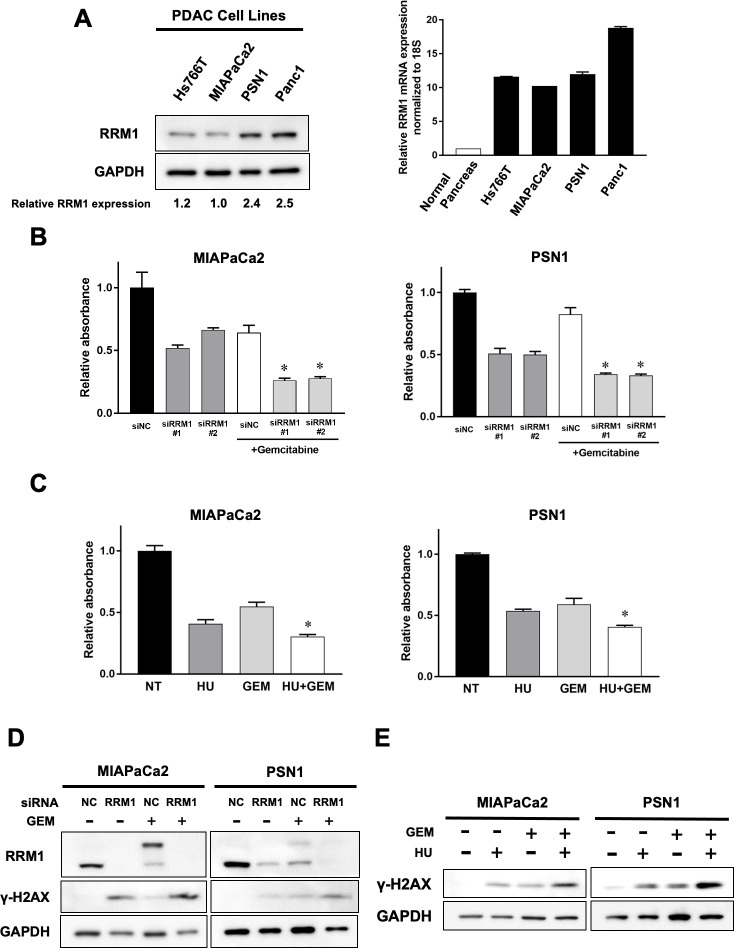
Patients with high RRM1 expression had significantly poorer clinical outcomes (overall survival; p = 0.006, disease-free survival; p = 0.0491). In particular, high RRM1 expression was also associated with poorer overall survival on adjuvant chemotherapy (p = 0.008). We found that RRM1 expression was increased 24 hours after exposure to gemcitabine and could be suppressed by histone acetyltransferase inhibition. RRM1 activation in response to gemcitabine exposure was induced mainly in the cytoplasm and cytoplasmic RRM1 activation was related to cancer cell viability. In contrast, cancer cells lacking cytoplasmic RRM1 activation were confirmed to show severe DNA damage. RRM1 inhibition with specific siRNA or hydroxyurea enhanced the cytotoxic effects of gemcitabine for pancreatic cancer cells.
Cytoplasmic RRM1 activation is involved in biological processes related to drug resistance in response to gemcitabine exposure and could be a potential target for pancreatic cancer treatment.
RRM1 与 DNA 复制和 DNA 损伤修复功能相关。然而,RRM1 在胰腺癌中的生物学活性尚未确定。
为了确定 RRM1 表达与胰腺癌预后之间的关系,并探讨 RRM1 在癌症生物学中的功能,我们通过免疫组织化学染色检测了 121 例胰腺癌患者的 RRM1 表达水平,并进行了体外实验分析 RRM1 表达的功能后果。
高 RRM1 表达的患者临床结局明显较差(总生存;p = 0.006,无病生存;p = 0.0491)。特别是,高 RRM1 表达与辅助化疗的总生存较差也相关(p = 0.008)。我们发现,吉西他滨暴露 24 小时后 RRM1 表达增加,组蛋白乙酰转移酶抑制可抑制 RRM1 表达。吉西他滨暴露诱导的 RRM1 激活主要发生在细胞质中,细胞质中 RRM1 激活与癌细胞活力有关。相比之下,缺乏细胞质 RRM1 激活的癌细胞被证实表现出严重的 DNA 损伤。用特异性 siRNA 或羟基脲抑制 RRM1 增强了吉西他滨对胰腺癌细胞的细胞毒性作用。
细胞质 RRM1 激活参与了吉西他滨暴露后与耐药性相关的生物学过程,可能是胰腺癌治疗的潜在靶点。