Department of Medical Oncology, Dana-Farber Cancer Institute, Boston, MA, USA.
N Engl J Med. 2013 Aug 8;369(6):517-28. doi: 10.1056/NEJMoa1211115.
Immunosuppression is associated with a variety of idiopathic clinical syndromes that may have infectious causes. It has been hypothesized that the cord colitis syndrome, a complication of umbilical-cord hematopoietic stem-cell transplantation, is infectious in origin.
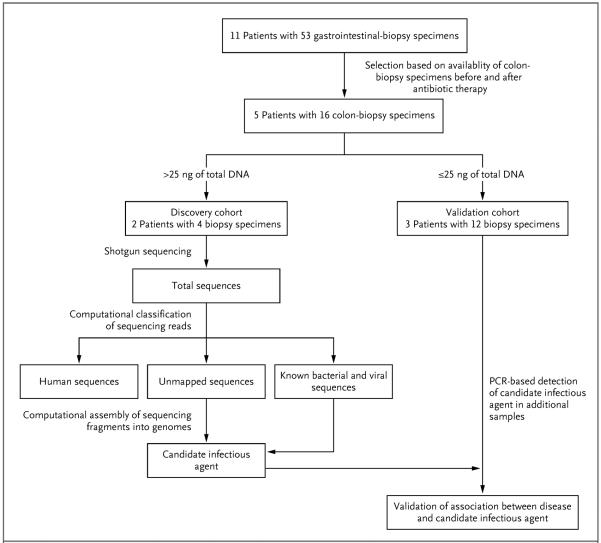
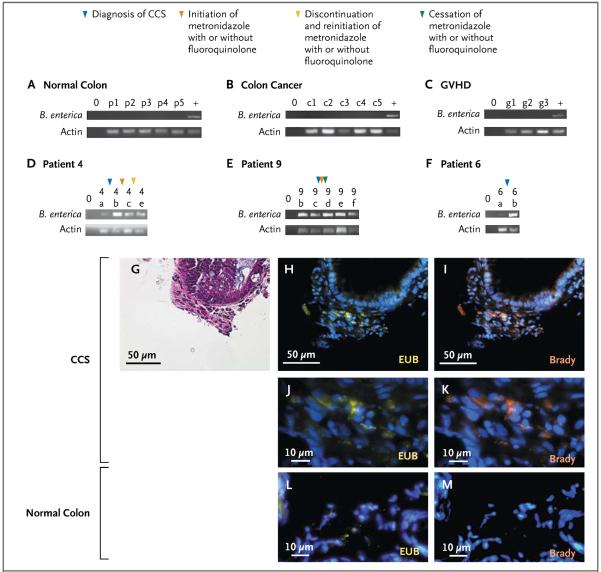
We performed shotgun DNA sequencing on four archived, paraffin-embedded endoscopic colon-biopsy specimens obtained from two patients with cord colitis. Computational subtraction of human and known microbial sequences and assembly of residual sequences into a bacterial draft genome were performed. We used polymerase-chain-reaction (PCR) assays and fluorescence in situ hybridization to determine whether the corresponding bacterium was present in additional patients and controls.
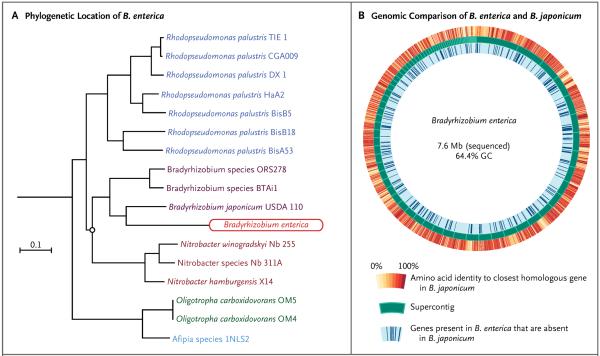
DNA sequencing of the biopsy specimens revealed more than 2.5 million sequencing reads that did not match known organisms. These sequences were computationally assembled into a 7.65-Mb draft genome showing a high degree of homology with genomes of bacteria in the bradyrhizobium genus. The corresponding newly discovered bacterium was provisionally named Bradyrhizobium enterica. PCR identified B. enterica nucleotide sequences in biopsy specimens from all three additional patients with cord colitis whose samples were tested, whereas B. enterica sequences were absent in samples obtained from healthy controls and patients with colon cancer or graft-versus-host disease.
We assembled a novel bacterial draft genome from the direct sequencing of tissue specimens from patients with cord colitis. Association of these sequences with cord colitis suggests that B. enterica may be an opportunistic human pathogen. (Funded by the National Cancer Institute and others.)
免疫抑制与多种可能由感染引起的特发性临床综合征有关。人们推测,脐带血造血干细胞移植的并发症——脐带结肠炎综合征起源于感染。
我们对两名患有脐带结肠炎的患者的 4 份存档的石蜡包埋内镜结肠活检标本进行了鸟枪法 DNA 测序。通过计算减去人类和已知微生物序列,并将剩余序列组装成细菌草图基因组,来进行操作。我们使用聚合酶链反应(PCR)检测和荧光原位杂交来确定相应的细菌是否存在于其他患者和对照中。
活检标本的 DNA 测序显示,有超过 250 万个测序读数与已知生物不匹配。这些序列通过计算组装成一个 765Mb 的草图基因组,与缓生根瘤菌属的细菌基因组具有高度同源性。这种新发现的细菌被暂时命名为肠杆菌 Enterica。PCR 鉴定了所有三个患有脐带结肠炎的额外患者的活检标本中的肠杆菌 Enterica 核苷酸序列,而在健康对照者和患有结肠癌或移植物抗宿主病的患者的样本中则不存在肠杆菌 Enterica 序列。
我们从患有脐带结肠炎的患者的组织标本的直接测序中组装了一个新的细菌草图基因组。这些序列与脐带结肠炎的关联表明,肠杆菌 Enterica 可能是一种机会性人类病原体。(由美国国立癌症研究所等资助)