Transgene; Illkirch-Graffenstaden, France.
MAbs. 2013 Sep-Oct;5(5):736-47. doi: 10.4161/mabs.25743. Epub 2013 Jul 15.
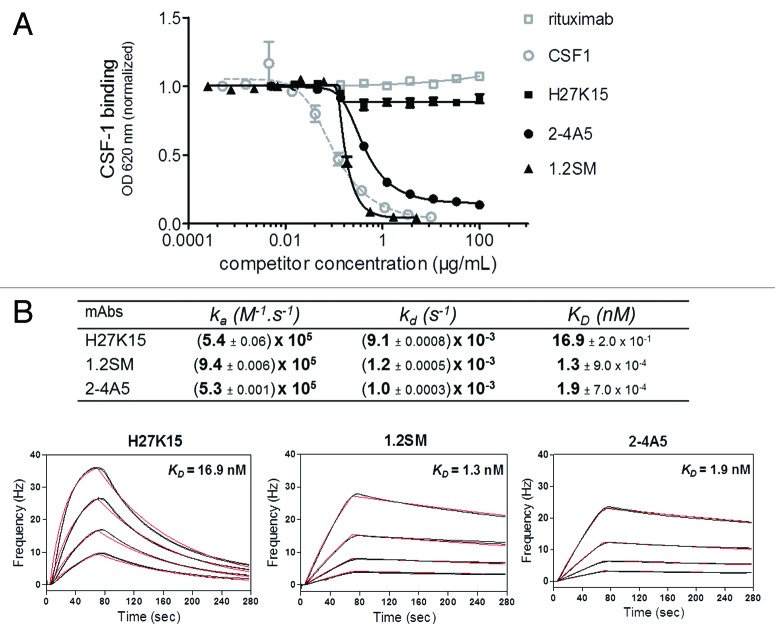
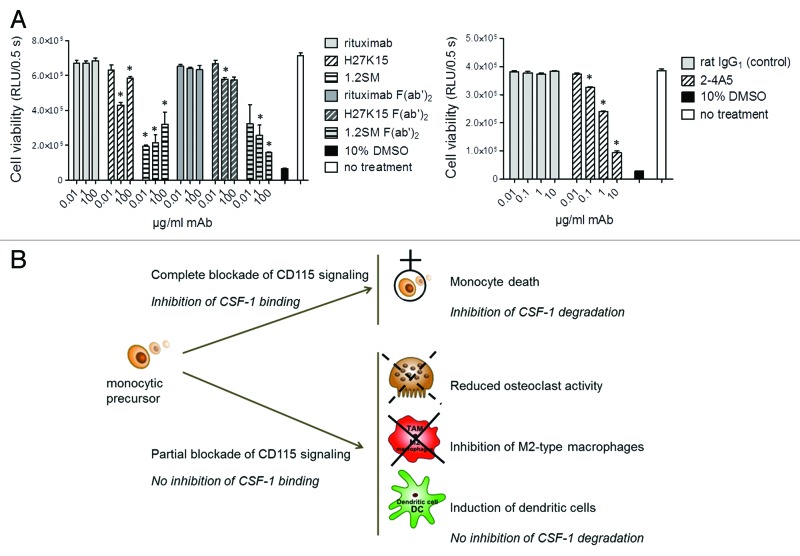
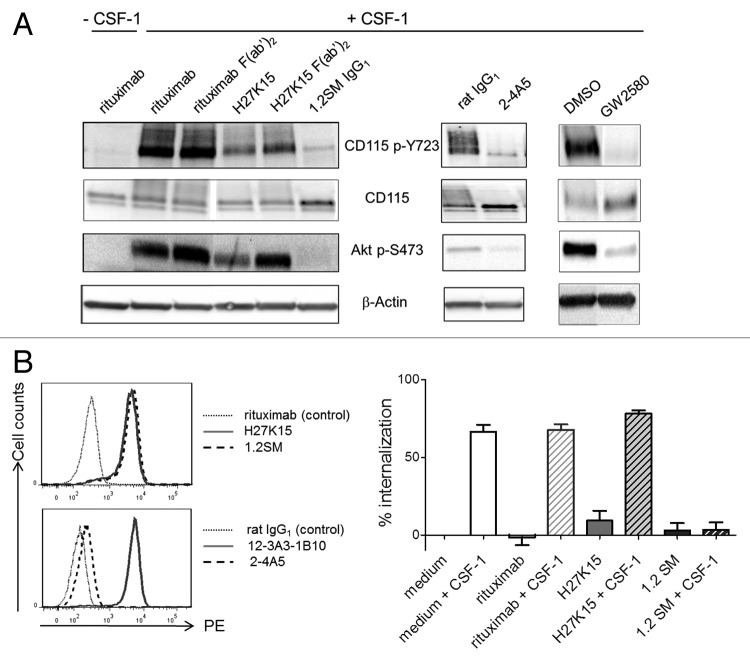
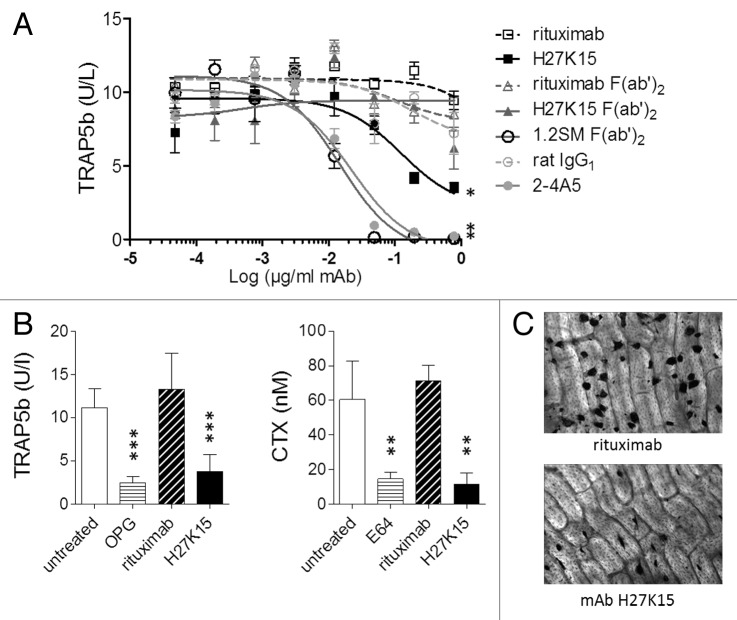
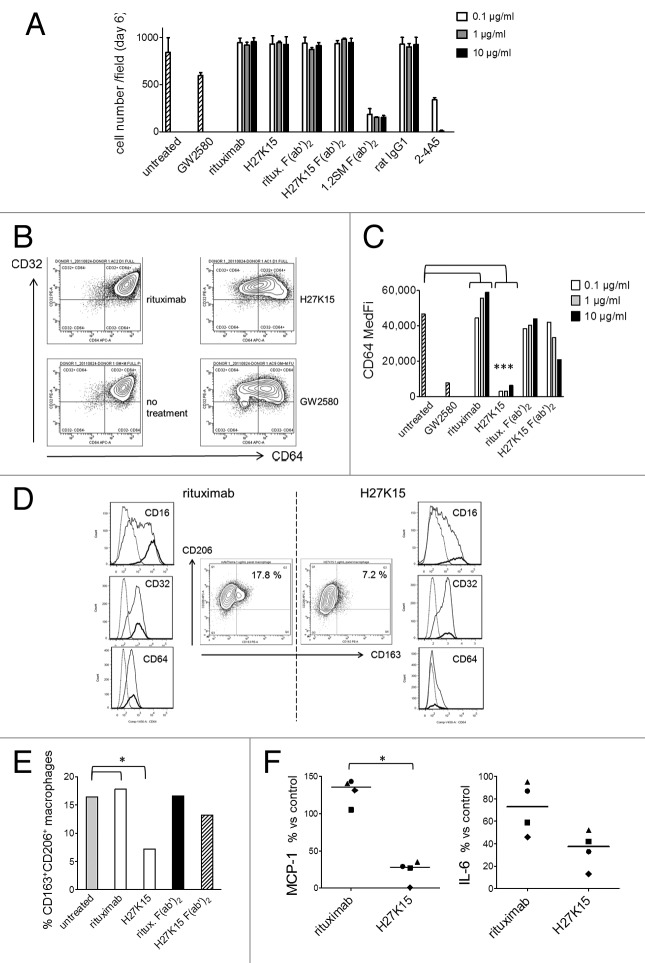
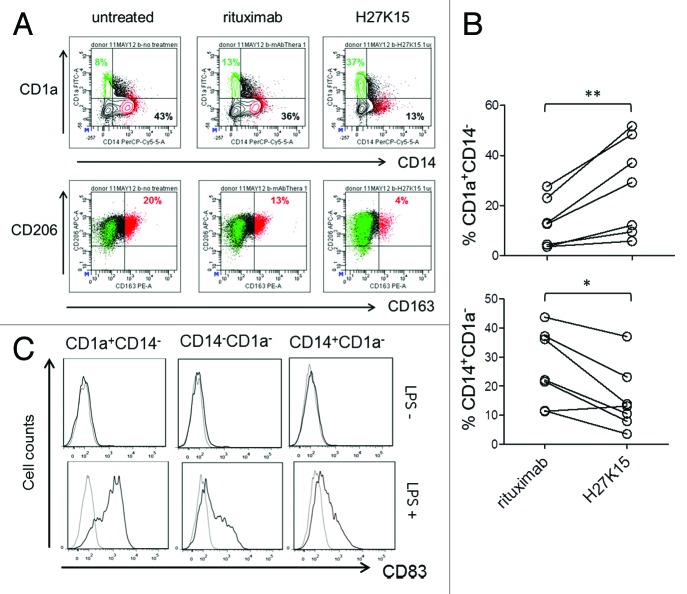
Cancer progression has been associated with the presence of tumor-associated M2-macrophages (M2-TAMs) able to inhibit anti-tumor immune responses. It is also often associated with metastasis-induced bone destruction mediated by osteoclasts. Both cell types are controlled by the CD115 (CSF-1R)/colony-stimulating factor-1 (CSF-1, M-CSF) pathway, making CD115 a promising target for cancer therapy. Anti-human CD115 monoclonal antibodies (mAbs) that inhibit the receptor function have been generated in a number of laboratories. These mAbs compete with CSF-1 binding to CD115, dramatically affecting monocyte survival and preventing osteoclast and macrophage differentiation, but they also block CD115/CSF-1 internalization and degradation, which could lead to potent rebound CSF-1 effects in patients after mAb treatment has ended. We thus generated and selected a non-ligand competitive anti-CD115 mAb that exerts only partial inhibitory effects on CD115 signaling without blocking the internalization or the degradation of the CD115/CSF-1 complex. This mAb, H27K15, affects monocyte survival only minimally, but downregulates osteoclast differentiation and activity. Importantly, it inhibits monocyte differentiation to CD163(+)CD64(+) M2-polarized suppressor macrophages, skewing their differentiation toward CD14(-)CD1a(+) dendritic cells (DCs). In line with this observation, H27K15 also drastically inhibits monocyte chemotactic protein-1 secretion and reduces interleukin-6 production; these two molecules are known to be involved in M2-macrophage recruitment. Thus, the non-depleting mAb H27K15 is a promising anti-tumor candidate, able to inhibit osteoclast differentiation, likely decreasing metastasis-induced osteolysis, and able to prevent M2 polarization of TAMs while inducing DCs, hence contributing to the creation of more efficient anti-tumor immune responses.
癌症的进展与肿瘤相关的 M2 巨噬细胞(M2-TAMs)的存在有关,这些巨噬细胞能够抑制抗肿瘤免疫反应。它也常与破骨细胞介导的转移性骨破坏有关。这两种细胞类型都受 CD115(CSF-1R)/集落刺激因子-1(CSF-1,M-CSF)途径的控制,这使得 CD115 成为癌症治疗的一个有前途的靶点。许多实验室已经产生了抑制受体功能的抗人 CD115 单克隆抗体(mAbs)。这些 mAbs 与 CSF-1 竞争与 CD115 结合,显著影响单核细胞的存活,并阻止破骨细胞和巨噬细胞分化,但它们也阻断了 CD115/CSF-1 的内化和降解,这可能导致 mAb 治疗结束后患者出现强烈的 CSF-1 反弹效应。因此,我们产生并选择了一种非配体竞争性抗 CD115 mAb,它仅对 CD115 信号产生部分抑制作用,而不阻断 CD115/CSF-1 复合物的内化或降解。这种 mAb,H27K15,仅对单核细胞存活产生微小影响,但下调破骨细胞分化和活性。重要的是,它抑制单核细胞向 CD163(+)CD64(+)M2 极化的抑制性巨噬细胞分化,使其向 CD14(-)CD1a(+)树突状细胞(DCs)分化。与这一观察结果一致,H27K15 还极大地抑制单核细胞趋化蛋白-1 的分泌并减少白细胞介素-6 的产生;这两种分子已知参与 M2 巨噬细胞的募集。因此,非耗竭性 mAb H27K15 是一种很有前途的抗肿瘤候选药物,能够抑制破骨细胞分化,可能减少转移性骨溶解,能够防止 TAMs 的 M2 极化,同时诱导 DCs,从而有助于创造更有效的抗肿瘤免疫反应。