Oregon Institute of Marine Biology, University of Oregon, Charleston, OR, USA.
Front Zool. 2013 Aug 9;10(1):47. doi: 10.1186/1742-9994-10-47.
The nemertean pilidium is a long-lived feeding larva unique to the life cycle of a single monophyletic group, the Pilidiophora, which is characterized by this innovation. That the pilidium feeds on small planktonic unicells seems clear; how it does so is unknown and not readily inferred, because it shares little morphological similarity with other planktotrophic larvae.
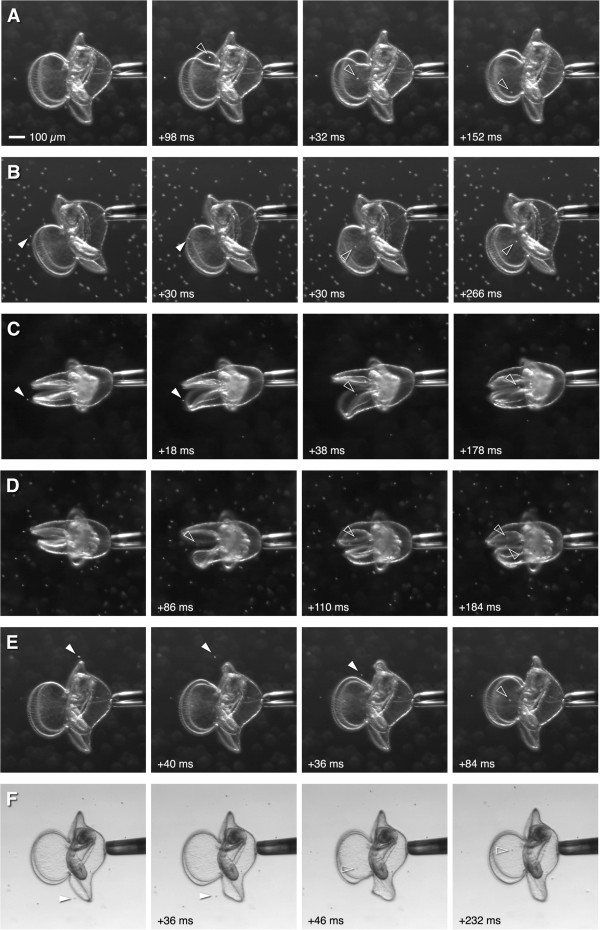
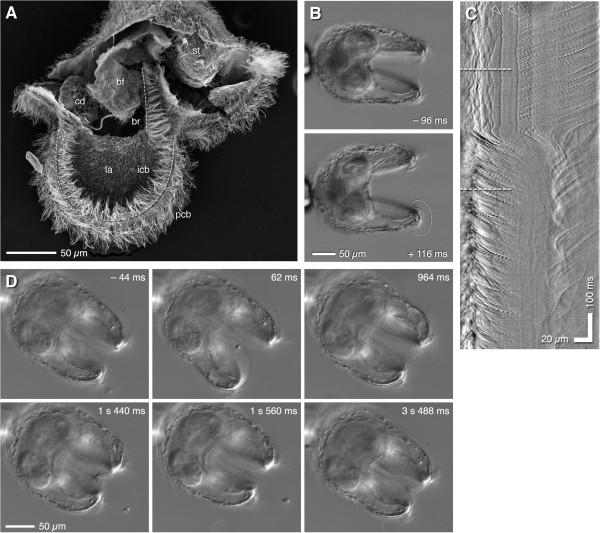
Using high-speed video of trapped lab-reared pilidia of Micrura alaskensis, we documented a multi-stage feeding mechanism. First, the external ciliation of the pilidium creates a swimming and feeding current which carries suspended prey past the primary ciliated band spanning the posterior margins of the larval body. Next, the larva detects prey that pass within reach, then conducts rapid and coordinated deformations of the larval body to re-direct passing cells and surrounding water into a vestibular space between the lappets, isolated from external currents but not quite inside the larva. Once a prey cell is thus captured, internal ciliary bands arranged within this vestibule prevent prey escape. Finally, captured cells are transported by currents within a buccal funnel toward the stomach entrance. Remarkably, we observed that the prey of choice - various cultured cryptomonads - attempt to escape their fate.
The feeding mechanism deployed by the pilidium larva coordinates local control of cilia-driven water transport with sensorimotor behavior, in a manner clearly distinct from any other well-studied larval feeding mechanisms. We hypothesize that the pilidium's feeding strategy may be adapted to counter escape responses such as those deployed by cryptomonads, and speculate that similar needs may underlie convergences among disparate planktotrophic larval forms.
纽形动物担轮幼虫是一个长寿命的摄食幼虫,是一个单系群——担轮幼虫门的生命周期所特有的,这个创新特征使该门与众不同。担轮幼虫以小的浮游单细胞生物为食似乎是清楚的;但它是如何做到这一点的尚不清楚,也不容易推断,因为它与其他浮游幼虫形态上的相似性很小。
我们使用陷阱捕捉的实验室培养的阿拉斯加微虫的高速视频记录了一个多阶段的摄食机制。首先,担轮幼虫外部的纤毛产生一个游泳和摄食的水流,将悬浮的猎物带到幼虫体后缘的初级纤毛带周围。接下来,幼虫检测到经过触手可及的猎物,然后进行快速而协调的幼虫体变形,将经过的细胞和周围的水重新引导到瓣片之间的前庭空间,这个空间与外部水流隔离,但不完全在幼虫体内。一旦一个猎物细胞被捕获,内部纤毛带在这个前庭内阻止猎物逃脱。最后,被捕获的细胞被内部的水流运送到位于入口处的胃。值得注意的是,我们观察到,幼虫的首选猎物——各种培养的隐藻——试图逃避它们的命运。
担轮幼虫幼虫的摄食机制将局部控制的纤毛驱动的水流与感觉运动行为协调起来,这种方式显然与任何其他研究充分的幼虫摄食机制不同。我们假设,担轮幼虫的摄食策略可能是为了对抗隐藻等物种所部署的逃避反应,并且推测类似的需求可能是不同的浮游幼虫形式之间趋同的基础。