Borich Michael R, Brown Katlyn E, Boyd Lara A
Department of Physical Therapy (M.R.B., L.A.B.), Graduate Program in Rehabilitation Sciences (K.E.B., L.A.B.), and Brain Research Centre (L.A.B.), University of British Columbia, Vancouver, British Columbia, Canada.
J Neurol Phys Ther. 2014 Jul;38(3):151-60. doi: 10.1097/NPT.0b013e3182a3d353.
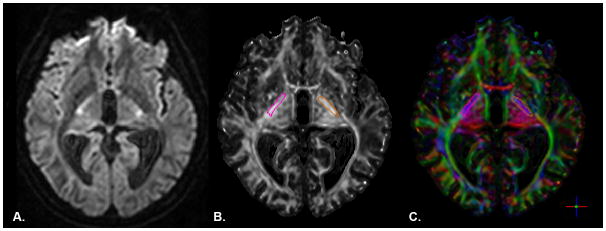
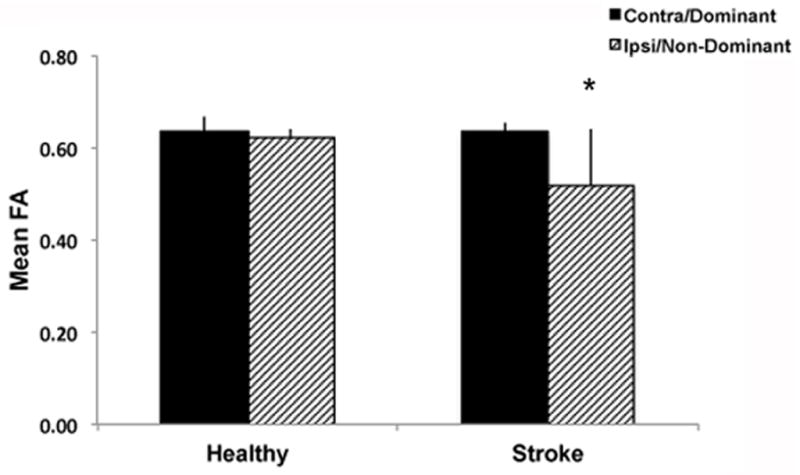
Imaging advances allow investigation of white matter after stroke; a growing body of literature has shown links between diffusion-based measures of white matter microstructure and motor function. However, the relationship between these measures and motor skill learning has not been considered in individuals with stroke. The aim of this study was to investigate the relationships between posttraining white matter microstructural status, as indexed by diffusion tensor imaging within the ipsilesional posterior limb of the internal capsule (PLIC), and learning of a novel motor task in individuals with chronic stroke.
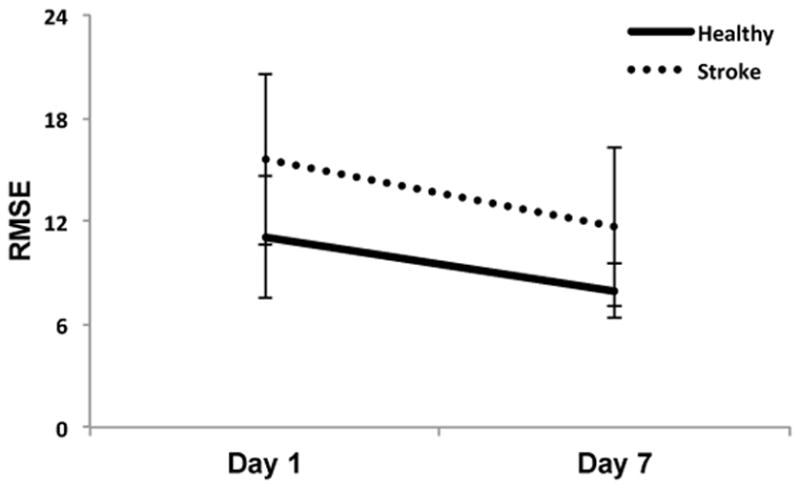
A total of 13 participants with chronic stroke and 9 healthy controls practiced a visuomotor pursuit task across 5 sessions. Change in motor behavior associated with learning was indexed by comparing baseline performance with a delayed retention test. Fractional anisotropy (FA) indexed at the retention test was the primary diffusion tensor imaging-derived outcome measure.
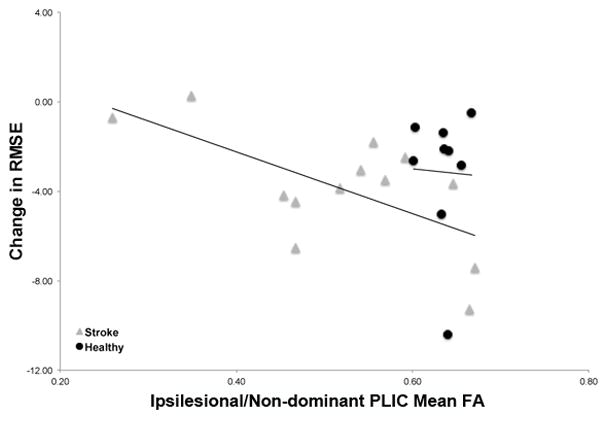
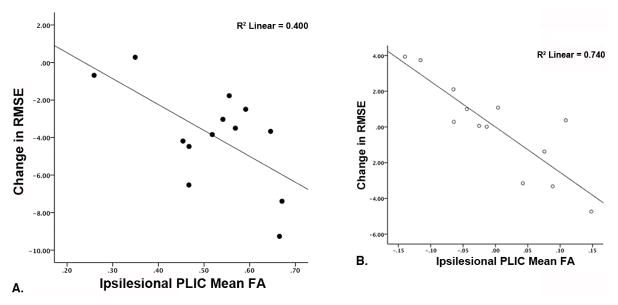
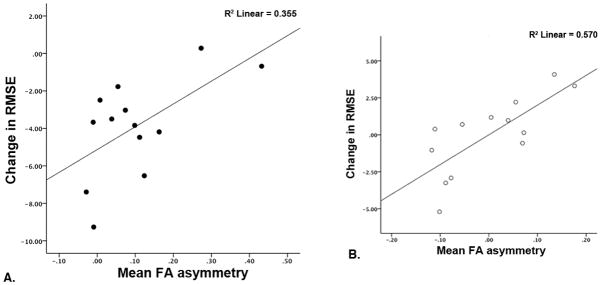
In individuals with chronic stroke, we discovered an association between posttraining ipsilesional PLIC FA and the magnitude of change associated with motor learning; hierarchical multiple linear regression analyses revealed that the combination of age, time poststroke, and ipsilesional PLIC FA posttraining was associated with motor learning-related change (R = 0.649; P = 0.02). Baseline motor performance was not related to posttraining ipsilesional PLIC FA.
Diffusion characteristics of posttraining ipsilesional PLIC were linked to the magnitude of change in skilled motor behavior. These results imply that the microstructural properties of regional white matter indexed by diffusion behavior may be an important factor to consider when determining potential response to rehabilitation in persons with stroke.
(see Video, Supplemental Digital Content 1, http://links.lww.com/JNPT/A59) for more insights from the authors.
影像学的进展使得对中风后白质的研究成为可能;越来越多的文献表明,基于扩散的白质微观结构测量与运动功能之间存在联系。然而,中风患者中这些测量指标与运动技能学习之间的关系尚未得到探讨。本研究的目的是调查内囊后肢(PLIC)患侧扩散张量成像所显示的训练后白质微观结构状态与慢性中风患者新运动任务学习之间的关系。
13名慢性中风患者和9名健康对照者在5个阶段中练习一项视觉运动追踪任务。通过将基线表现与延迟保留测试进行比较,来确定与学习相关的运动行为变化。保留测试时的分数各向异性(FA)是扩散张量成像得出的主要结果指标。
在慢性中风患者中,我们发现训练后患侧PLIC的FA与运动学习相关的变化幅度之间存在关联;分层多元线性回归分析显示,年龄、中风后时间和训练后患侧PLIC的FA相结合与运动学习相关变化有关(R = 0.649;P = 0.02)。基线运动表现与训练后患侧PLIC的FA无关。
训练后患侧PLIC的扩散特征与熟练运动行为的变化幅度相关。这些结果表明,由扩散行为所反映的局部白质微观结构特性可能是确定中风患者康复潜在反应时需要考虑的一个重要因素。
(见视频,补充数字内容1,http://links.lww.com/JNPT/A59),以获取作者的更多见解。