Immune Cell Biology, MRC National Institute for Medical Research, Mill Hill, London, United Kingdom.
PLoS Comput Biol. 2013;9(7):e1003102. doi: 10.1371/journal.pcbi.1003102. Epub 2013 Jul 25.
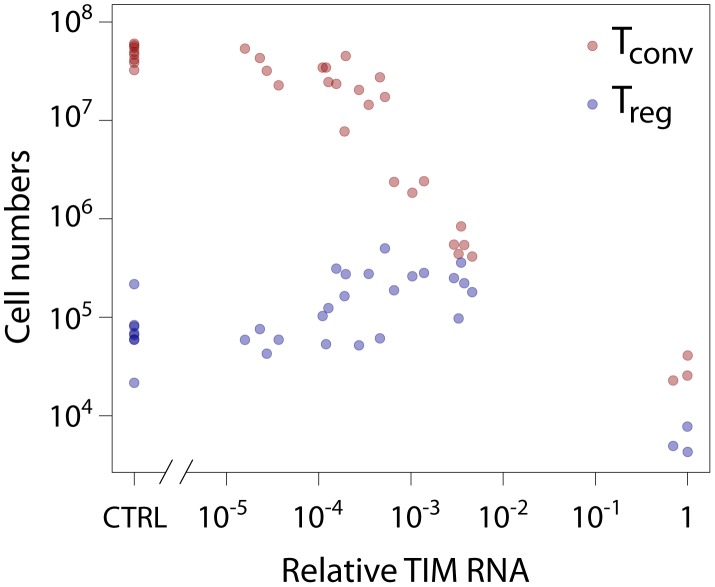
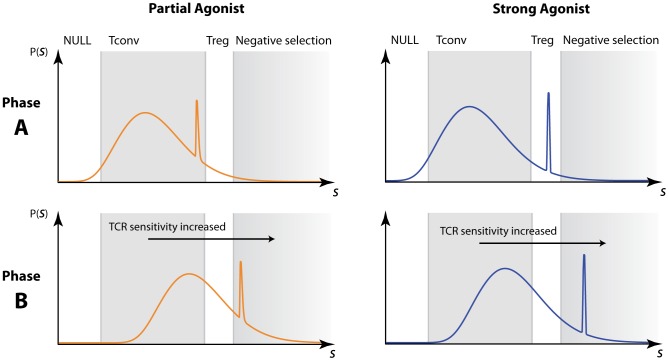
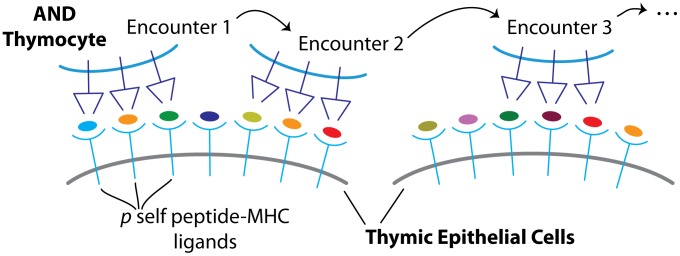
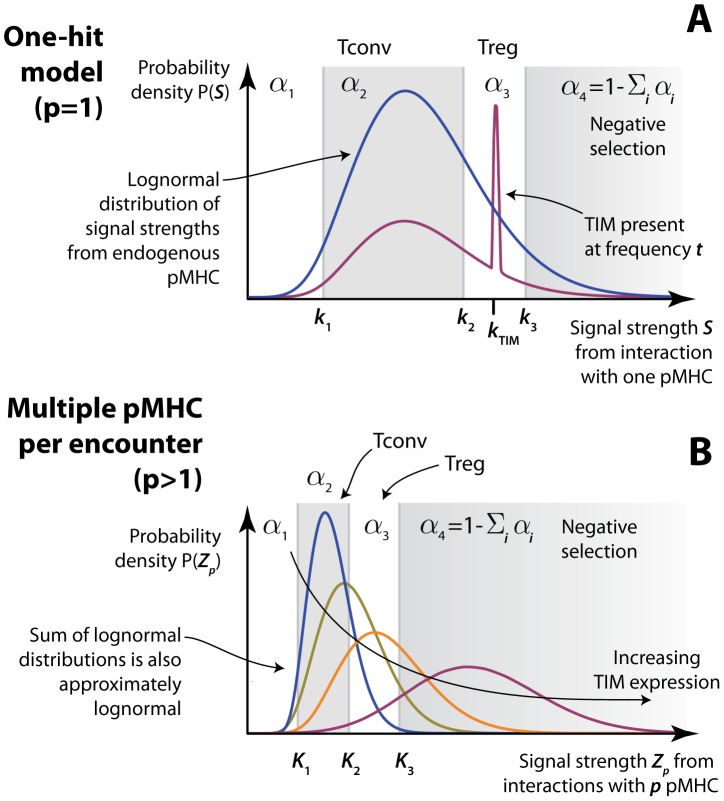
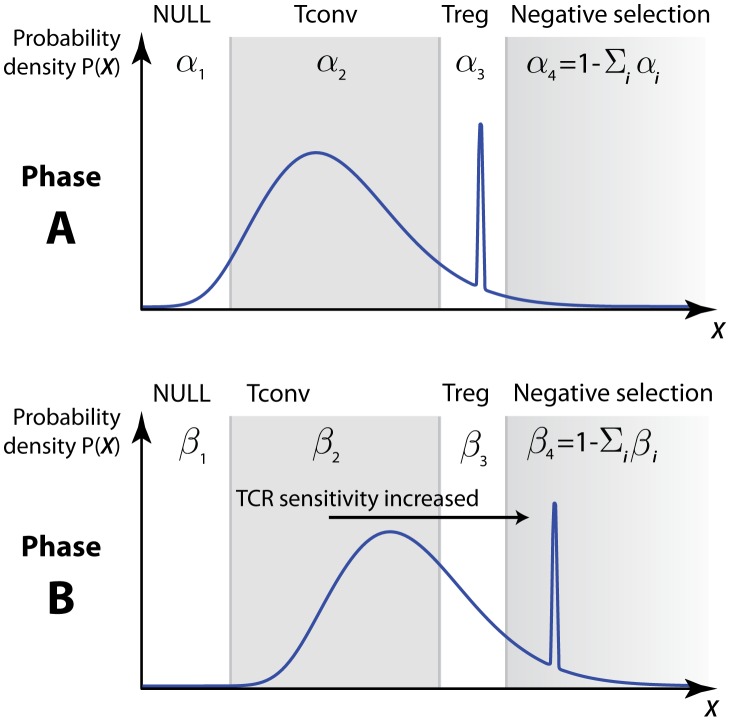
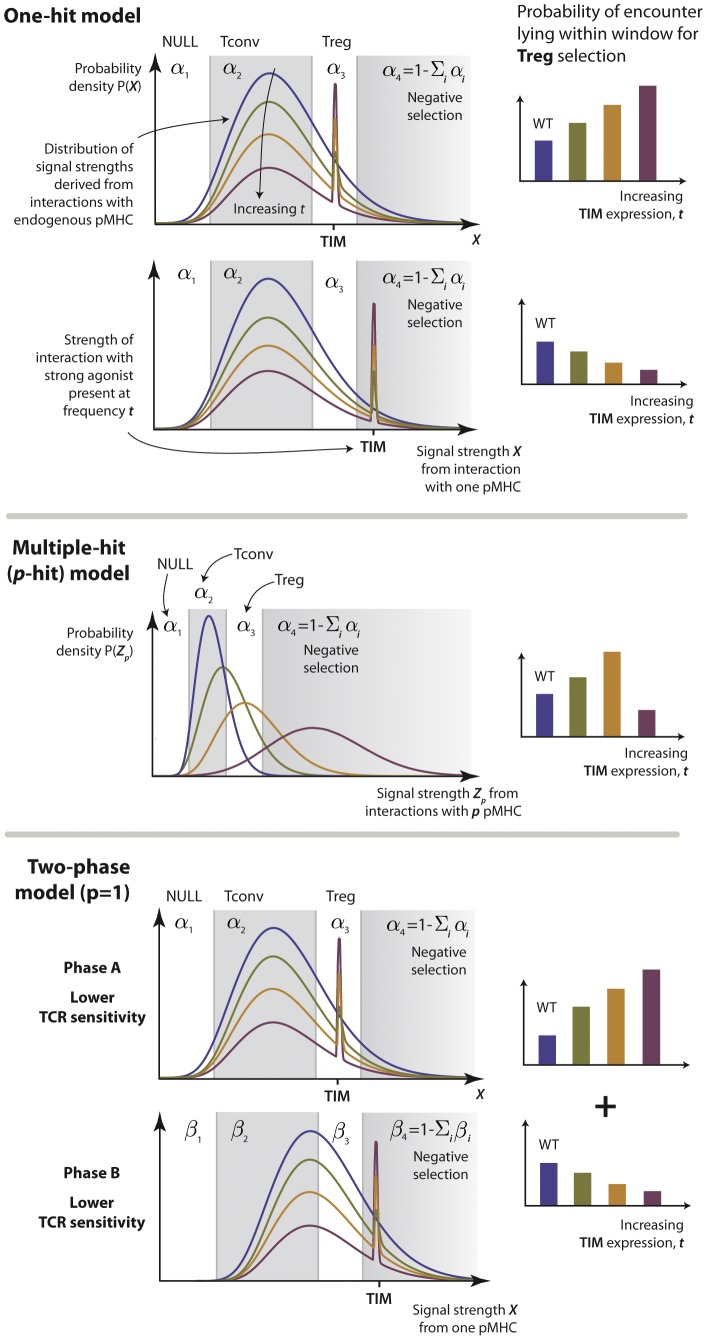
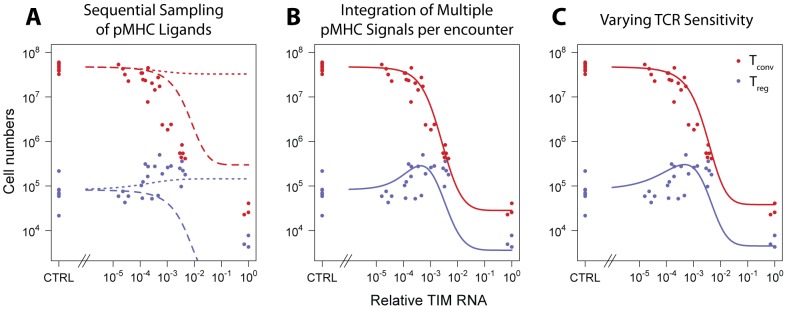
Conventional and regulatory T cells develop in the thymus where they are exposed to samples of self-peptide MHC (pMHC) ligands. This probabilistic process selects for cells within a range of responsiveness that allows the detection of foreign antigen without excessive responses to self. Regulatory T cells are thought to lie at the higher end of the spectrum of acceptable self-reactivity and play a crucial role in the control of autoimmunity and tolerance to innocuous antigens. While many studies have elucidated key elements influencing lineage commitment, we still lack a full understanding of how thymocytes integrate signals obtained by sampling self-peptides to make fate decisions. To address this problem, we apply stochastic models of signal integration by T cells to data from a study quantifying the development of the two lineages using controllable levels of agonist peptide in the thymus. We find two models are able to explain the observations; one in which T cells continually re-assess fate decisions on the basis of multiple summed proximal signals from TCR-pMHC interactions; and another in which TCR sensitivity is modulated over time, such that contact with the same pMHC ligand may lead to divergent outcomes at different stages of development. Neither model requires that T(conv) and T(reg) are differentially susceptible to deletion or that the two lineages need qualitatively different signals for development, as have been proposed. We find additional support for the variable-sensitivity model, which is able to explain apparently paradoxical observations regarding the effect of partial and strong agonists on T(conv) and T(reg) development.
传统和调节性 T 细胞在胸腺中发育,在那里它们接触到自身肽 MHC(pMHC)配体的样本。这个概率过程选择了在一定反应范围内的细胞,使它们能够检测到外来抗原,而不会对自身产生过度反应。调节性 T 细胞被认为处于可接受的自身反应性范围的较高端,在控制自身免疫和对无害抗原的耐受性方面发挥着关键作用。虽然许多研究已经阐明了影响谱系决定的关键因素,但我们仍然缺乏对胸腺细胞如何整合通过采样自身肽获得的信号以做出命运决定的全面理解。为了解决这个问题,我们应用 T 细胞信号整合的随机模型来解释一项研究的数据,该研究使用胸腺中的可控激动肽水平来量化两种谱系的发育。我们发现有两种模型能够解释观察结果;一种是 T 细胞基于 TCR-pMHC 相互作用的多个近端信号的总和不断重新评估命运决定;另一种是 TCR 敏感性随时间而变化,因此与相同的 pMHC 配体接触可能会在不同的发育阶段导致不同的结果。这两种模型都不需要 T(conv)和 T(reg)对删除有不同的敏感性,也不需要两种谱系对发育有不同的信号,正如已经提出的那样。我们发现了对可变敏感性模型的额外支持,该模型能够解释关于部分和强激动剂对 T(conv)和 T(reg)发育的影响的明显矛盾的观察结果。