Department of Psychology, University of Texas at Austin , Austin, TX , USA.
Front Hum Neurosci. 2013 Aug 2;7:450. doi: 10.3389/fnhum.2013.00450. eCollection 2013.
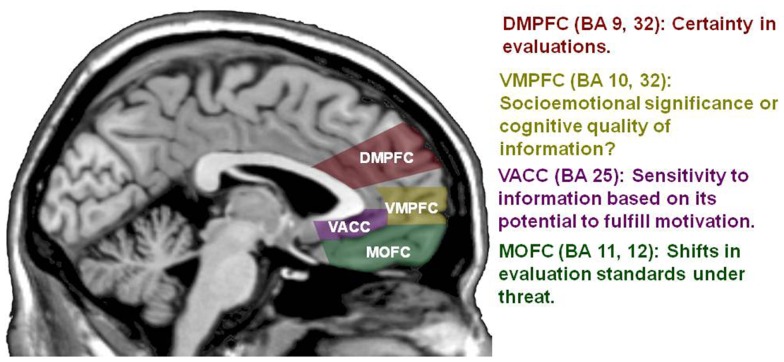
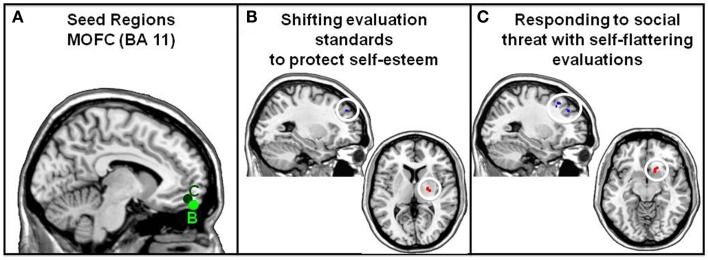
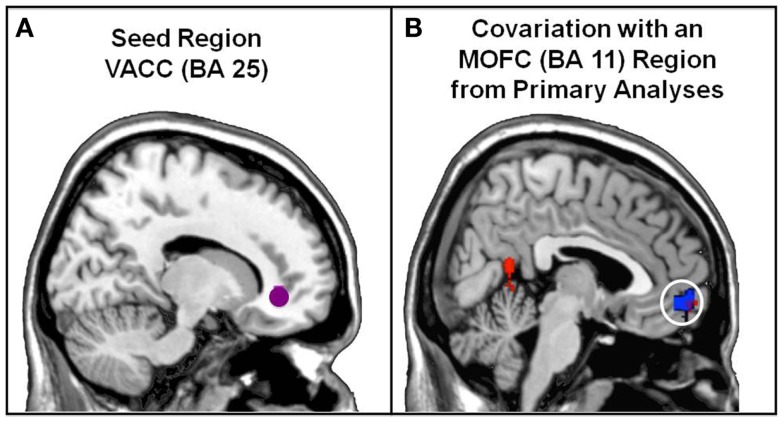
An integration of existing research and newly conducted psychophysiological interaction (PPI) connectivity analyses suggest a new framework for understanding the contribution of midline regions to social cognition. Recent meta-analyses suggest that there are no midline regions that are exclusively associated with self-processing. Whereas medial prefrontal cortex (MPFC) is broadly modulated by self-processing, subdivisions within MPFC are differentially modulated by the evaluation of close others (ventral MPFC: BA 10/32) and the evaluation of other social targets (dorsal MPFC: BA 9/32). The role of DMPFC in social cognition may also be less uniquely social than previously thought; it may be better characterized as a region that indexes certainty about evaluation rather than previously considered social mechanisms (i.e., correction of self-projection). VMPFC, a region often described as an important mediator of socioemotional significance, may instead perform a more cognitive role by reflecting the type of information brought to bear on evaluations of people we know well. Furthermore, the new framework moves beyond MPFC and hypothesizes that two other midline regions, ventral anterior cingulate cortex (VACC: BA 25) and medial orbitofrontal cortex (MOFC: BA 11), aid motivational influences on social cognition. Despite the central role of motivation in psychological models of self-perception, neural models have largely ignored the topic. Positive connectivity between VACC and MOFC may mediate bottom-up sensitivity to information based on its potential for helping us evaluate ourselves or others the way we want. As connectivity becomes more positive with striatum and less positive with middle frontal gyrus (BA 9/44), MOFC mediates top-down motivational influences by adjusting the standards we bring to bear on evaluations of ourselves and other people.
现有的研究和新进行的心理生理交互(PPI)连接分析的整合,为理解中线区域对社会认知的贡献提供了一个新的框架。最近的荟萃分析表明,没有专门与自我处理相关的中线区域。虽然内侧前额叶皮层(MPFC)广泛受到自我处理的调节,但 MPFC 的细分区域受到对亲密他人的评价(腹侧 MPFC:BA 10/32)和对其他社会目标的评价(背侧 MPFC:BA 9/32)的不同调节。DMPFC 在社会认知中的作用可能也不像以前认为的那样具有独特的社会性;它可能更好地被描述为一个索引评估确定性的区域,而不是以前认为的社会机制(即,自我投射的修正)。VMPFC,一个经常被描述为重要的社会情感意义中介的区域,可能通过反映我们对熟悉的人进行评价时所带来的信息类型,而扮演更具认知性的角色。此外,新框架超越了 MPFC,并假设另外两个中线区域,腹侧前扣带皮层(VACC:BA 25)和内侧眶额皮层(MOFC:BA 11),有助于对社会认知的动机影响。尽管动机在自我感知的心理模型中起着核心作用,但神经模型在很大程度上忽略了这个主题。VACC 和 MOFC 之间的正连接可能介导了基于信息的自下而上的敏感性,这些信息基于其帮助我们以我们想要的方式评估自己或他人的潜力。随着与纹状体的连接变得更加积极,与中间额回(BA 9/44)的连接变得不那么积极,MOFC 通过调整我们对自己和他人的评价所带来的标准,来调节自上而下的动机影响。