Dipartimento di Scienze Agrarie, Forestali e Alimentari, Università degli Studi di Torino, Grugliasco, Italy.
PLoS One. 2013 Jul 31;8(7):e69074. doi: 10.1371/journal.pone.0069074. Print 2013.
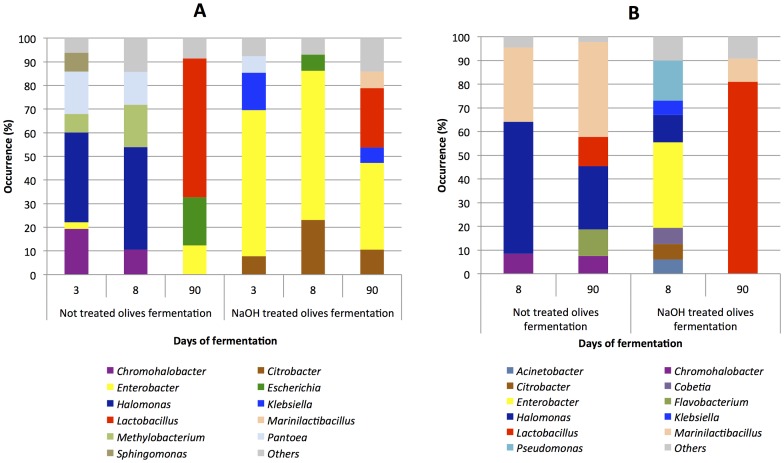
Limited information is available on the impact of the NaOH treatment on table olive fermentations, and for this reason a polyphasic approach has been adopted here to investigate its effect on the fermentation dynamics and bacterial biodiversity. The microbial counts of the main groups involved in the transformation have not shown any differences, apart from a more prompt start of the fermentation when the olives were subjected to the NaOH treatment. The data produced by culture-independent analyses highlighted that the fermentation of table olives not treated with NaOH is the result of the coexistence of two different ecosystems: the surface of the olives and the brines. A sodium hydroxide treatment not only eliminates this difference, but also affects the bacterial ecology of the olives to a great extent. As proved by high-throughput sequencing, the fermentation of the olives not treated with NaOH was characterized by the presence of halophilic bacteria, which were substituted by Lactobacillus at the later stages of the fermentation, while enterobacteria were dominant when the olives were treated with sodium hydroxide. Higher biodiversity was found for Lactobacillus plantarum isolated during untreated fermentation. Different biotypes were found on the olive surface and in the brines. When the debittering process was carried out, a decrease in the number of L. plantarum biotypes were observed and those originating from the surface of the olive did not differentiate from the ones present in the brines.
NaOH 处理对橄榄发酵的影响的相关信息有限,因此,这里采用多相方法来研究其对发酵动力学和细菌生物多样性的影响。除了经过 NaOH 处理的橄榄发酵更快开始外,主要参与转化的微生物计数没有显示出任何差异。非培养分析产生的数据表明,未经 NaOH 处理的橄榄发酵是两个不同生态系统共存的结果:橄榄表面和盐水。NaOH 处理不仅消除了这种差异,而且在很大程度上还影响了橄榄的细菌生态。高通量测序证明,未经 NaOH 处理的橄榄发酵的特征是存在嗜盐细菌,这些细菌在发酵后期被乳杆菌取代,而当橄榄用氢氧化钠处理时,肠杆菌占优势。在未处理的发酵过程中分离出的植物乳杆菌具有更高的生物多样性。在橄榄表面和盐水中发现了不同的生物型。当进行脱苦过程时,观察到 L. plantarum 生物型数量减少,并且源自橄榄表面的生物型与存在于盐水中的生物型没有区别。