Herbal Medicine Research Division, Korea Institute of Oriental Medicine, Daejeon, Republic of Korea.
PLoS One. 2013 Jul 30;8(7):e70093. doi: 10.1371/journal.pone.0070093. Print 2013.
Chronic cerebral hypoperfusion induced by permanent occlusion of the bilateral common carotid artery (BCCAO) in rats has been commonly used for the study of Alzheimer's disease and vascular dementia. Despite the apparent cognitive dysfunction in rats with BCCAO, the molecular markers or pathways involved in the pathological alternation have not been clearly identified.
Temporal changes (sham, 21, 35, 45, 55 and 70 days) in gene expression in the hippocampus of rats after BCCAO were measured using time-course microarray analysis. Gene Ontology (GO) and pathway analyses were performed to identify the functional involvement of temporally regulated genes in BCCAO.
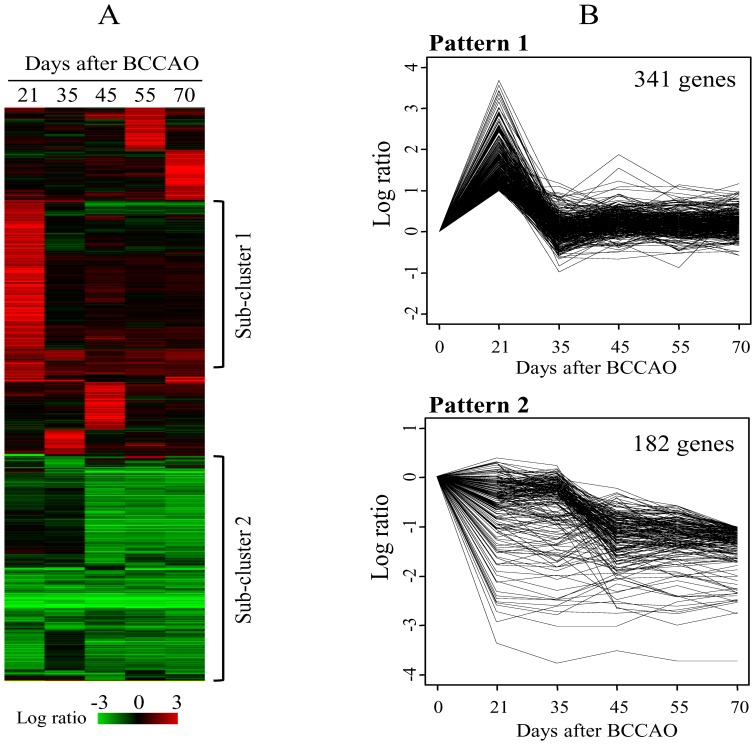
Two major gene expression patterns were observed in the hippocampus of rats after BCCAO. One pattern, which was composed of 341 early up-regulated genes after the surgical procedure, was dominantly involved in immune-related biological functions (false discovery rate [FDR]<0.01). Another pattern composed of 182 temporally delayed down-regulated genes was involved in sensory perception such as olfactory and cognition functions (FDR<0.01). In addition to the two gene expression patterns, the temporal change of GO and the pathway activities using all differentially expressed genes also confirmed that an immune response was the main early change, whereas sensory functions were delayed responses. Moreover, we identified FADD and SOCS3 as possible core genes in the sensory function loss process using text-based mining and interaction network analysis.
The biphasic regulatory mechanism first reported here could provide molecular evidence of BCCAO-induced impaired memory in rats as well as mechanism of the development of vascular dementia.
永久性阻断双侧颈总动脉(BCCAO)引起的慢性大脑低灌注已被广泛用于阿尔茨海默病和血管性痴呆的研究。尽管 BCCAO 大鼠表现出明显的认知功能障碍,但涉及病理改变的分子标志物或途径尚未明确。
使用时间过程微阵列分析测量 BCCAO 后大鼠海马中基因表达的时间变化(假手术,21、35、45、55 和 70 天)。进行基因本体论(GO)和途径分析,以确定时间调节基因在 BCCAO 中的功能参与。
在 BCCAO 后大鼠海马中观察到两种主要的基因表达模式。一种模式由手术后 341 个早期上调基因组成,主要涉及免疫相关的生物学功能(错误发现率[FDR] <0.01)。另一种模式由 182 个时间延迟下调的基因组成,涉及嗅觉和认知等感觉感知功能(FDR <0.01)。除了这两种基因表达模式外,使用所有差异表达基因的 GO 时间变化和途径活性也证实,免疫反应是主要的早期变化,而感觉功能是延迟的反应。此外,我们使用基于文本的挖掘和相互作用网络分析,确定了 FADD 和 SOCS3 作为感觉功能丧失过程中可能的核心基因。
这里首次报道的双相调节机制可为 BCCAO 诱导大鼠记忆障碍的分子证据以及血管性痴呆发展的机制提供依据。