Department of Physiology, University of Kentucky College of Medicine, Lexington, Kentucky, USA.
PLoS One. 2013 Jul 30;8(7):e70505. doi: 10.1371/journal.pone.0070505. Print 2013.
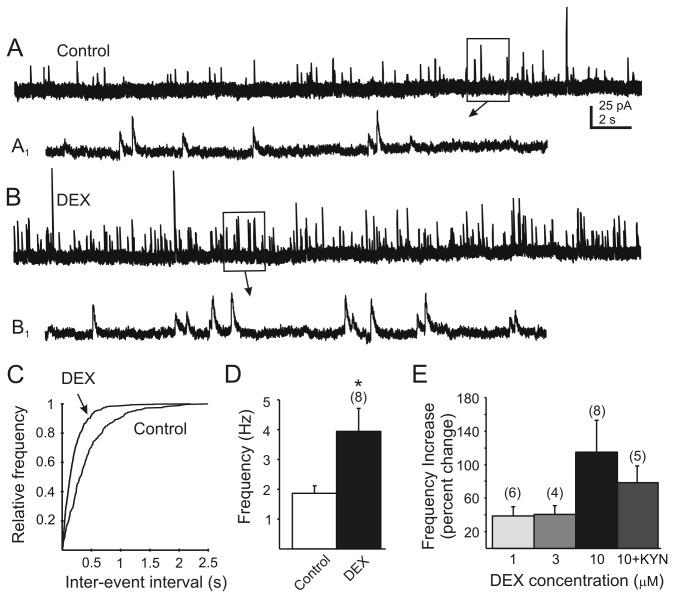
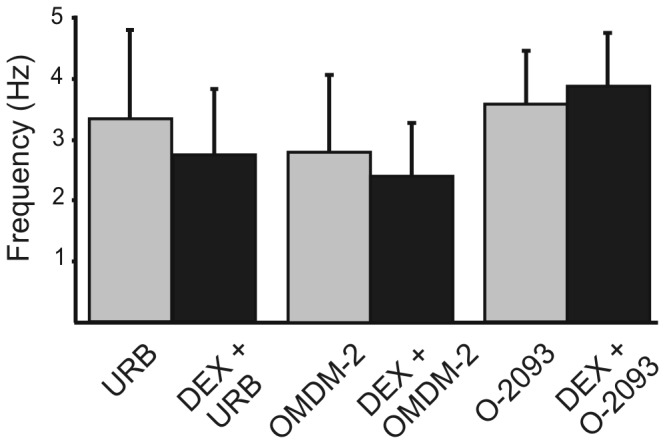
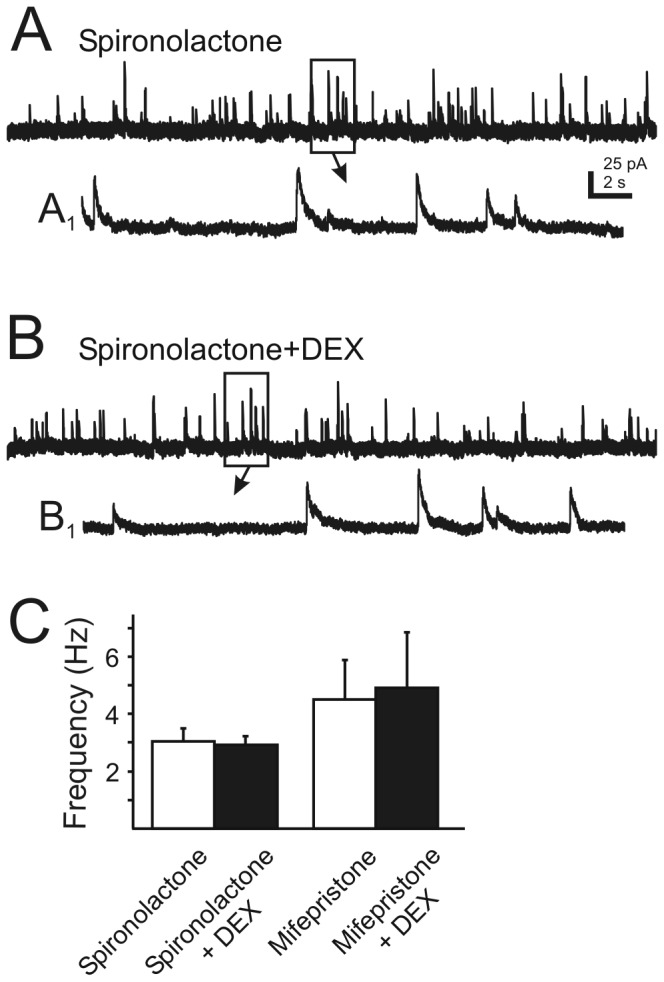
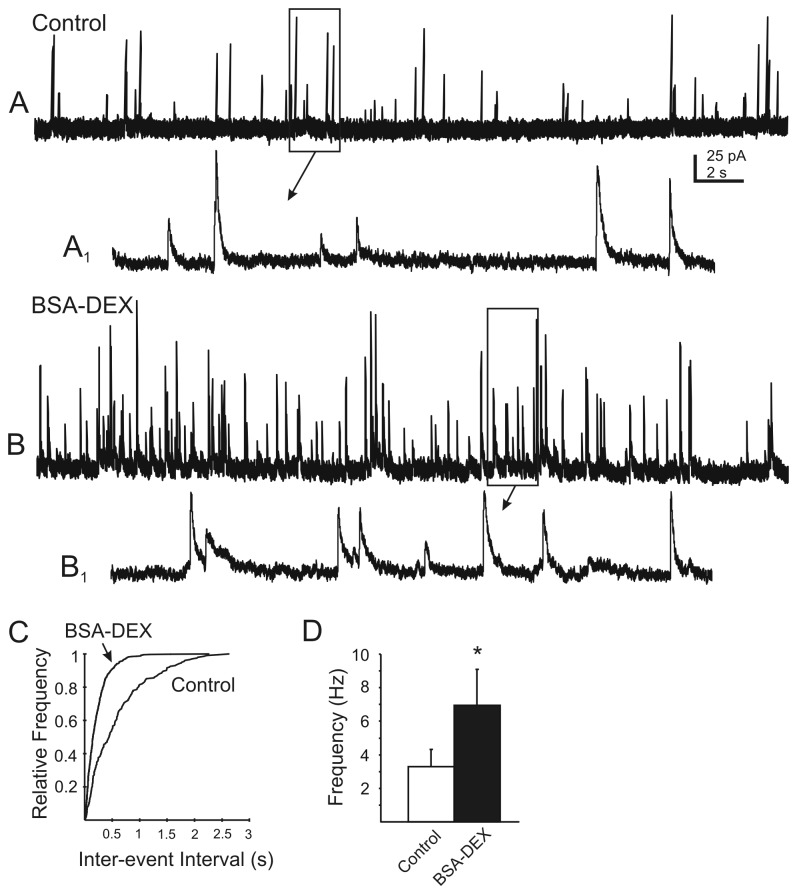
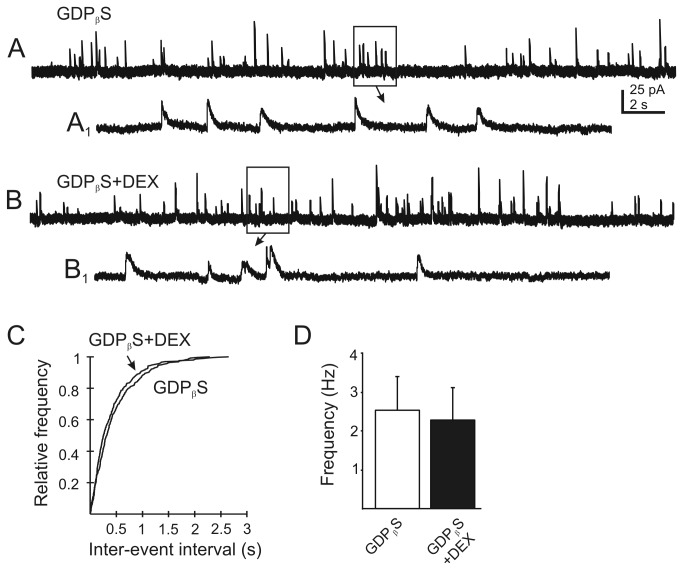
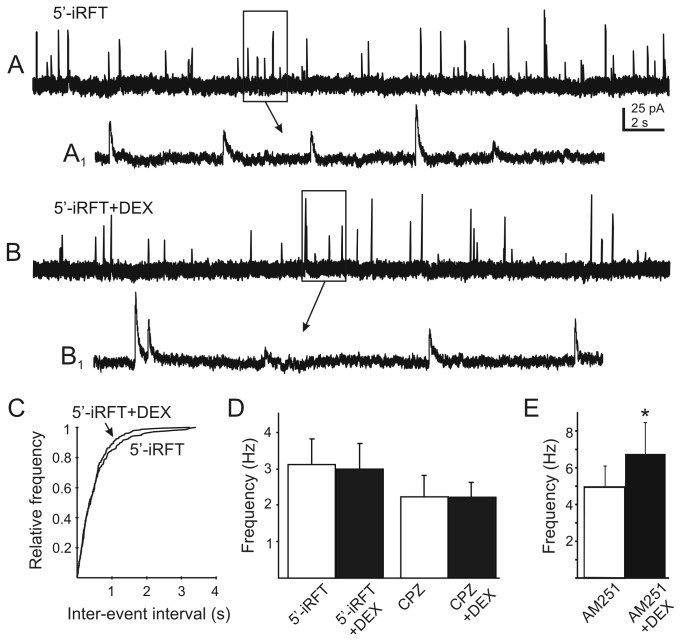
Glucocorticoids influence vagal parasympathetic output to the viscera via mechanisms that include modulation of neural circuitry in the dorsal vagal complex, a principal autonomic regulatory center. Glucocorticoids can modulate synaptic neurotransmitter release elsewhere in the brain by inducing release of retrograde signalling molecules. We tested the hypothesis that the glucocorticoid agonist dexamethasone (DEX) modulates GABA release in the rat dorsal motor nucleus of the vagus (DMV). Whole-cell patch-clamp recordings revealed that DEX (1-10 µM) rapidly (i.e. within three minutes) increased the frequency of tetrodotoxin-resistant, miniature IPSCs (mIPSCs) in 67% of DMV neurons recorded in acutely prepared slices. Glutamate-mediated mEPSCs were also enhanced by DEX (10 µM), and blockade of ionotropic glutamate receptors reduced the DEX effect on mIPSC frequency. Antagonists of type I or II corticosteroid receptors blocked the effect of DEX on mIPSCs. The effect was mimicked by application of the membrane-impermeant BSA-conjugated DEX, and intracellular blockade of G protein function with GDP βS in the recorded cell prevented the effect of DEX. The enhancement of GABA release was blocked by the TRPV1 antagonists, 5'-iodoresiniferatoxin or capsazepine, but was not altered by the cannabinoid type 1 receptor antagonist AM251. The DEX effect was prevented by blocking fatty acid amide hydrolysis or by inhibiting anandamide transport, implicating involvement of the endocannabinoid system in the response. These findings indicate that DEX induces an enhancement of GABA release in the DMV, which is mediated by activation of TRPV1 receptors on afferent terminals. The effect is likely induced by anandamide or other 'endovanilloid', suggesting activation of a local retrograde signal originating from DMV neurons to enhance synaptic inhibition locally in response to glucocorticoids.
糖皮质激素通过调节包括背侧迷走复合体(主要自主调节中心)中的神经回路在内的机制影响内脏的迷走副交感神经输出。糖皮质激素可以通过诱导逆行信号分子的释放来调节大脑其他部位的突触神经递质释放。我们检验了这样一个假设,即糖皮质激素激动剂地塞米松(DEX)调节大鼠迷走神经背核(DMV)中的 GABA 释放。全细胞膜片钳记录显示,DEX(1-10 μM)在急性切片中记录的 67%的 DMV 神经元中,快速(即在三分钟内)增加了河豚毒素抗性、微小 IPSC(mIPSC)的频率。DEX(10 μM)也增强了谷氨酸介导的 mEPSC,离子型谷氨酸受体阻断剂降低了 DEX 对 mIPSC 频率的影响。I 型或 II 型皮质类固醇受体拮抗剂阻断了 DEX 对 mIPSCs 的影响。用不透过膜的 BSA 结合 DEX 进行处理可以模拟这种作用,并且在记录细胞中用 GDPβS 阻断 G 蛋白功能可以阻止 DEX 的作用。TRPV1 拮抗剂 5'-碘-Resiniferatoxin 或 Capsazepine 阻断了 GABA 释放的增强,但大麻素 1 型受体拮抗剂 AM251 没有改变。阻断脂肪酸酰胺水解或抑制大麻素转运可以阻止 DEX 的作用,这表明内源性大麻素系统参与了这一反应。这些发现表明,DEX 诱导 DMV 中 GABA 释放增强,这是通过传入末端 TRPV1 受体的激活介导的。该作用可能是由大麻素或其他“内源性大麻素”诱导的,这表明激活源自 DMV 神经元的局部逆行信号,以响应糖皮质激素增强局部的突触抑制。