Institute of Pathology, Medical University of Graz, Graz, Austria.
PLoS One. 2013 Jul 31;8(7):e70714. doi: 10.1371/journal.pone.0070714. Print 2013.
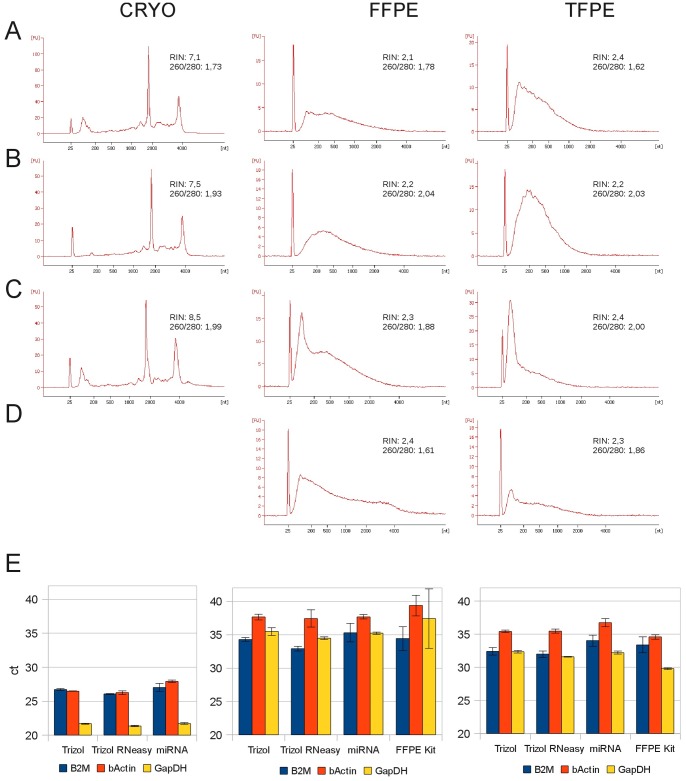
Analysis of RNA isolated from fixed and paraffin-embedded tissues is widely used in biomedical research and molecular pathological diagnostics. We have performed a comprehensive and systematic investigation of the impact of factors in the pre-analytical workflow, such as different fixatives, fixation time, RNA extraction method and storage of tissues in paraffin blocks, on several downstream reactions including complementary DNA (cDNA) synthesis, quantitative reverse transcription polymerase chain reaction (qRT-PCR) and microarray hybridization. We compared the effects of routine formalin fixation with the non-crosslinking, alcohol-based Tissue Tek Xpress Molecular Fixative (TTXMF, Sakura Finetek), and cryopreservation as gold standard for molecular analyses. Formalin fixation introduced major changes into microarray gene expression data and led to marked gene-to-gene variations in delta-ct values of qRT-PCR. We found that qRT-PCR efficiency and gene-to-gene variations were mainly attributed to differences in the efficiency of cDNA synthesis as the most sensitive step. These differences could not be reliably detected by quality assessment of total RNA isolated from formalin-fixed tissues by electrophoresis or spectrophotometry. Although RNA from TTXMF fixed samples was as fragmented as RNA from formalin fixed samples, much higher cDNA yield and lower ct-values were obtained in qRT-PCR underlining the negative impact of crosslinking by formalin. In order to better estimate the impact of pre-analytical procedures such as fixation on the reliability of downstream analysis, we applied a qRT-PCR-based assay using amplicons of different length and an assay measuring the efficiency of cDNA generation. Together these two assays allowed better quality assessment of RNA extracted from fixed and paraffin-embedded tissues and should be used to supplement quality scores derived from automated electrophoresis. A better standardization of the pre-analytical workflow, application of additional quality controls and detailed sample information would markedly improve the comparability and reliability of molecular studies based on formalin-fixed and paraffin-embedded tissue samples.
从固定和石蜡包埋组织中分离的 RNA 分析广泛应用于生物医学研究和分子病理诊断。我们对预分析工作流程中的各种因素(如不同的固定剂、固定时间、RNA 提取方法以及石蜡块中组织的储存)对包括 cDNA 合成、定量逆转录聚合酶链反应(qRT-PCR)和微阵列杂交在内的下游反应的影响进行了全面和系统的研究。我们比较了常规福尔马林固定与非交联、基于酒精的 TissueTek Xpress 分子固定剂(TTXMF,Sakura Finetek)以及作为分子分析金标准的冷冻保存的效果。福尔马林固定会对微阵列基因表达数据产生重大影响,并导致 qRT-PCR 的 delta-ct 值基因间的明显变化。我们发现 qRT-PCR 效率和基因间的差异主要归因于 cDNA 合成效率的差异,这是最敏感的步骤。这些差异无法通过电泳或分光光度法评估福尔马林固定组织中分离的总 RNA 的质量来可靠地检测到。尽管 TTXMF 固定样本的 RNA 与福尔马林固定样本的 RNA 一样碎片化,但 qRT-PCR 中获得的 cDNA 产量更高,ct 值更低,这突出了福尔马林交联的负面影响。为了更好地估计固定等预分析程序对下游分析可靠性的影响,我们应用了一种基于 qRT-PCR 的检测方法,该方法使用不同长度的扩增子和一种测量 cDNA 生成效率的检测方法。这两种检测方法一起可以更好地评估从固定和石蜡包埋组织中提取的 RNA 的质量,并应补充自动电泳得出的质量评分。更好地标准化预分析工作流程、应用额外的质量控制和详细的样本信息将显著提高基于福尔马林固定和石蜡包埋组织样本的分子研究的可比性和可靠性。