Roy M. Huffington Department of Earth Sciences, Southern Methodist University, Dallas, Texas, United States of America.
PLoS One. 2013 Aug 2;8(8):e69308. doi: 10.1371/journal.pone.0069308. Print 2013.
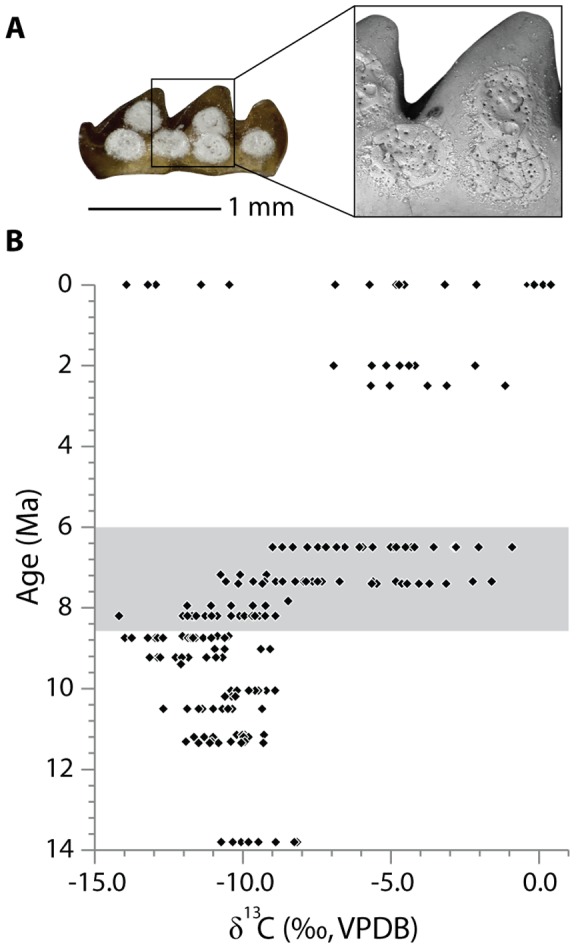
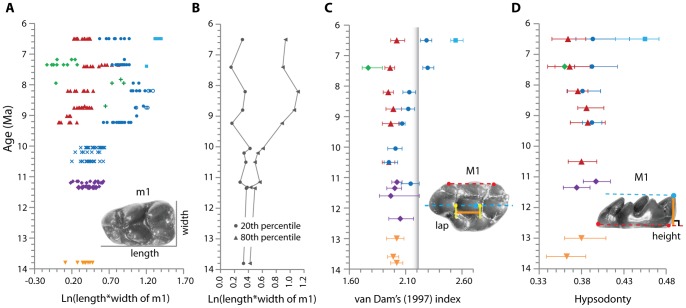
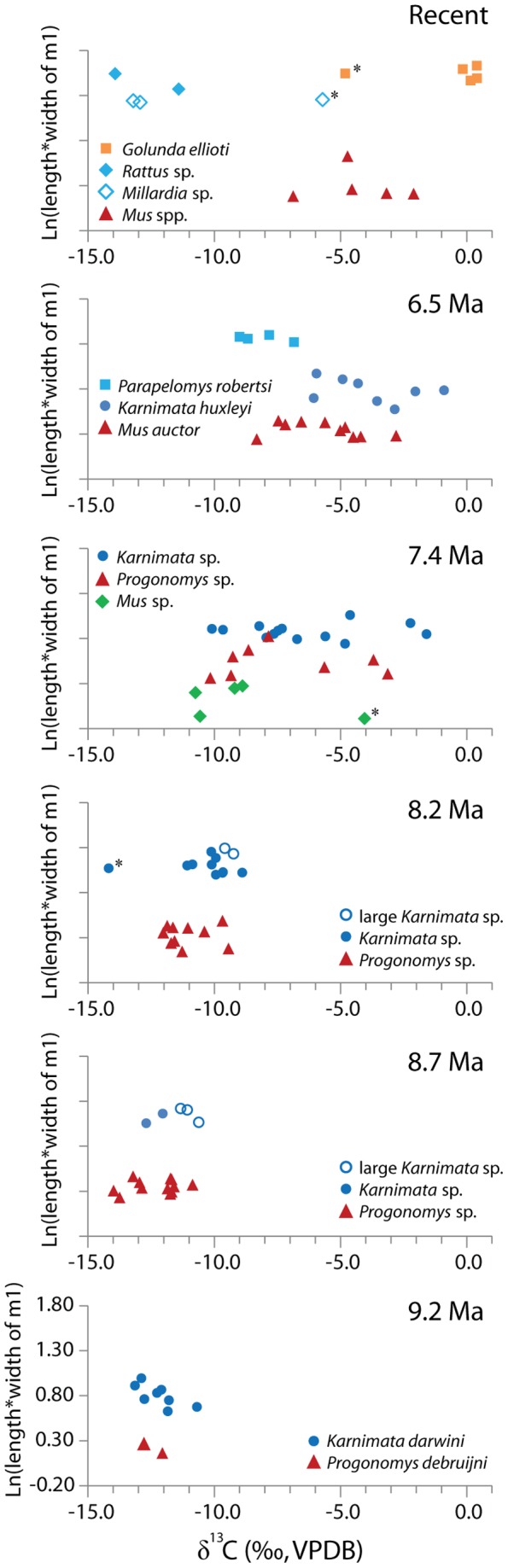
Stable carbon isotope analysis in tooth enamel is a well-established approach to infer C3 and C4 dietary composition in fossil mammals. The bulk of past work has been conducted on large herbivorous mammals. One important finding is that their dietary habits of fossil large mammals track the late Miocene ecological shift from C3 forest and woodland to C4 savannah. However, few studies on carbon isotopes of fossil small mammals exist due to limitations imposed by the size of rodent teeth, and the isotopic ecological and dietary behaviors of small mammals to climate change remain unknown. Here we evaluate the impact of ecological change on small mammals by fine-scale comparisons of carbon isotope ratios (δ(13)C) with dental morphology of murine rodents, spanning 13.8 to ∼2.0 Ma, across the C3 to C4 vegetation shift in the Miocene Siwalik sequence of Pakistan. We applied in-situ laser ablation GC-IRMS to lower first molars and measured two grazing indices on upper first molars. Murine rodents yield a distinct, but related, record of past ecological conditions from large herbivorous mammals, reflecting available foods in their much smaller home ranges. In general, larger murine species show more positive δ(13)C values and have higher grazing indices than smaller species inhabiting the same area at any given age. Two clades of murine rodents experienced different rates of morphological change. In the faster-evolving clade, the timing and trend of morphological innovations are closely tied to consumption of C4 diet during the vegetation shift. This study provides quantitative evidence of linkages among diet, niche partitioning, and dental morphology at a more detailed level than previously possible.
牙釉质稳定碳同位素分析是一种成熟的方法,可以推断化石哺乳动物中的 C3 和 C4 饮食组成。过去的大部分工作都是在大型食草哺乳动物身上进行的。一个重要的发现是,它们的饮食习惯与中新世晚期从 C3 森林和林地到 C4 热带稀树草原的生态转变相吻合。然而,由于啮齿动物牙齿的大小限制,以及对气候变化的小型哺乳动物的同位素生态和饮食行为的了解有限,因此很少有关于化石小型哺乳动物的碳同位素研究。在这里,我们通过对巴基斯坦中新世锡瓦利克序列中跨越 C3 到 C4 植被转变的 13.8 到 ∼2.0 Ma 的啮齿目动物牙齿形态的精细比较,评估了生态变化对小型哺乳动物的影响。我们应用原位激光烧蚀 GC-IRMS 测量了下第一磨牙的碳同位素比值 (δ(13)C),并在上第一磨牙上测量了两个放牧指数。与大型食草动物相比,啮齿目动物提供了一个独特但相关的过去生态条件记录,反映了其小得多的家园范围内的可用食物。一般来说,较大的啮齿动物的 δ(13)C 值更积极,且在同一地区的较小物种具有更高的放牧指数。两种啮齿目动物支系经历了不同的形态变化速度。在进化较快的支系中,形态创新的时间和趋势与植被转变期间 C4 饮食的消耗密切相关。与之前可能的情况相比,这项研究提供了在更详细的层面上,饮食、生态位分化和牙齿形态之间联系的定量证据。