Graduate Program in Science for Aging and Yonsei Research Institute of Aging Science, Yonsei University, Seoul, Republic of Korea.
PLoS One. 2013 Aug 1;8(8):e69669. doi: 10.1371/journal.pone.0069669. Print 2013.
The cross talk between RAGE and angiotensin II (AngII) activation may be important in the development of atherosclerosis. Soluble RAGE (sRAGE), a truncated soluble form of the receptor, acts as a decoy and prevents the inflammatory response mediated by RAGE activation. In this study, we sought to determine the effect of sRAGE in inhibiting AngII-induced atherosclerosis in apolipoprotein E knockout mice (Apo E KO).
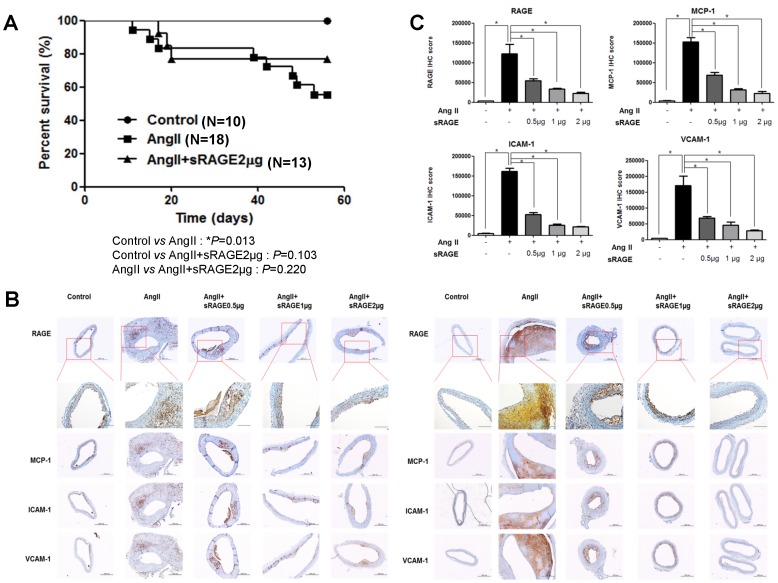
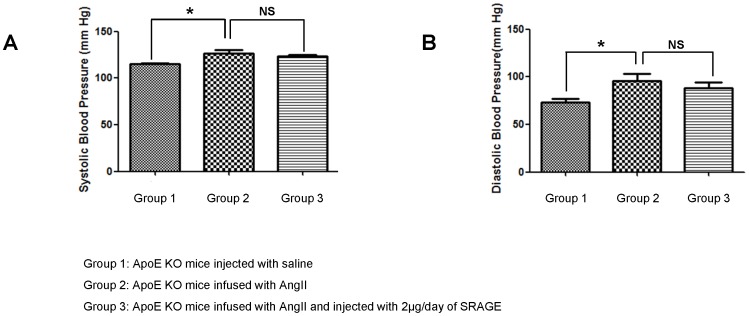
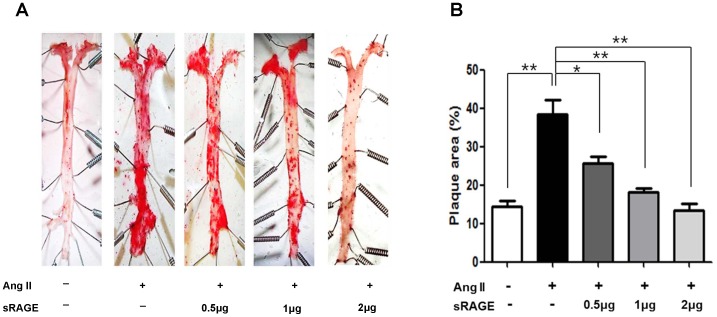
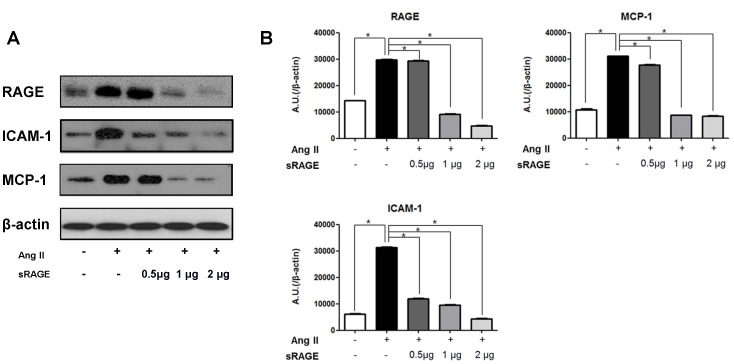
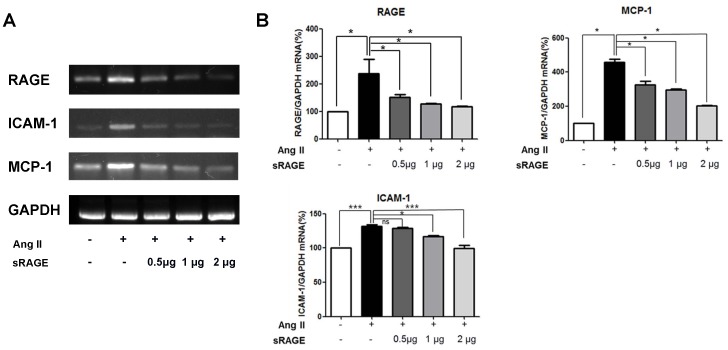
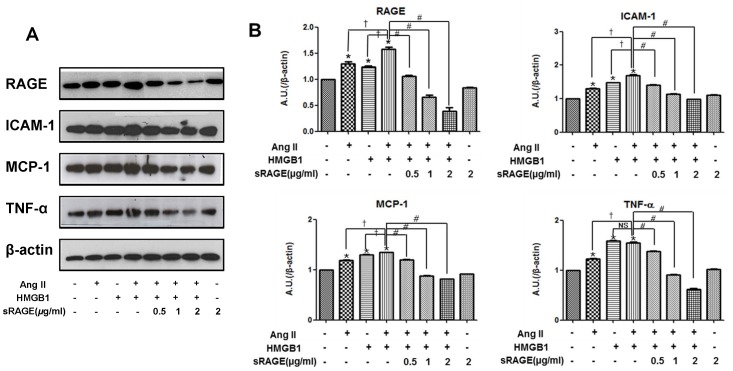
9 week old Apo E KO mice were infused subcutaneously with AngII (1 µg/min/kg) and saline for 4 weeks using osmotic mini-pumps. The mice were divided into 4 groups 1. saline infusion and saline injection; 2. saline infusion and sRAGE injection; 3. AngII infusion and saline injection; 4. AngII infusion and sRAGE injection. Saline or 0.5 µg, 1 µg, to 2 µg/day/mouse of sRAGE were injected intraperitoneally daily for 28 days. We showed that atherosclerotic plaque areas in the AngII-infused Apo E KO mice and markers of inflammation such as RAGE, ICAM-1, VCAM-1, and MCP-1 were increased in aorta compared to that of the Apo E KO mice. However, the treatment of 0.5 µg, 1 µg, and 2 µg of sRAGE in AngII group resulted in the dose-dependent decrease in atherosclerotic plaque area. We also demonstrated that sRAGE decreased RAGE expression level as well as inflammatory cytokines and cell adhesion molecules in AngII or HMGB1 treated-rat aorta vascular smooth muscle cells.
The results demonstrated that partical blockade of RAGE activation by sRAGE prevent AngII -induced atherosclerosis. Therefore these results suggested that first, RAGE activation may be important in mediating AngII-induced atherogenesis, and second, AngII activation is a major pathway in the development of atherosclerosis. Taken together, results from this study may provide the basis for future anti- atherosclerotic drug development mediated through RAGE activation.
晚期糖基化终末产物受体(RAGE)与血管紧张素 II(AngII)激活的串扰可能在动脉粥样硬化的发生中起重要作用。可溶性 RAGE(sRAGE)是受体的一种截断的可溶性形式,作为诱饵,可防止 RAGE 激活介导的炎症反应。在这项研究中,我们试图确定 sRAGE 在抑制载脂蛋白 E 敲除(Apo E KO)小鼠的 AngII 诱导的动脉粥样硬化中的作用。
使用渗透微型泵将 9 周龄的 Apo E KO 小鼠皮下输注 AngII(1μg/min/kg)和盐水 4 周。将小鼠分为 4 组:1. 盐水输注和盐水注射;2. 盐水输注和 sRAGE 注射;3. AngII 输注和盐水注射;4. AngII 输注和 sRAGE 注射。每天腹腔内注射 0.5μg、1μg、2μg/天/只的 sRAGE 28 天。我们发现与 Apo E KO 小鼠相比,AngII 输注的 Apo E KO 小鼠的动脉粥样硬化斑块面积和炎症标志物(如 RAGE、ICAM-1、VCAM-1 和 MCP-1)增加。然而,AngII 组中 0.5μg、1μg 和 2μg 的 sRAGE 处理导致动脉粥样硬化斑块面积呈剂量依赖性减少。我们还表明,sRAGE 降低了 AngII 或高迁移率族蛋白 B1 处理的大鼠主动脉血管平滑肌细胞中 RAGE 表达水平以及炎症细胞因子和细胞间黏附分子。
结果表明,sRAGE 通过部分阻断 RAGE 激活来预防 AngII 诱导的动脉粥样硬化。因此,这些结果表明,首先,RAGE 激活可能在介导 AngII 诱导的动脉粥样形成中起重要作用,其次,AngII 激活是动脉粥样硬化发生的主要途径。总之,这项研究的结果可能为未来通过 RAGE 激活介导的抗动脉粥样硬化药物开发提供基础。