Pulmonary Division, University Hospital Zurich, Zurich, Switzerland.
PLoS One. 2013 Aug 1;8(8):e70081. doi: 10.1371/journal.pone.0070081. Print 2013.
Travel to mountain areas is popular. However, the effects of acute exposure to moderate altitude on the cardiovascular system and metabolism are largely unknown.
To investigate the effects of acute exposure to moderate altitude on vascular function, metabolism and systemic inflammation.
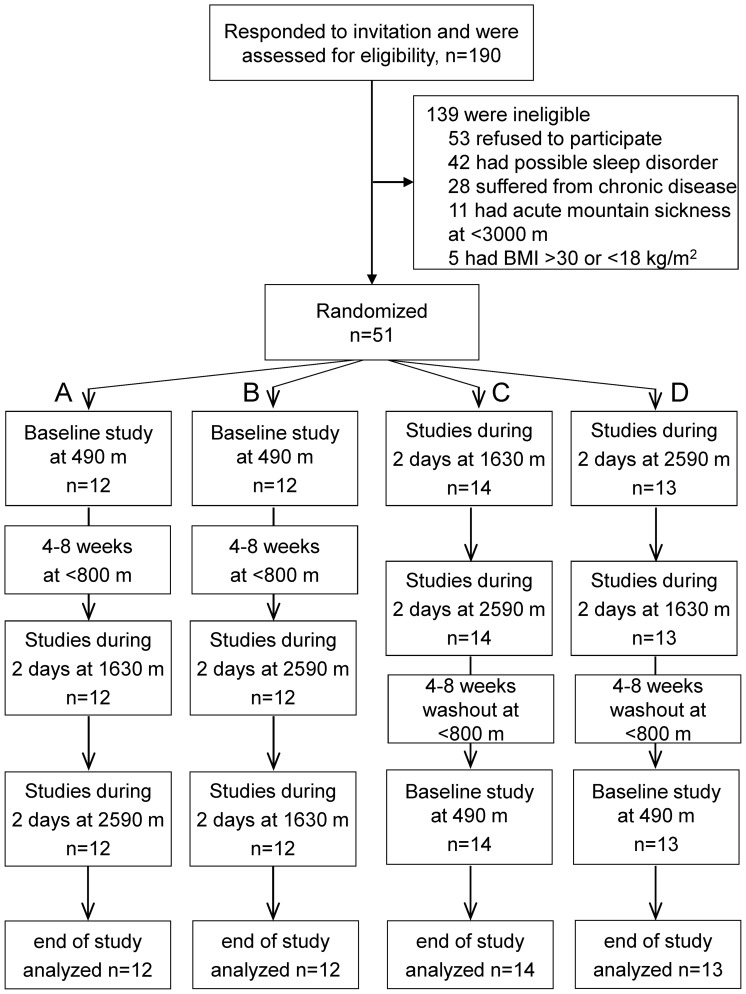
In 51 healthy male subjects with a mean (SD) age of 26.9 (9.3) years, oxygen saturation, blood pressure, heart rate, arterial stiffness, lipid profiles, low density lipoprotein (LDL) particle size, insulin resistance (HOMA-index), highly-sensitive C-reactive protein and pro-inflammatory cytokines were measured at 490 m (Zurich) and during two days at 2590 m, (Davos Jakobshorn, Switzerland) in randomized order. The largest differences in outcomes between the two altitudes are reported.
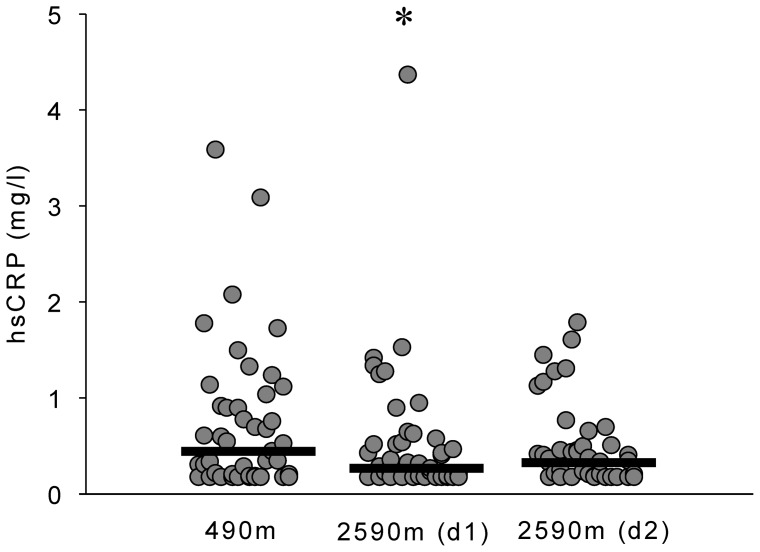
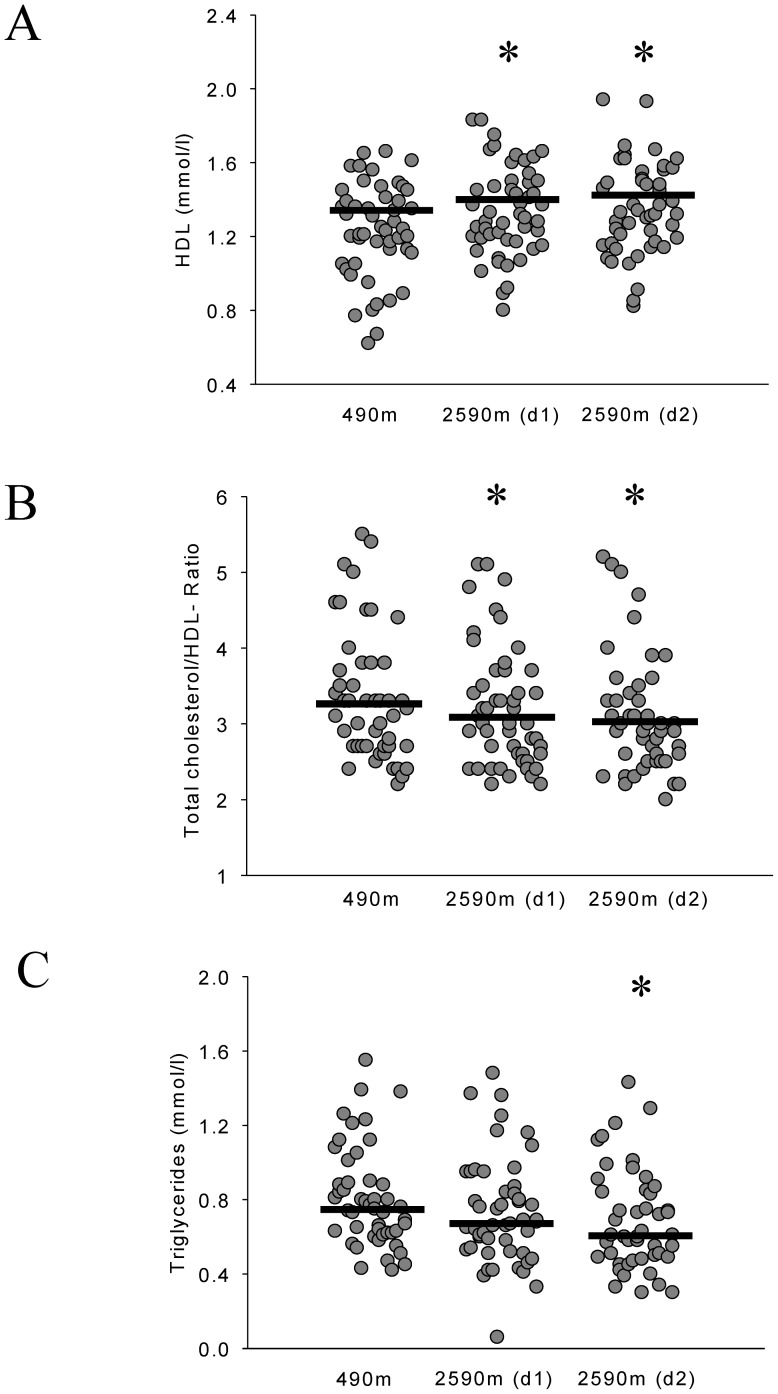
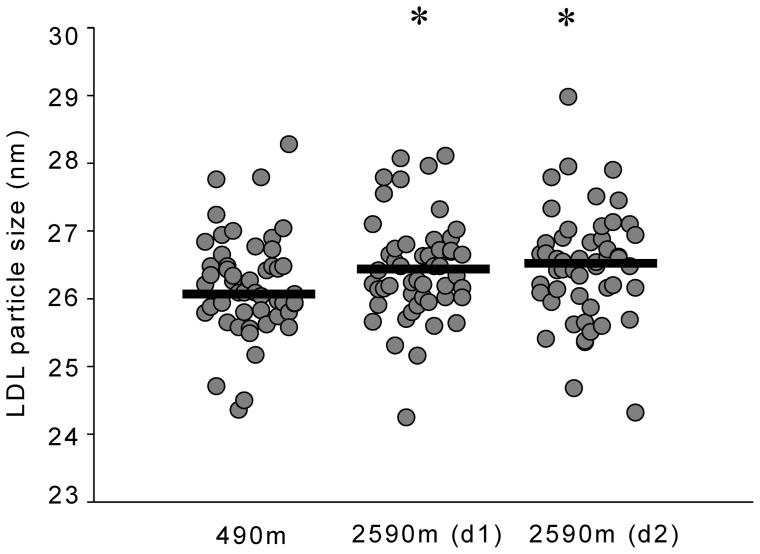
Mean (SD) oxygen saturation was significantly lower at 2590 m, 91.0 (2.0)%, compared to 490 m, 96.0 (1.0)%, p<0.001. Mean blood pressure (mean difference +4.8 mmHg, p<0.001) and heart rate (mean difference +3.3 bpm, p<0.001) were significantly higher at 2590 m, compared to 490 m, but this was not associated with increased arterial stiffness. At 2590 m, lipid profiles improved (median difference triglycerides -0.14 mmol/l, p=0.012, HDL +0.08 mmol/l, p<0.001, total cholesterol/HDL-ratio -0.25, p=0.001), LDL particle size increased (median difference +0.45 nm, p=0.048) and hsCRP decreased (median difference -0.18 mg/l, p=0.024) compared to 490 m. No significant change in pro-inflammatory cytokines or insulin resistance was observed upon ascent to 2590 m.
Short-term stay at moderate altitude is associated with increased blood pressure and heart rate likely due to augmented sympathetic activity. Exposure to moderate altitude improves the lipid profile and systemic inflammation, but seems to have no significant effect on glucose metabolism.
ClinicalTrials.gov NCT01130948.
前往山区是很受欢迎的。然而,急性暴露于中等海拔高度对心血管系统和新陈代谢的影响在很大程度上尚不清楚。
研究急性暴露于中等海拔高度对血管功能、代谢和全身炎症的影响。
在 51 名年龄为 26.9(9.3)岁的健康男性中,以随机顺序测量血氧饱和度、血压、心率、动脉僵硬度、血脂谱、低密度脂蛋白(LDL)颗粒大小、胰岛素抵抗(HOMA 指数)、高敏 C 反应蛋白和促炎细胞因子,在 490 m(苏黎世)和 2590 m(瑞士达沃斯雅各布港)持续两天。报告了两个海拔高度之间结果的最大差异。
2590 m 时的平均(SD)血氧饱和度明显较低,为 91.0(2.0)%,而 490 m 时为 96.0(1.0)%,p<0.001。2590 m 时的平均血压(平均差值+4.8 mmHg,p<0.001)和心率(平均差值+3.3 bpm,p<0.001)明显高于 490 m,但这与动脉僵硬度的增加无关。在 2590 m 时,血脂谱改善(中位数差异甘油三酯-0.14 mmol/l,p=0.012,HDL+0.08 mmol/l,p<0.001,总胆固醇/HDL-比值-0.25,p=0.001),LDL 颗粒大小增加(中位数差异+0.45 nm,p=0.048),hsCRP 降低(中位数差异-0.18 mg/l,p=0.024),与 490 m 相比。升高至 2590 m 时,促炎细胞因子或胰岛素抵抗无明显变化。
短期暴露于中等海拔高度与血压和心率升高有关,可能是由于交感神经活动增强所致。暴露于中等海拔高度可改善血脂谱和全身炎症,但似乎对葡萄糖代谢没有显著影响。
ClinicalTrials.gov NCT01130948。