Department of Laboratory Medicine, Shengjing Hospital, China Medical University, Shenyang, PR China.
PLoS One. 2013 Aug 6;8(8):e70457. doi: 10.1371/journal.pone.0070457. Print 2013.
A large number of studies have confirmed that excessive apoptosis is one of the reasons for deficient neuronal function in neural tube defects (NTDs). A previous study from our laboratory used 2-D gel electrophoresis to demonstrate that 14-3-3ζ expression was low in the spinal cords of rat fetuses with spina bifida aperta at embryonic day (E) 17. As a member of the 14-3-3 protein family, 14-3-3ζ plays a crucial role in the determination of cell fate and anti-apoptotic activity. However, neither the expression of 14-3-3ζ in defective spinal cords, nor the correlation between 14-3-3ζ and excessive apoptosis in NTDs has been fully confirmed.
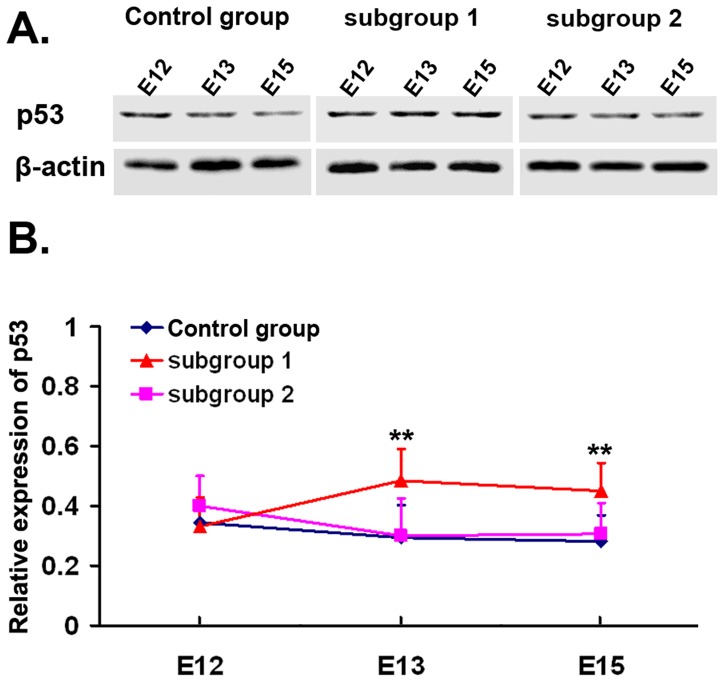
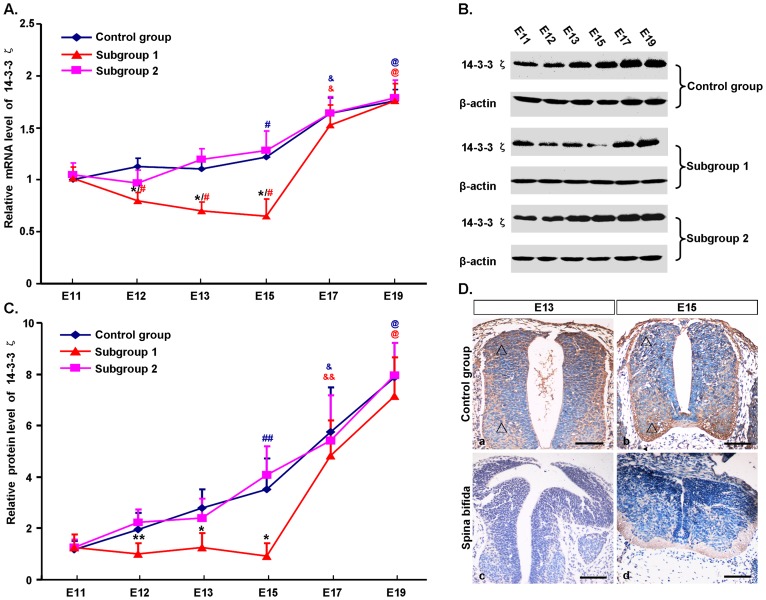
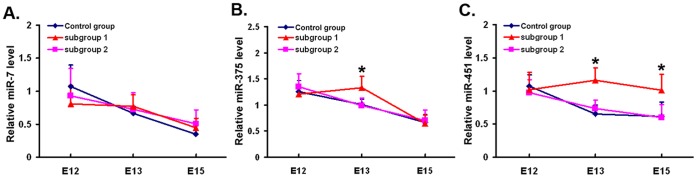
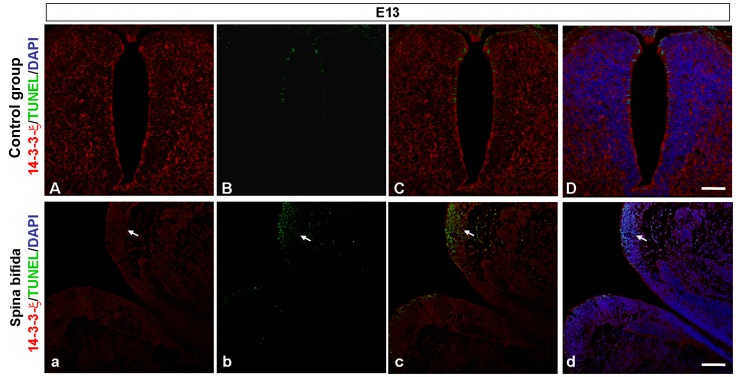
METHODOLOGY/PRINCIPAL FINDINGS: We used immunoblotting and quantitative real-time PCR (qRT-PCR) to quantify the expression of 14-3-3ζ and double immunofluorescence to visualize 14-3-3ζ and apoptosis. We found that, compared with controls, 14-3-3ζ was down-regulated in spina bifida between E12 and E15. Excessive apoptotic cells and low expression of 14-3-3ζ were observed in the dorsal region of spinal cords with spina bifida during the same time period. To initially explore the molecular mechanisms of apoptosis in NTDs, we investigated the expression of microRNA-7 (miR-7), microRNA-375 (miR-375) and microRNA-451 (miR-451), which are known to down-regulate 14-3-3ζ in several different cell types. We also investigated the expression of p53, a molecule that is downstream of 14-3-3ζ and can be down-regulated by it. We discovered that, in contrast to the reduction of 14-3-3ζ expression, the expression of miR-451, miR-375 and p53 increased in spina bifida rat fetuses.
CONCLUSIONS/SIGNIFICANCE: These data suggest that the reduced expression of 14-3-3ζ plays a role in the excessive apoptosis that occurs in spina bifida and may be partly regulated by the over-expression of miR-451 and miR-375, and the consequent up-regulation of p53 might further promote apoptosis in spina bifida.
大量研究证实,过度凋亡是神经管缺陷(NTDs)中神经元功能缺陷的原因之一。本实验室之前的一项研究使用二维凝胶电泳技术证明,在 E17 天开放性脊柱裂胎鼠的脊髓中,14-3-3ζ 的表达降低。作为 14-3-3 蛋白家族的一员,14-3-3ζ 在细胞命运的决定和抗凋亡活性中发挥着关键作用。然而,14-3-3ζ 在缺陷性脊髓中的表达,以及 14-3-3ζ 与 NTDs 中过度凋亡之间的相关性尚未得到充分证实。
方法/主要发现:我们使用免疫印迹和实时定量 PCR(qRT-PCR)来定量 14-3-3ζ 的表达,并通过双重免疫荧光来可视化 14-3-3ζ 和凋亡。我们发现,与对照组相比,E12 至 E15 期间脊柱裂中的 14-3-3ζ 下调。在同一时期,脊柱裂的脊髓背侧区域观察到过多的凋亡细胞和 14-3-3ζ 的低表达。为了初步探讨 NTDs 中细胞凋亡的分子机制,我们研究了 microRNA-7(miR-7)、microRNA-375(miR-375)和 microRNA-451(miR-451)的表达,这些 miRNA 已知在几种不同的细胞类型中下调 14-3-3ζ。我们还研究了分子 p53 的表达,p53 是 14-3-3ζ 的下游分子,可以被其下调。我们发现,与 14-3-3ζ 表达的降低相反,miR-451、miR-375 和 p53 的表达在脊柱裂胎鼠中增加。
结论/意义:这些数据表明,14-3-3ζ 的表达减少在脊柱裂中发生的过度凋亡中起作用,并且可能部分受 miR-451 和 miR-375 的过表达以及随之而来的 p53 的上调调节,而 p53 的上调可能进一步促进脊柱裂中的凋亡。