Department of Molecular Medicine, University of Auckland, Auckland, New Zealand.
PLoS One. 2013 Aug 1;8(8):e71337. doi: 10.1371/journal.pone.0071337. Print 2013.
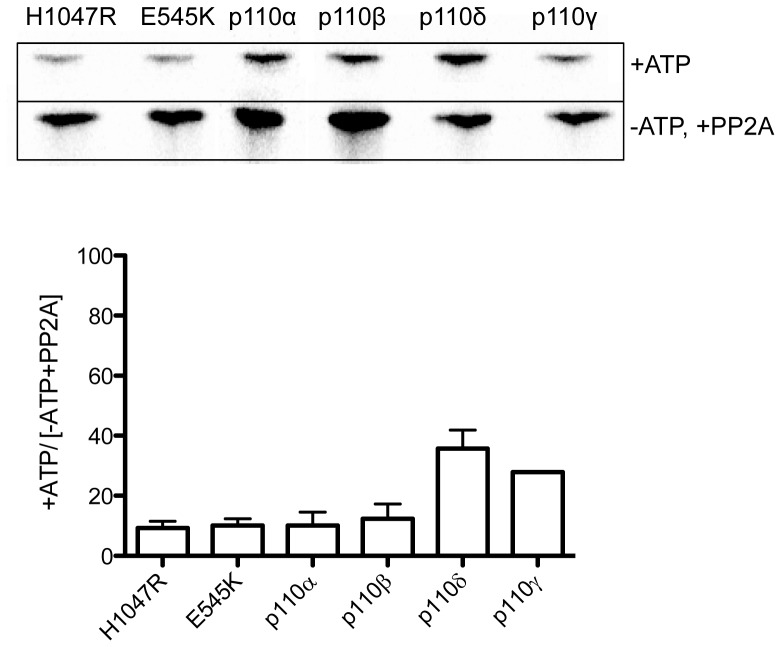
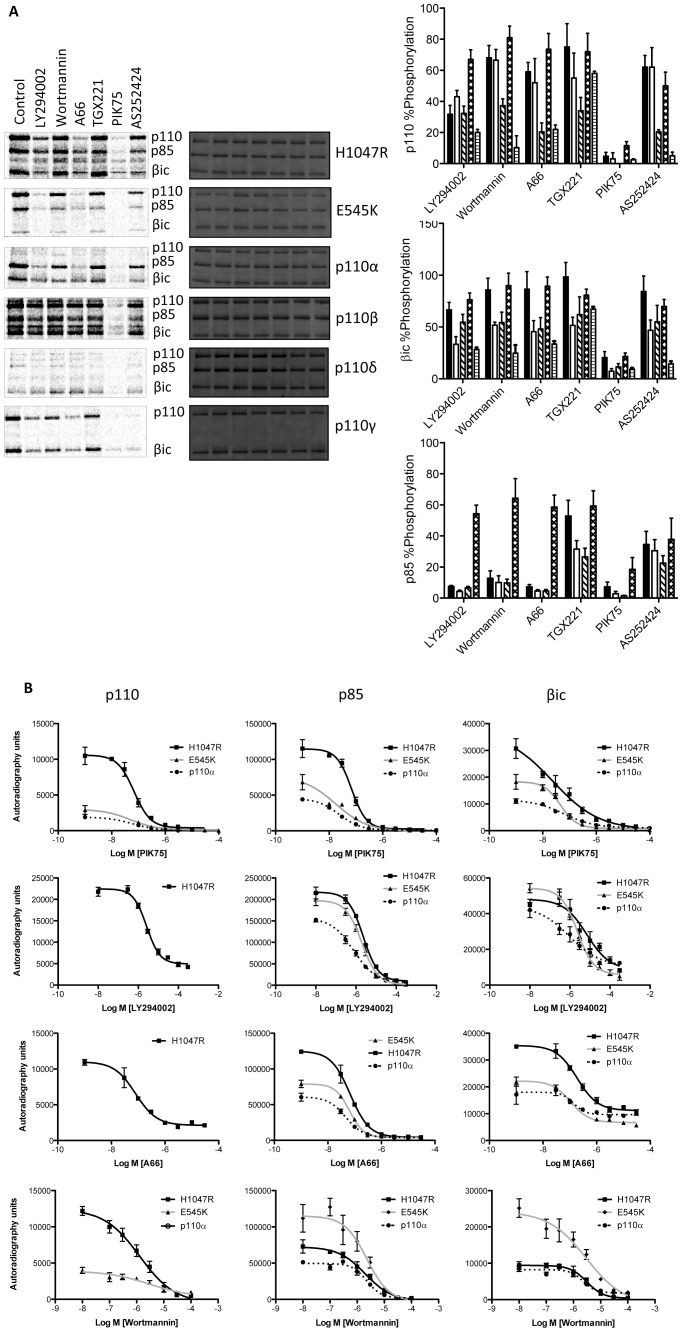
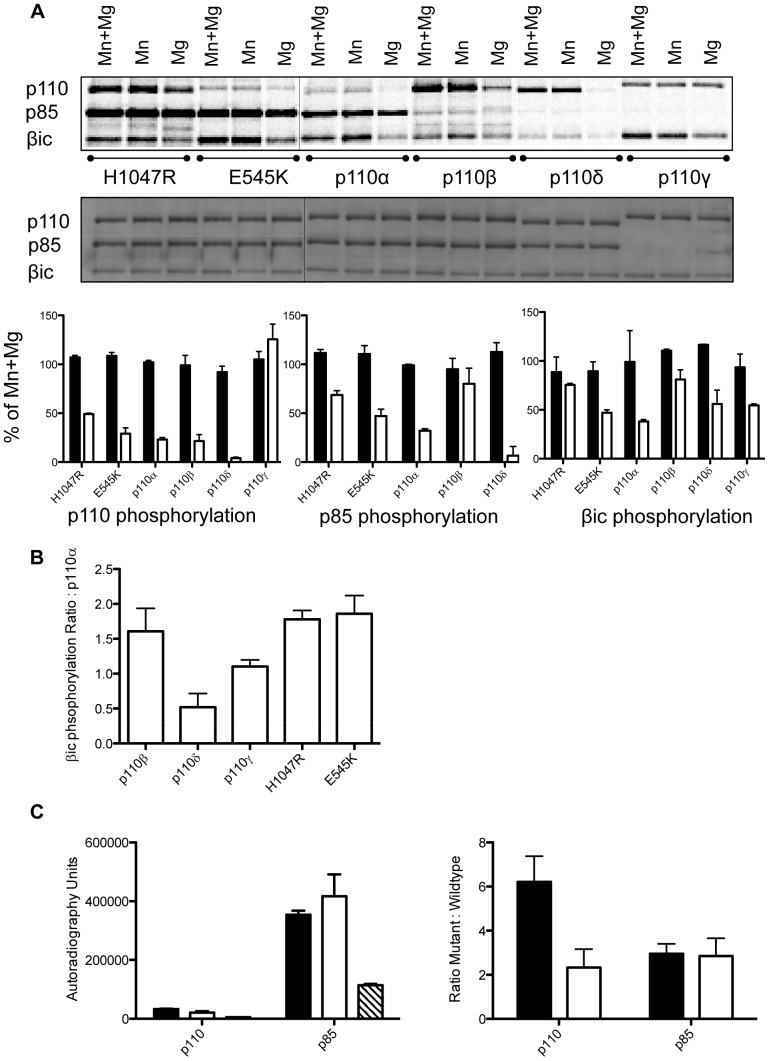
In addition to lipid kinase activity, the class-I PI 3-kinases also function as protein kinases targeting regulatory autophosphorylation sites and exogenous substrates. The latter include a recently identified regulatory phosphorylation of the GM-CSF/IL-3 βc receptor contributing to survival of acute myeloid leukaemia cells. Previous studies suggested differences in the protein kinase activity of the 4 isoforms of class-I PI 3-kinase so we compared the ability of all class-I PI 3-kinases and 2 common oncogenic mutants to autophosphorylate, and to phosphorylate an intracellular fragment of the GM-CSF/IL-3 βc receptor (βic). We find p110α, p110β and p110γ all phosphorylate βic but p110δ is much less effective. The two most common oncogenic mutants of p110α, H1047R and E545K have stronger protein kinase activity than wildtype p110α, both in terms of autophosphorylation and towards βic. Importantly, the lipid kinase activity of the oncogenic mutants is still inhibited by autophosphorylation to a similar extent as wildtype p110α. Previous evidence indicates the protein kinase activity of p110α is Mn(2+) dependent, casting doubt over its role in vivo. However, we show that the oncogenic mutants of p110α plus p110β and p110γ all display significant activity in the presence of Mg(2+). Furthermore we demonstrate that some small molecule inhibitors of p110α lipid kinase activity (PIK-75 and A66) are equally effective against the protein kinase activity, but other inhibitors (e.g. wortmannin and TGX221) show different patterns of inhibition against the lipid and protein kinases activities. These findings have implications for the function of PI 3-kinase, especially in tumours carrying p110α mutations.
除了脂质激酶活性外,I 类 PI3-激酶还作为蛋白激酶发挥作用,靶向调节自身磷酸化位点和外源底物。后者包括最近发现的 GM-CSF/IL-3βc 受体的调节性磷酸化,有助于急性髓系白血病细胞的存活。先前的研究表明 I 类 PI3-激酶的 4 种同工型在蛋白激酶活性上存在差异,因此我们比较了所有 I 类 PI3-激酶和 2 种常见致癌突变体的自身磷酸化和磷酸化 GM-CSF/IL-3βc 受体(βic)的能力。我们发现 p110α、p110β 和 p110γ 均可磷酸化βic,但 p110δ 的效果要差得多。p110α 的两种最常见致癌突变体 H1047R 和 E545K 的蛋白激酶活性均强于野生型 p110α,无论是自身磷酸化还是针对βic。重要的是,致癌突变体的脂质激酶活性仍然受到自身磷酸化的类似程度抑制,类似于野生型 p110α。先前的证据表明,p110α 的蛋白激酶活性依赖于 Mn2+,这使其在体内的作用受到质疑。然而,我们表明,p110α 的致癌突变体加上 p110β 和 p110γ 在存在 Mg2+的情况下均显示出显著的活性。此外,我们证明了一些针对 p110α 脂质激酶活性的小分子抑制剂(PIK-75 和 A66)对蛋白激酶活性同样有效,但其他抑制剂(如wortmannin 和 TGX221)对脂质和蛋白激酶活性的抑制模式不同。这些发现对 PI3-激酶的功能具有重要意义,特别是在携带 p110α 突变的肿瘤中。