Laboratory of Pediatric Infectious Diseases, Radboud University Medical Centre, Nijmegen, The Netherlands.
PLoS One. 2013 Aug 6;8(8):e72193. doi: 10.1371/journal.pone.0072193. Print 2013.
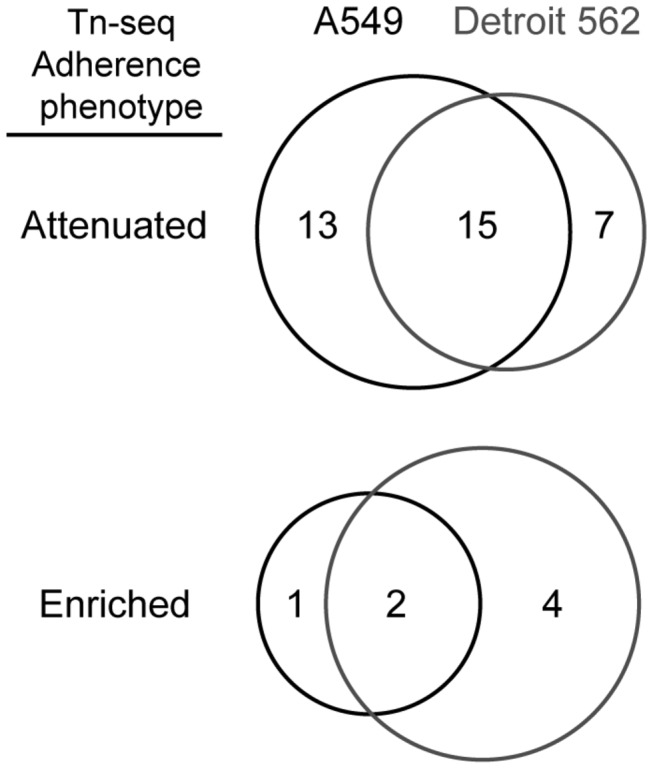
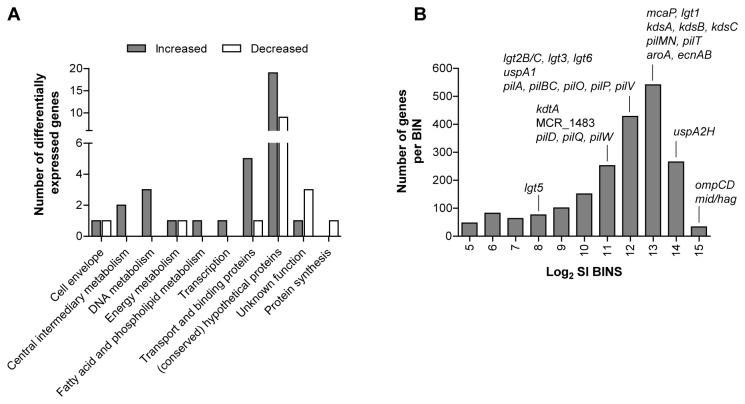
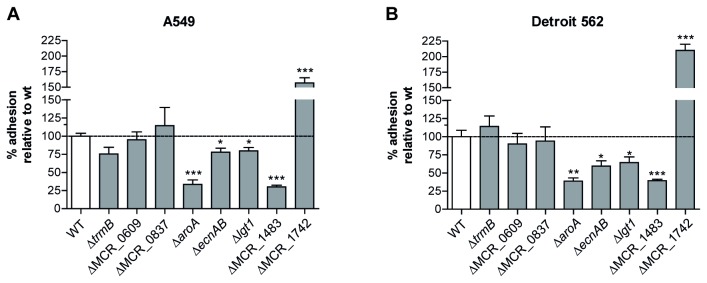
Moraxella catarrhalis is a mucosal pathogen that causes childhood otitis media and exacerbations of chronic obstructive pulmonary disease in adults. During the course of infection, M. catarrhalis needs to adhere to epithelial cells of different host niches such as the nasopharynx and lungs, and consequently, efficient adhesion to epithelial cells is considered an important virulence trait of M. catarrhalis. By using Tn-seq, a genome-wide negative selection screenings technology, we identified 15 genes potentially required for adherence of M. catarrhalis BBH18 to pharyngeal epithelial Detroit 562 and lung epithelial A549 cells. Validation with directed deletion mutants confirmed the importance of aroA (3-phosphoshikimate 1-carboxyvinyl-transferase), ecnAB (entericidin EcnAB), lgt1 (glucosyltransferase), and MCR_1483 (outer membrane lipoprotein) for cellular adherence, with ΔMCR_1483 being most severely attenuated in adherence to both cell lines. Expression profiling of M. catarrhalis BBH18 during adherence to Detroit 562 cells showed increased expression of 34 genes in cell-attached versus planktonic bacteria, among which ABC transporters for molybdate and sulfate, while reduced expression of 16 genes was observed. Notably, neither the newly identified genes affecting adhesion nor known adhesion genes were differentially expressed during adhesion, but appeared to be constitutively expressed at a high level. Profiling of the transcriptional response of Detroit 562 cells upon adherence of M. catarrhalis BBH18 showed induction of a panel of pro-inflammatory genes as well as genes involved in the prevention of damage of the epithelial barrier. In conclusion, this study provides new insight into the molecular interplay between M. catarrhalis and host epithelial cells during the process of adherence.
流感嗜血杆菌是一种黏膜病原体,可引起儿童中耳炎和成人慢性阻塞性肺疾病恶化。在感染过程中,流感嗜血杆菌需要黏附于鼻咽和肺部等不同宿主小生境的上皮细胞,因此,有效的黏附上皮细胞被认为是流感嗜血杆菌的一个重要毒力特征。我们使用 Tn-seq 技术(一种全基因组负选择筛选技术),鉴定了 15 个可能与流感嗜血杆菌 BBH18 黏附咽上皮 Detroit 562 和肺上皮 A549 细胞相关的基因。通过定向缺失突变体验证,证实了 aroA(3-磷酸莽草酸 1-羧基乙烯基转移酶)、ecnAB(肠菌素 EcnAB)、lgt1(葡萄糖基转移酶)和 MCR_1483(外膜脂蛋白)对细胞黏附的重要性,其中 ΔMCR_1483 对两种细胞系的黏附作用最为严重减弱。流感嗜血杆菌 BBH18 在黏附 Detroit 562 细胞过程中的表达谱显示,与浮游菌相比,34 个基因在细胞附着时表达增加,其中包括钼酸盐和硫酸盐的 ABC 转运蛋白,而 16 个基因的表达减少。值得注意的是,无论是新发现的影响黏附的基因还是已知的黏附基因,在黏附过程中都没有差异表达,而是似乎以高水平持续表达。流感嗜血杆菌 BBH18 黏附 Detroit 562 细胞时,对 Detroit 562 细胞转录谱的分析显示,诱导了一组促炎基因以及参与上皮屏障损伤预防的基因的表达。总之,本研究为流感嗜血杆菌与宿主上皮细胞在黏附过程中的分子相互作用提供了新的见解。