University of Groningen, University Medical Center Groningen (UMCG), Department of Epidemiology, Groningen, the Netherlands.
Respir Res. 2013 Aug 9;14(1):83. doi: 10.1186/1465-9921-14-83.
Lung growth in utero and lung function loss during adulthood can be affected by exposure to environmental tobacco smoke (ETS). The underlying mechanisms have not been fully elucidated. Both ETS exposure and single nucleotide polymorphisms (SNPs) in Glutathione S-Transferase (GST) Omega genes have been associated with the level of lung function. This study aimed to assess if GSTO SNPs interact with ETS exposure in utero and during adulthood on the level of lung function during adulthood.
We used cross-sectional data of 8,128 genotyped participants from the LifeLines cohort study. Linear regression models (adjusted for age, sex, height, weight, current smoking, ex-smoking and packyears smoked) were used to analyze the associations between in utero, daily and workplace ETS exposure, GSTO SNPs, the interaction between ETS and GSTOs, and level of lung function (FEV(1), FEV(1)/FVC). Since the interactions between ETS and GSTOs may be modified by active tobacco smoking we additionally assessed associations in never and ever smokers separately. A second sample of 5,308 genotyped LifeLines participants was used to verify our initial findings.
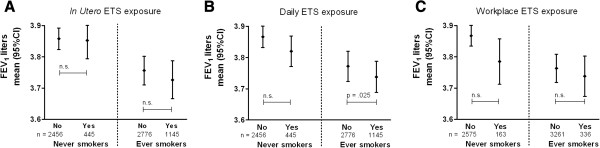
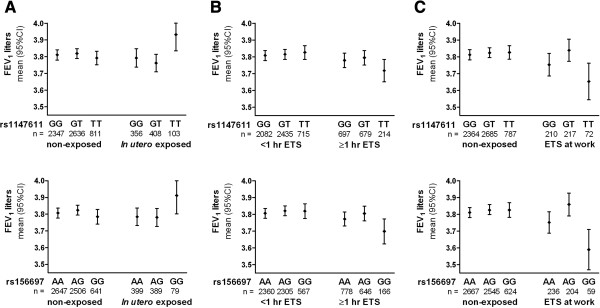
Daily and workplace ETS exposure was associated with significantly lower FEV(1)levels. GSTO SNPs (recessive model) interacted with in utero ETS and were associated with higher levels of FEV(1), whereas the interactions with daily and workplace ETS exposure were associated with lower levels of FEV(1), effects being more pronounced in never smokers. The interaction of GSTO2 SNP rs156697 with in utero ETS associated with a higher level of FEV(1) was significantly replicated in the second sample. Overall, the directions of the interactions of in utero and workplace ETS exposure with the SNPs found in the second (verification) sample were in line with the first sample.
GSTO genotypes interact with in utero and adulthood ETS exposure on adult lung function level, but in opposite directions.
子宫内暴露于环境烟草烟雾(ETS)会影响胎儿肺部生长和成年后肺功能丧失。其潜在机制尚未完全阐明。ETS 暴露和谷胱甘肽 S-转移酶(GST)O 基因的单核苷酸多态性(SNP)与肺功能水平均相关。本研究旨在评估 GSTO SNP 是否与子宫内和成年期 ETS 暴露相互作用,从而影响成年期的肺功能水平。
我们使用来自 LifeLines 队列研究的 8128 名基因分型参与者的横断面数据。使用线性回归模型(调整年龄、性别、身高、体重、当前吸烟、既往吸烟和吸烟包年数)分析子宫内、日常和工作场所 ETS 暴露、GSTO SNP、ETS 和 GSTO 之间的相互作用与肺功能(FEV1、FEV1/FVC)之间的关联。由于 ETS 和 GSTO 之间的相互作用可能受到主动吸烟的影响,因此我们还分别在从不吸烟者和曾吸烟者中评估了这些关联。使用 LifeLines 中 5308 名基因分型参与者的第二个样本来验证我们的初步发现。
日常和工作场所 ETS 暴露与 FEV1 水平显著降低相关。GSTO SNP(隐性模型)与子宫内 ETS 相互作用,与 FEV1 水平升高相关,而与日常和工作场所 ETS 暴露的相互作用与 FEV1 水平降低相关,这种影响在从不吸烟者中更为明显。GSTO2 SNP rs156697 与子宫内 ETS 的相互作用与 FEV1 水平升高相关,在第二个样本中得到显著复制。总体而言,第二个(验证)样本中发现的与子宫内和工作场所 ETS 暴露相互作用的 SNPs 的交互作用方向与第一个样本一致。
GSTO 基因型与子宫内和成年期 ETS 暴露相互作用,影响成年期肺功能水平,但作用方向相反。