Department of Pathology and Lab Medicine, BC Child and Family Research Institute, University of British Columbia, Vancouver, BC V5Z 4H4, Canada.
BMC Genomics. 2013 Aug 10;14:544. doi: 10.1186/1471-2164-14-544.
MicroRNAs (miRNAs) are a family of short, non-coding RNAs modulating expression of human protein coding genes (miRNA target genes). Their dysfunction is associated with many human diseases, including neurodevelopmental disorders. It has been recently shown that genomic copy number variations (CNVs) can cause aberrant expression of integral miRNAs and their target genes, and contribute to intellectual disability (ID).
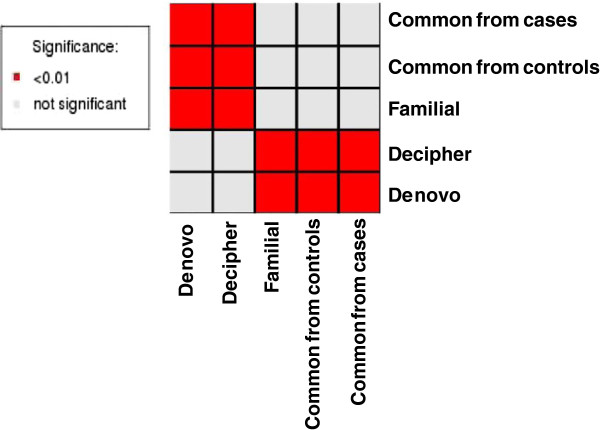
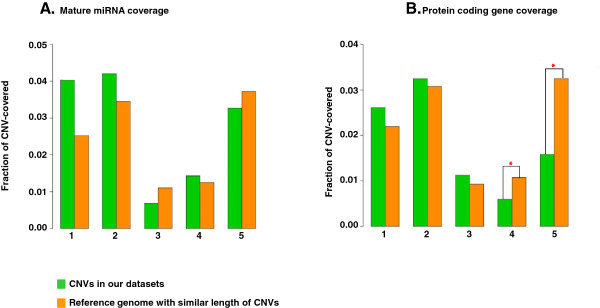
To better understand the CNV-miRNA relationship in ID, we investigated the prevalence and function of miRNAs and miRNA target genes in five groups of CNVs. Three groups of CNVs were from 213 probands with ID (24 de novo CNVs, 46 familial and 216 common CNVs), one group of CNVs was from a cohort of 32 cognitively normal subjects (67 CNVs) and one group of CNVs represented 40 ID related syndromic regions listed in DECIPHER (30 CNVs) which served as positive controls for CNVs causing or predisposing to ID. Our results show that 1). The number of miRNAs is significantly higher in de novo or DECIPHER CNVs than in familial or common CNV subgroups (P < 0.01). 2). miRNAs with brain related functions are more prevalent in de novo CNV groups compared to common CNV groups. 3). More miRNA target genes are found in de novo, familial and DECIPHER CNVs than in the common CNV subgroup (P < 0.05). 4). The MAPK signaling cascade is found to be enriched among the miRNA target genes from de novo and DECIPHER CNV subgroups.
Our findings reveal an increase in miRNA and miRNA target gene content in de novo versus common CNVs in subjects with ID. Their expression profile and participation in pathways support a possible role of miRNA copy number change in cognition and/or CNV-mediated developmental delay. Systematic analysis of expression/function of miRNAs in addition to coding genes integral to CNVs could uncover new causes of ID.
微小 RNA(miRNA)是一类短的非编码 RNA,可调节人类蛋白编码基因(miRNA 靶基因)的表达。它们的功能障碍与许多人类疾病有关,包括神经发育障碍。最近的研究表明,基因组拷贝数变异(CNV)可导致 miRNA 和其靶基因的异常表达,并导致智力障碍(ID)。
为了更好地理解 ID 中 CNV-miRNA 的关系,我们研究了 5 组 CNV 中 miRNA 和 miRNA 靶基因的患病率和功能。三组 CNV 来自 213 名 ID 患者(24 个新发 CNV、46 个家族性 CNV 和 216 个常见 CNV),一组 CNV 来自认知正常受试者队列(67 个 CNV),一组 CNV 代表 DECIPHER 中列出的 40 个 ID 相关综合征区域(30 个 CNV),这些 CNV 作为导致或易患 ID 的 CNV 的阳性对照。我们的结果表明:1)新发或 DECIPHER CNV 中的 miRNA 数量明显高于家族性或常见 CNV 亚组(P<0.01)。2)与常见 CNV 亚组相比,新发 CNV 组中与大脑相关功能的 miRNA 更为常见。3)新发、家族性和 DECIPHER CNV 中发现的 miRNA 靶基因多于常见 CNV 亚组(P<0.05)。4)MAPK 信号级联在新发和 DECIPHER CNV 亚组的 miRNA 靶基因中富集。
我们的研究结果表明,ID 患者中与新发 CNV 相比,常见 CNV 中的 miRNA 和 miRNA 靶基因含量增加。它们的表达谱和参与的途径支持 miRNA 拷贝数变化在认知和/或 CNV 介导的发育迟缓中的可能作用。除了 CNV 中整合的编码基因外,对 miRNA 的表达/功能进行系统分析可能会发现新的 ID 病因。